Plus-Plus: How one simple shape builds almost anything
Plus-Plus uses a single, puzzle-like piece to unlock open-ended building. Since 2011, the Danish set has stood out for turning simple geometry into surprisingly complex play.
Compare prices and availability
Check current prices and availability for this guide on eBay.
As an eBay Partner, we may be compensated if you make a purchase.
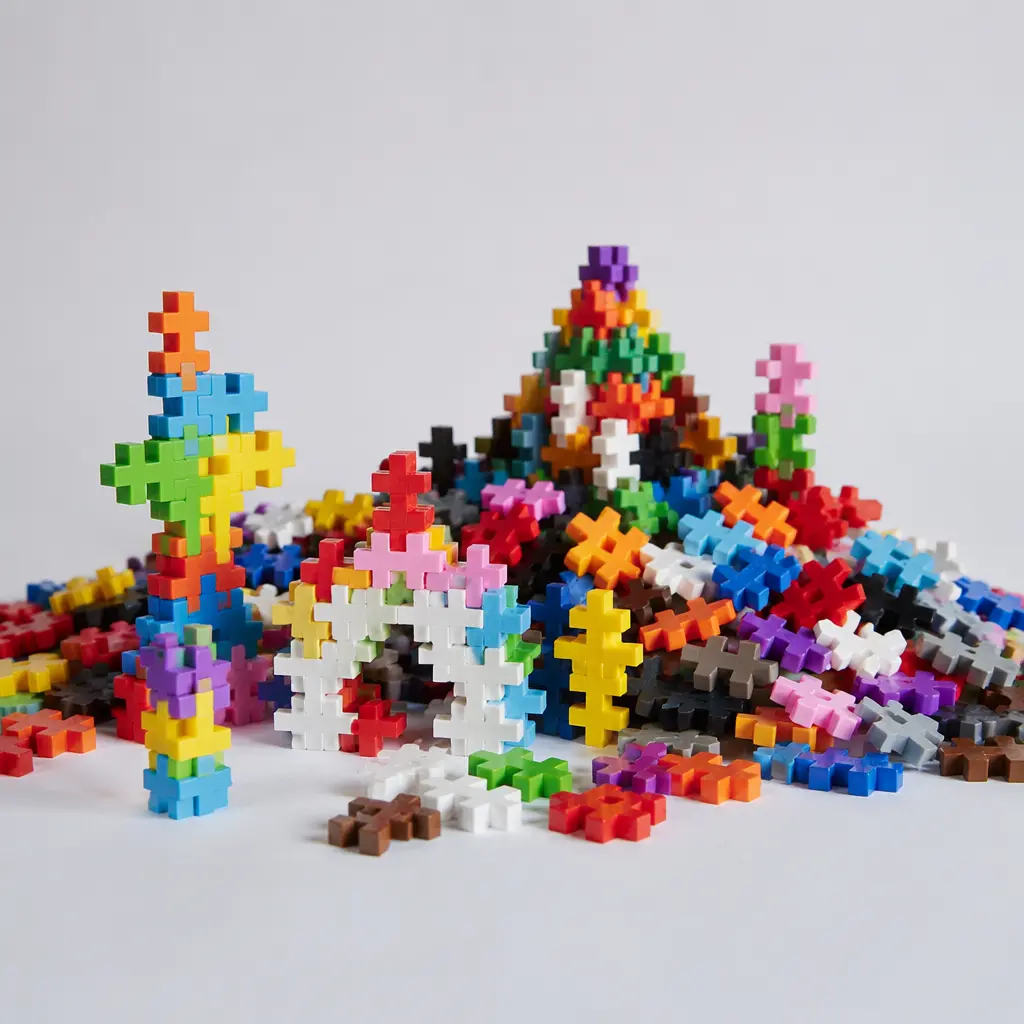
At first glance, Plus-Plus doesn’t look like it should work. Every piece is the same: a small, flat shape that resembles two plus signs fused together. No wheels, no special connectors, no characters. And yet, from this single form, builders create animals, mosaics, vehicles, and surprisingly sturdy 3D structures. That tension—between extreme simplicity and creative depth—is what has made Plus-Plus one of the quiet success stories of modern building toys.
Where it came from
Plus-Plus originated in Denmark in 2011, a country with a long tradition of thoughtful, design-led toys. The idea was to create a construction system that stripped building back to its essentials. Instead of multiple specialised parts, the designers focused on one carefully engineered shape that could connect in multiple directions.
The original goal wasn’t to compete directly with established brick systems, but to offer an alternative approach—one that leaned more toward creative exploration and less toward step-by-step replication. From early classroom use to family living rooms, Plus-Plus spread largely through word of mouth, helped by educators who appreciated its mix of free play and quiet logic.
Why it works
The genius of Plus-Plus is hidden in its geometry. Each piece connects at multiple points and angles, allowing builds to expand sideways, stack vertically, or fold into layered forms. Because every element is identical, builders quickly learn that it’s the arrangement—not the part—that creates complexity.
This design encourages experimentation. There’s no obvious “right” piece to reach for, so trial and error becomes part of the fun. Structures feel more like puzzles than models, rewarding patience and spatial thinking rather than speed.
- One-piece system with no specialised parts to learn
- Connects in two dimensions and three dimensions
- Flat builds can transform into sturdy 3D forms
- Bright colours make patterns and mosaics intuitive
- Mistakes are easy to undo without dismantling everything
Who it’s for
Plus-Plus is typically recommended for children around preschool age and up, but its appeal stretches far wider. Younger children enjoy snapping pieces together and making simple shapes, while older kids gravitate toward more complex builds and pixel-style pictures. Adults often find it unexpectedly calming, using it as a desk toy or creative break. It’s one of those rare toys that can sit on a table during a family gathering and quietly attract builders of every age.
Variants and what to look for today
Today, Plus-Plus is available in a range of sizes and colour mixes. The standard size is the most versatile, suitable for detailed builds and classroom use. Larger versions are often aimed at younger children, offering easier handling while preserving the same connection logic.
Sets may come as loose assortments for free building or with idea guides that suggest patterns, animals, or flat mosaics. When shopping, it’s worth focusing on genuine Plus-Plus pieces, as the precision of the connections affects how well structures hold together. Poorly made alternatives often lack the satisfying snap that makes the system work.
Frequently asked questions
Is Plus-Plus more like a puzzle or a building set?
It sits somewhere in between. While it functions as a construction toy, the repeated use of one shape gives it a puzzle-like quality, especially when following patterns or creating symmetrical designs.
Can it really build sturdy 3D models?
Yes, within reason. When layered correctly, Plus-Plus structures can be surprisingly strong. The key is overlapping connections rather than stacking straight up.
Does it help with learning or STEM skills?
Many educators use Plus-Plus to support spatial reasoning, pattern recognition, and problem-solving. While it’s not a formal teaching tool, the underlying skills align well with early STEM concepts.
Will kids get bored with only one shape?
Surprisingly, boredom is rare. The limitation becomes a challenge, pushing builders to think creatively about how to achieve new forms using the same piece.
Plus-Plus proves that innovation in toys doesn’t always come from adding more parts or flashy features. Sometimes, it’s about removing everything unnecessary and trusting that a well-designed idea can carry the play. More than a decade on, its single shape continues to invite builders to see just how much is possible with almost nothing at all.