Etch A Sketch: The shake-to-erase classic that still charms
Born in 1960, Etch A Sketch turned two knobs and a little physics into a drawing icon. Here’s how it works, why it lasted, and what to know when buying one today.
Compare prices and availability
Check current prices and availability for this guide on eBay.
As an eBay Partner, we may be compensated if you make a purchase.
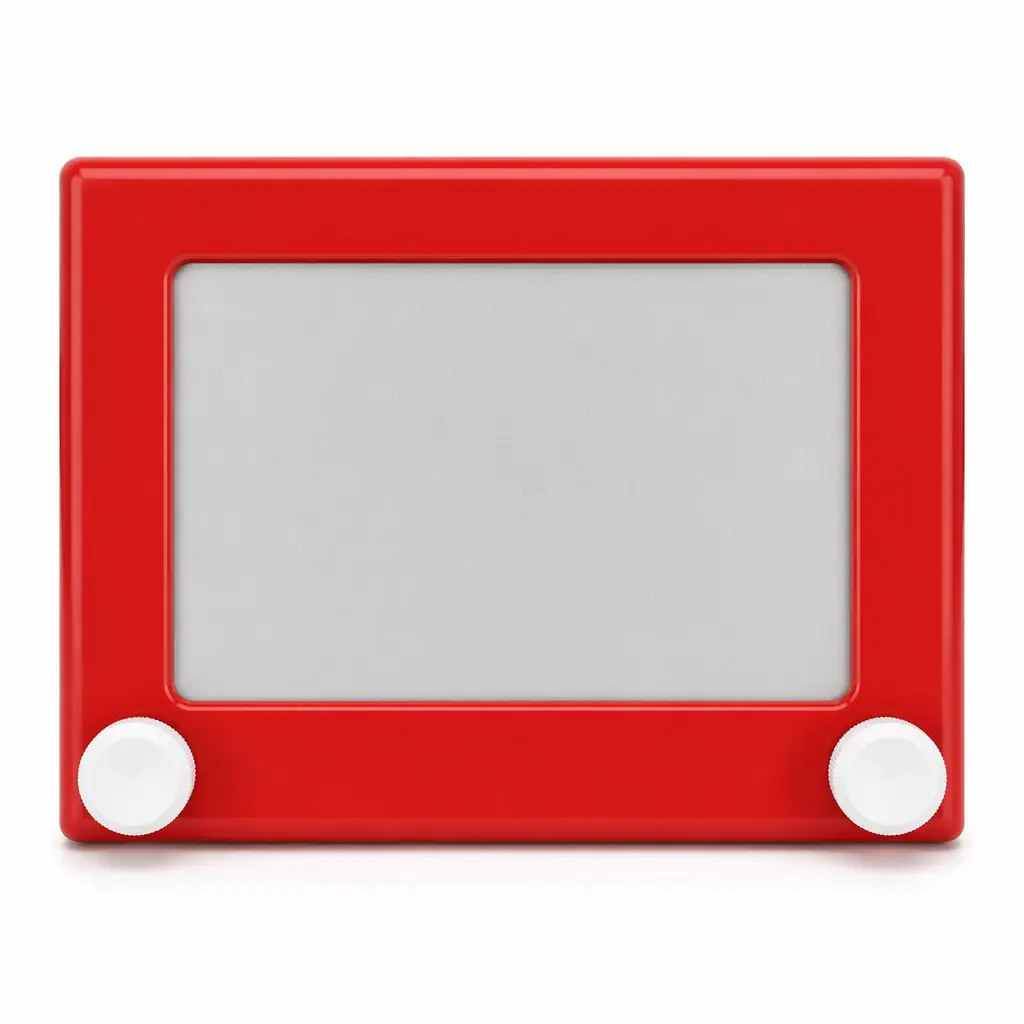
Few toys explain themselves as quickly as Etch A Sketch. Turn one knob and a line moves left to right; turn the other and it moves up and down. Shake it, and everything disappears. That simple promise—draw, erase, start again—has kept this mechanical drawing toy on shelves and in family homes for more than six decades.
Where it came from
Etch A Sketch began life in 1960 as the invention of French electrician André Cassagnes. While working with aluminium powder used for light switch plates, Cassagnes noticed that a stylus could scrape lines through the powder when the plate was coated on the inside. The idea became a drawing screen sealed inside a frame—no ink, no paper, no mess.
The toy was brought to the US market by the Ohio Art Company and quickly became a hit. Its television debut helped, but so did the novelty: a reusable drawing surface at a time when most kids’ art meant crayons and stacks of paper. From the start, it felt a little bit magical and a little bit educational.
Why it works
At heart, Etch A Sketch is a lesson in constraints. You can’t lift the line, you can’t freehand curves easily, and you can’t save your work unless you leave it untouched. Those limits are exactly why it’s engaging. Players learn to plan ahead, break pictures into straight segments, and accept that mistakes are part of the process.
- Purely mechanical design with no batteries or screens
- Two-knob control that maps directly to horizontal and vertical movement
- Instant reset by shaking—no erasers or refills needed
- Quiet, focused play that encourages patience and problem-solving
Who it’s for
Children usually get the hang of the knobs around early primary-school age, but the appeal stretches well beyond that. Older kids enjoy the challenge of drawing recognisable pictures, while adults often come back to it for nostalgia or as a mindful, screen-free desk toy. It’s one of those rare items that works as both a beginner’s art tool and a lifelong puzzle.
Variants and what to look for today
While the basic idea hasn’t changed, Etch A Sketch has appeared in different sizes and formats over the years. Full-size versions offer more drawing space and smoother control, while smaller travel-sized editions trade precision for portability. Some modern versions add colour effects or alternative shapes, but the core two-knob mechanism remains the point.
When shopping today, look for a solid-feeling frame and smooth knob action. Very cheap imitations may have uneven powder distribution or stiff controls, which makes drawing frustrating. Sticking with established versions usually means better build quality and a screen that clears cleanly when shaken.
Frequently asked questions
How does Etch A Sketch actually draw?
Inside the screen is fine aluminium powder coating the back. Turning the knobs moves a stylus that scrapes the powder away, leaving a darker line. Shaking redistributes the powder to reset the surface.
Is it messy or does it leak?
A properly sealed Etch A Sketch isn’t messy at all. The powder stays inside the screen. If you notice leaks or clumping, it’s usually a sign of damage or very poor manufacturing.
Can you save a drawing?
There’s no built-in way to preserve artwork. Some people photograph their finished drawings, which fits the toy’s fleeting, start-again spirit.
Is Etch A Sketch educational?
While it’s not a teaching aid in the formal sense, it builds hand–eye coordination, spatial awareness, and planning skills. Those benefits come naturally through play.
Etch A Sketch endures because it doesn’t try to be more than it is. With no updates needed and no power switch to flip, it remains a quiet challenge in a noisy toy world—proof that a clever idea, well executed, can last for generations.