View-Master: The pocket viewer that turned pictures into places
First launched in 1939, the View-Master made photography feel three‑dimensional. This editorial profile looks at where it came from, why the simple viewer-and-reel design endured, and what to know today.
Compare prices and availability
Check current prices and availability for this guide on eBay.
As an eBay Partner, we may be compensated if you make a purchase.
Long before screens fit in pockets, the View‑Master promised something close to virtual travel. You held it up to your eyes, clicked a lever, and suddenly a flat photograph gained depth. Mountains felt farther away, animals seemed closer, and landmarks had a sense of scale that ordinary pictures couldn’t deliver. For decades, that small plastic viewer was a child’s first taste of immersive media.
Where it came from
The View‑Master debuted at the 1939 New York World’s Fair, created by William Gruber, a photographer, and Harold Graves, a businessman. Their original idea wasn’t a toy at all. It was a new way to showcase scenic photography, using colour film and stereoscopic pairs to create a convincing illusion of depth.
Early reels focused on travel and education—national parks, famous cities, and cultural landmarks—aimed as much at adults as children. After the Second World War, the brand gradually shifted toward family entertainment, adding animals, science subjects, and later licensed stories. That move turned a clever optical device into a household staple.
Why it works
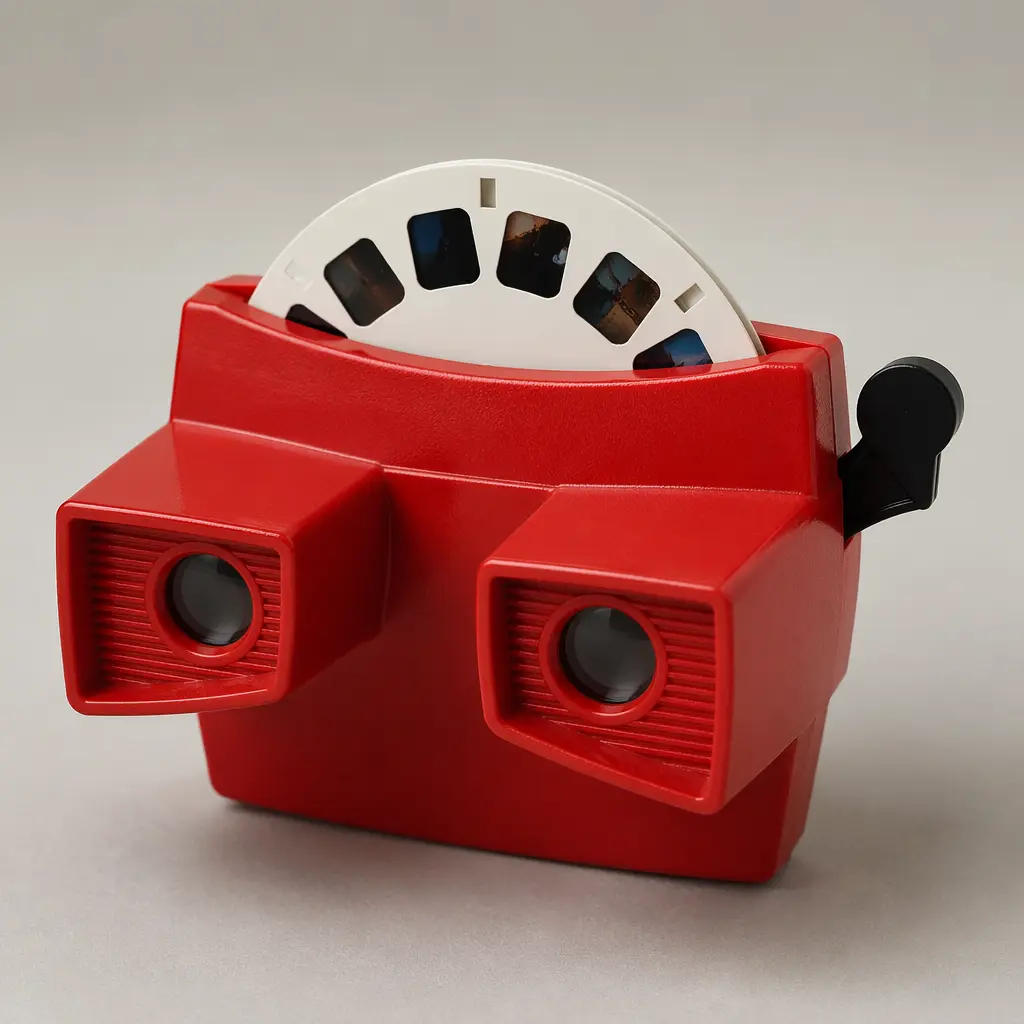
At its core, the View‑Master is elegantly simple. Each reel contains seven pairs of tiny colour images. When you look through the viewer, each eye sees a slightly different picture, and your brain combines them into a single 3D scene. The satisfying click as you advance the reel is part of the experience—slow, deliberate, and focused.
That simplicity is why it endured. There are no batteries to die and no settings to learn. It invites patience and curiosity, rewarding kids who take time to look closely. Standout features include:
- True stereoscopic 3D using real photographs
- Durable viewer with a mechanical, tactile feel
- Interchangeable reels covering many subjects
- Short, focused viewing sessions that don’t overwhelm
Who it's for
Traditionally, View‑Master has suited children from about five or six upward, once they can align their eyes comfortably and handle small reels. It also has strong adult appeal. Parents and grandparents often rediscover it as a nostalgic object, while collectors appreciate older reels for their photography and subject matter. It’s one of those rare toys that can be shared across generations without much explanation.
Variants and what to look for today
Over the years, the View‑Master family has expanded and shifted. Classic viewers are sturdy plastic with a manual lever. Later versions introduced lighter materials and, eventually, electronic or app‑based adaptations that use a smartphone screen. Purists tend to favour the traditional optical design for its clarity and independence from screens.
When looking for one today, focus on build quality and reel availability. Older reels emphasise travel, animals, and science, while newer sets lean toward characters and stories. Be cautious of very cheaply made viewers that can misalign the images, breaking the 3D effect. A good View‑Master should feel solid and provide a clean, comfortable view.
Frequently asked questions
Does View‑Master really show 3D images?
Yes. It uses stereoscopic photography, meaning two slightly different images are shown to each eye. Your brain combines them into a single image with depth, without the need for glasses or electronics.
Is it educational or just for fun?
Historically, it was both. Many reels were designed to teach geography, nature, and science. Even story‑based sets encourage observation and discussion, especially when shared with an adult.
Can modern reels be used with older viewers?
In most cases, yes. The reel format has remained largely consistent, which is part of the system’s longevity. Always check compatibility if buying newer editions.
Is it safe for young children?
It’s generally safe when used as intended, but small reels can be a choking hazard. Adult supervision is recommended for younger users.
The View‑Master sits at an interesting crossroads between toy, teaching tool, and media device. It never tried to do too much. By focusing on one clever idea—bringing depth to pictures—it earned a place in playrooms and classrooms alike. Even today, that simple click‑and‑look experience still feels a little magical.