Magna Doodle: Why a mess‑free drawing board became a family hero
First sold in the 1970s, the Magna Doodle turned drawing into a clean, reusable ritual. Its magnetic magic made it a quiet classic in homes, cars, and classrooms.
Compare prices and availability
Check current prices and availability for this guide on eBay.
As an eBay Partner, we may be compensated if you make a purchase.
For many families, the Magna Doodle wasn’t flashy or loud. It didn’t require batteries or instructions, and it didn’t come with a TV show tie‑in. Instead, it quietly earned a permanent place on coffee tables, back seats, and classroom shelves. The appeal was simple: a way for kids to draw freely, erase instantly, and start again—without markers on the walls or paper piling up.
Where it came from
The Magna Doodle traces its roots back to the early 1970s, when inventors were experimenting with magnetic particles as a drawing medium. Introduced in 1974 and later popularised by Fisher‑Price, the toy was designed as a reusable alternative to crayons and paper. The goal wasn’t to replace traditional art supplies, but to offer a cleaner, more portable option for young children.
At a time when parents were increasingly concerned about mess and safety, the Magna Doodle fit neatly into changing household expectations. Its sealed drawing surface meant no loose parts to ingest and no ink to spill. That combination helped it spread quickly through preschools and homes, becoming a familiar sight by the late 1970s and 1980s.
Why it works
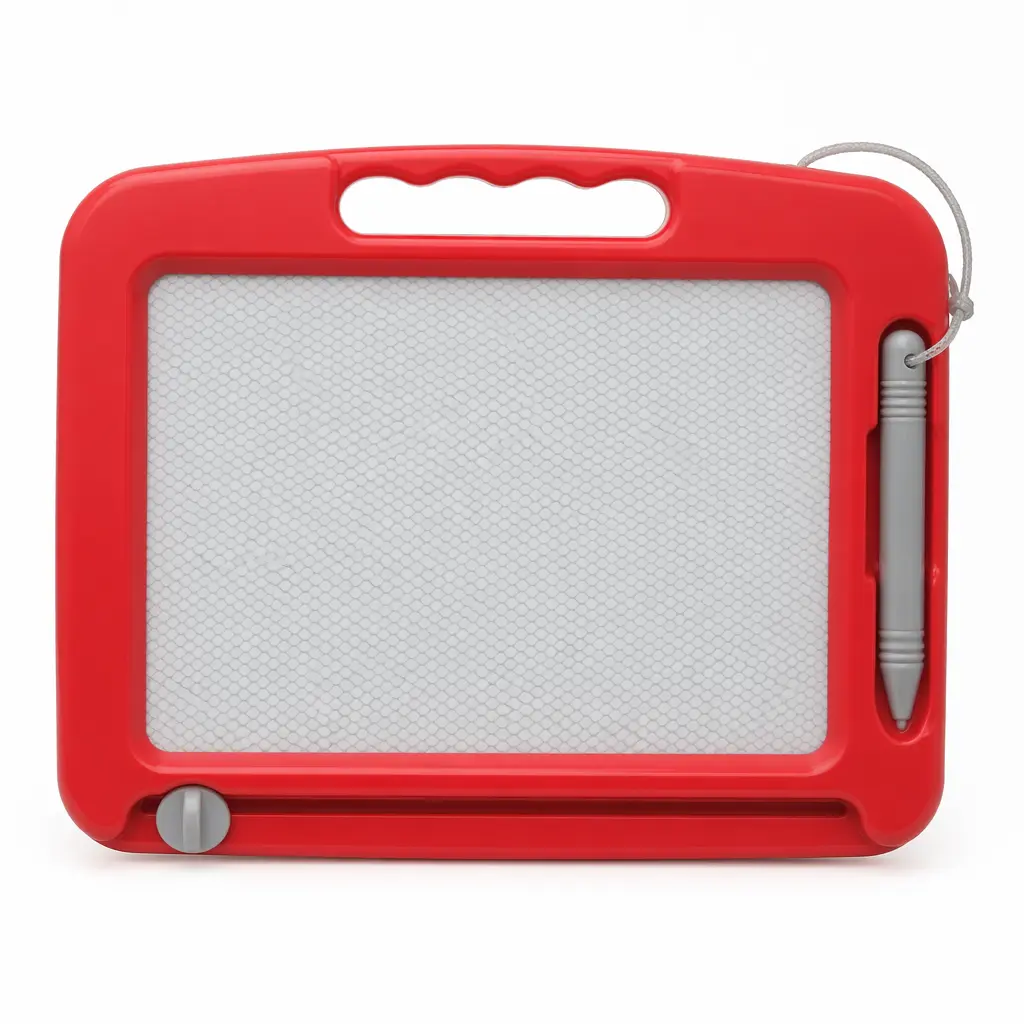
The Magna Doodle’s success rests on a clever bit of physics made invisible to the user. Inside the board is a layer of magnetic particles. When the stylus passes over the surface, it pulls those particles upward, creating dark lines. Slide the eraser bar, and the particles drop back down, returning the surface to blank.
This simple mechanic supports open‑ended play. There’s no right or wrong outcome, no finished state to preserve. Kids can experiment, make mistakes, and immediately try again. Standout features include:
- Completely mess‑free drawing with no ink, paint, or dust
- Instant erase encourages experimentation and repetition
- Durable, sealed design suited to younger children
- Portable format that works in cars, waiting rooms, and classrooms
Who it's for
Magna Doodles are typically aimed at preschool and early primary‑school ages, roughly from about 18 months through 6 years. The chunky stylus and resistance of the surface help build early hand strength and coordination. At the same time, many adults remember using one themselves and still find it oddly satisfying. That cross‑generational familiarity is part of its staying power.
Variants and what to look for today
Over the years, the Magna Doodle family has expanded beyond the original rectangle. Today you’ll find boards in a range of sizes, travel versions with handles, and models shaped like animals or themed frames. Some include stamp shapes attached to the pen, adding a bit of structure to the free drawing.
When shopping now, focus on build quality rather than extras. A good board should erase cleanly without leaving shadows, and the pen should be securely tethered. Generic magnetic drawing boards are widely available and often just as functional as branded versions. Be cautious of very thin boards, which can warp over time and affect the drawing surface.
Frequently asked questions
Is a Magna Doodle educational?
Yes, in an open‑ended way. It supports fine motor development, early writing practice, and creative expression, even though it doesn’t follow a structured curriculum.
Do the drawings fade over time?
On well‑made boards, drawings stay clear until erased. Older or lower‑quality boards may show faint marks after heavy use, but this doesn’t usually affect play.
Is it safe for toddlers?
Most magnetic drawing boards are designed with toddlers in mind, using sealed surfaces and chunky pens. Always check age recommendations and supervise younger children.
How does it compare to tablets?
Unlike screens, a Magna Doodle is tactile, silent, and distraction‑free. It doesn’t replace digital drawing, but it offers a different, more physical experience.
Nearly fifty years after its debut, the Magna Doodle remains a small triumph of thoughtful design. It solved a real problem for parents and gave children freedom to create without consequence. In a toy landscape full of noise and novelty, its quiet reliability is exactly why it endures.