KEVA Planks: How identical boards sparked open‑ended engineering play
KEVA Planks proved that simple, identical wooden boards could teach balance, gravity and design without instructions. Since the 1980s, they’ve turned free play into hands‑on engineering.
Compare prices and availability
Check current prices and availability for this guide on eBay.
As an eBay Partner, we may be compensated if you make a purchase.
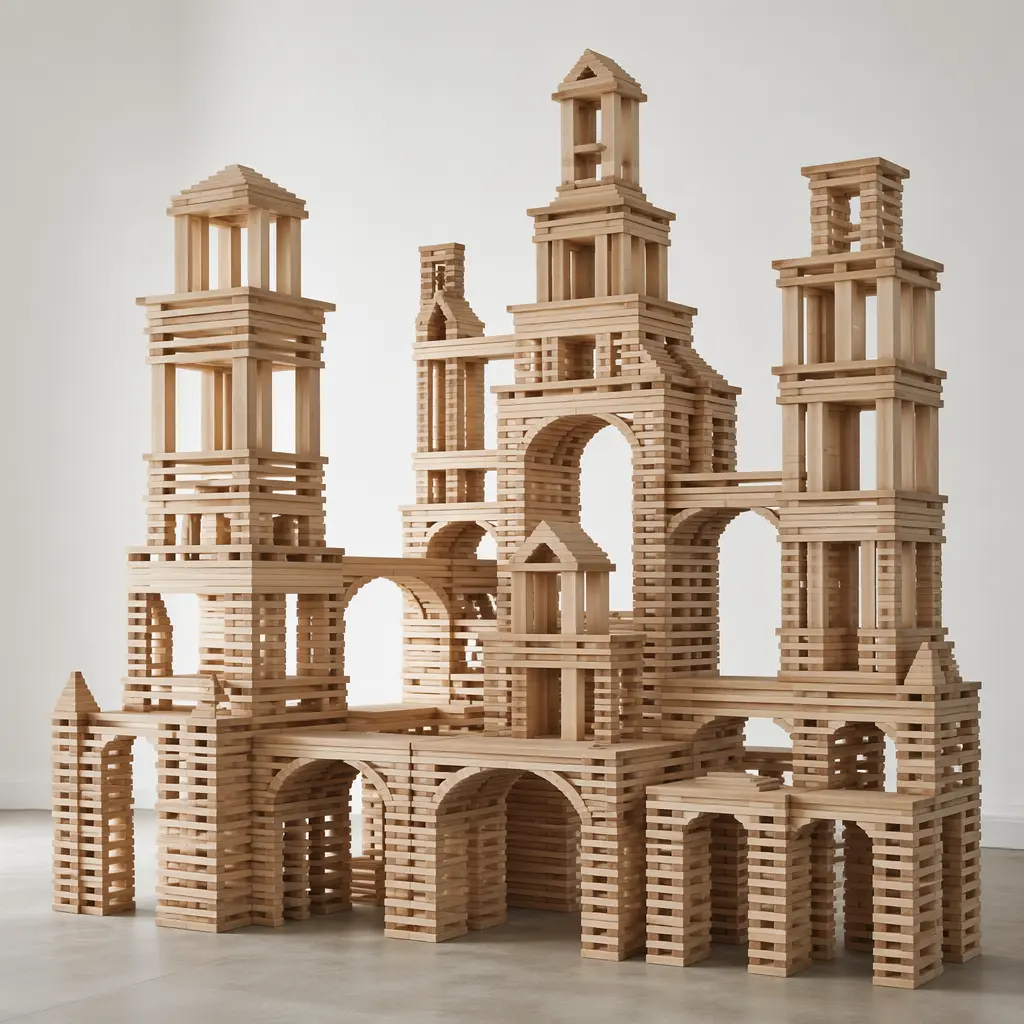
At first glance, KEVA Planks don’t look like much: just a pile of smooth, identical wooden boards. No colours, no connectors, no instructions. And yet, for nearly four decades, they’ve been quietly teaching kids (and plenty of adults) how structures stand up—or fall down. Their appeal lies in what they don’t do. KEVA Planks don’t tell you what to build. They simply hand over the laws of physics and let curiosity take over.
Where it came from
KEVA Planks were introduced in 1986 by educator and designer Tom Kuhn. His goal wasn’t to create another building set with rules and outcomes, but a tool that encouraged experimentation. Inspired by architectural principles and classroom learning, Kuhn focused on a single, consistent unit: a wooden plank with carefully chosen proportions.
Originally embraced by teachers and museums, KEVA Planks found a home in classrooms long before they became common in playrooms. Without studs, magnets or slots, they relied entirely on gravity and friction. That simplicity made them ideal for demonstrating real-world concepts like load-bearing, balance and structural failure—lessons that reveal themselves the moment a tower collapses.
Why it works
The genius of KEVA Planks is that every piece is the same. Because there’s no “special” block, kids quickly learn that success comes from arrangement, not parts. A stable bridge or tower isn’t about finding the right connector—it’s about spacing, alignment and weight distribution. Trial and error becomes the teacher.
This uniformity also removes the fear of doing it wrong. There are no instructions to follow or steps to miss. Builders start small, test ideas, knock things down and rebuild—often better the second time. Over time, play naturally shifts from stacking to designing, as kids begin to plan before they place.
- Identical planks encourage problem-solving over part selection
- No connectors means real-world physics are always in play
- Smooth wood provides just enough friction for balance challenges
- Open-ended design supports creativity across ages
Who it’s for
KEVA Planks are often recommended for ages five and up, but their reach is broader than that. Younger children enjoy simple stacking and knocking down, while older kids gravitate toward complex structures, patterns and even chain-reaction builds. Adults frequently find themselves drawn in too, especially when the goal becomes building higher, longer or more symmetrical than last time. It’s one of those toys that grows with the user rather than being outgrown.
Variants and what to look for today
Today, KEVA Planks are available in sets of varying sizes, from small starter boxes to large classroom-scale collections. The core idea hasn’t changed: all planks remain the same size and shape. Some modern sets include idea books, challenge cards or storage crates, but the building pieces themselves stay deliberately plain.
If you’re shopping now, consistency and finish matter most. Planks should be smooth, uniformly cut and made from solid wood. Cheaper alternatives sometimes vary slightly in size or warp over time, which makes precise balancing frustrating. The charm of KEVA-style play depends on every piece behaving the same way.
Frequently asked questions
Do KEVA Planks teach STEM skills?
Yes, though they do it quietly. Concepts like balance, symmetry, force and structural stability emerge naturally through play rather than formal lessons.
Are instructions necessary?
No. Many sets include idea guides, but they’re optional. The absence of instructions is part of what makes the toy effective.
How many planks are enough?
Smaller sets work well for beginners, but larger builds quickly benefit from more pieces. Structures become more interesting once kids can experiment with scale.
Are they safe for younger children?
The planks are sturdy and smooth, but because they’re long and hard, adult supervision is recommended for younger builders.
KEVA Planks endure because they trust the player. By offering nothing but identical pieces of wood, they invite imagination, patience and persistence. In a toy world crowded with features and instructions, their restraint feels radical—and it’s exactly why they continue to inspire builders decades after their debut.