The Play Cash Register: Why ringing things up still matters
From chunky plastic tills to app-linked scanners, the play cash register keeps teaching maths, manners and confidence through pretend shopping.
Compare prices and availability
Check current prices and availability for this guide on eBay.
As an eBay Partner, we may be compensated if you make a purchase.
The play cash register is one of those toys that feels timeless, even as real shops change around it. Children have been pretending to run stores for generations, scanning imaginary groceries, counting coins, and announcing totals with great seriousness. What looks like simple make-believe turns out to be a compact lesson in maths, language and social skills — which helps explain why this toy keeps coming back in new forms.
Where it came from
Pretend shop toys emerged alongside the rise of mass retail in the 20th century. As supermarkets and department stores became everyday spaces for families, toy makers began shrinking that experience down to child size. Early play cash registers mirrored the look and feel of mechanical tills, complete with clacking buttons and spring-loaded drawers.
The original purpose was straightforward: to support imaginative role play. Children could copy what they saw adults do, taking turns as shopkeeper and customer. Over time, educators and parents recognised that this kind of play naturally reinforces counting, turn-taking and polite conversation, making the toy a staple in nurseries and classrooms as well as homes.
Why it works
At its core, the play cash register works because it gives children a clear role with simple rules. There is a beginning (choosing items), a process (ringing them up), and an end (paying and getting change). That structure makes it easy for children to invent stories while practising real-world skills.
Modern versions often add sounds, lights or scanners, but the appeal is still tactile and social. Pressing buttons, sliding coins and opening the drawer all provide satisfying feedback that keeps children engaged.
- Hands-on counting with coins and notes
- Early understanding of money and value
- Language practice through greetings and role-play scripts
- Turn-taking and basic negotiation
- Confidence from being “in charge” of a task
Who it's for
Play cash registers are typically aimed at preschool and early primary ages, when children are just starting to recognise numbers and enjoy copying adult routines. That said, older children often use them as props in more elaborate games, especially when combined with play kitchens or market stalls. There is also a surprising adult appeal: many parents enjoy joining in, modelling polite exchanges or gentle maths challenges without it feeling like formal teaching.
Variants and what to look for today
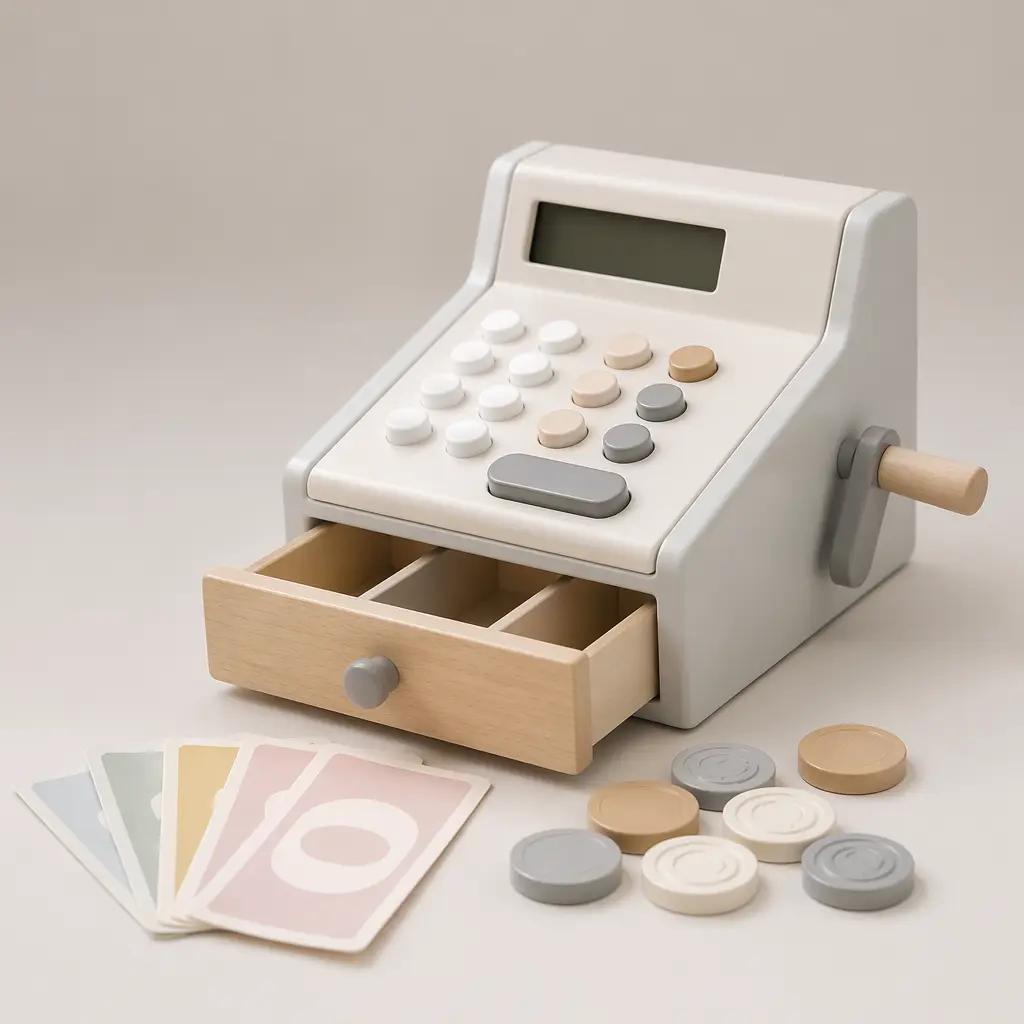
Today’s play cash registers range from chunky plastic models with sound effects to minimalist wooden designs that focus on open-ended play. Some sets include scanners, cards or play food, while others keep things simple with buttons and a drawer.
When choosing one, it’s worth thinking about how your child plays. Children who enjoy noise and action may love beeps and flashing lights, while others prefer quieter toys that leave more room for imagination. Look for sturdy construction and coins or notes that are large enough not to be a choking hazard. Very cheap versions can have flimsy drawers or buttons that stick, which can frustrate children and cut play short.
Frequently asked questions
Does a play cash register actually teach maths?
Yes, in an informal way. Children practise counting, recognising numbers and understanding simple addition through repeated play, especially when an adult joins in and gently prompts them.
Is pretend money confusing for kids?
Generally no. Most children understand that play money is symbolic. It can even open conversations about real money, saving and spending, as long as expectations are kept age-appropriate.
Do electronic features improve play?
They can add excitement, but they’re not essential. Many children engage just as deeply with simple, non-electronic registers that let them control the story.
What age is best to introduce one?
Many children start enjoying them around age three, once they can handle small objects and enjoy role play. Interest often grows as their number skills develop.
The play cash register endures because it sits at the crossroads of imagination and everyday life. Long after children outgrow certain toys, they still remember the feeling of running their own little shop — proof that sometimes the simplest setups deliver the richest lessons.