SmartGames IQ Puzzles: Pocket logic games with real bite
SmartGames’ IQ puzzles turned solo play into something deliberate: compact cases, escalating challenges, and just enough friction to keep minds busy on the go.
Compare prices and availability
Check current prices and availability for this guide on eBay.
As an eBay Partner, we may be compensated if you make a purchase.
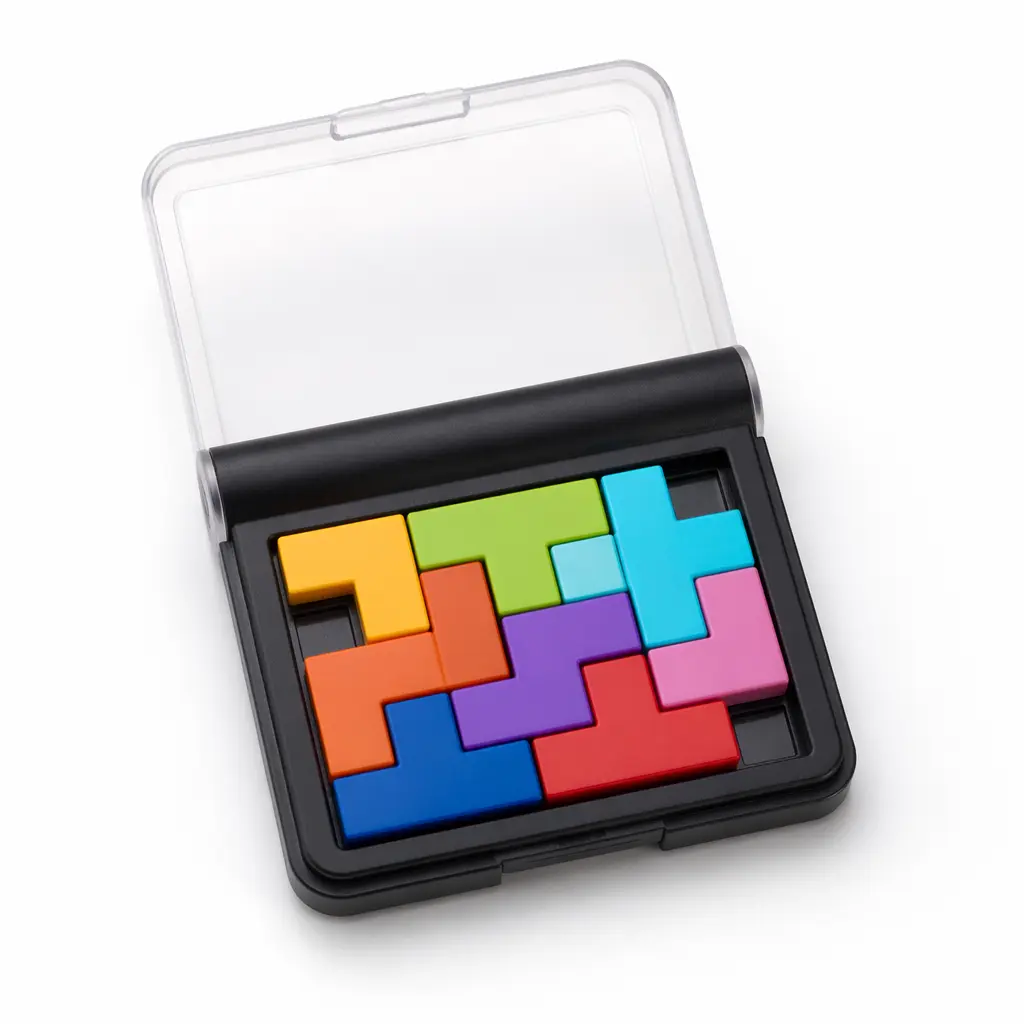
SmartGames IQ puzzles look modest at first glance: a palm-sized plastic case, a handful of bright pieces, and a booklet of challenges. Yet these small boxes helped redefine what solo play could feel like in the 2010s. Instead of passive distraction, they offered focused, purposeful thinking—something closer to a workout than a pastime.
Where it came from
SmartGames is a Belgian toy company founded with a focus on logic and STEM-style play. Around 2010, the company began expanding its range of single-player brain games aimed at children and adults alike. The IQ line emerged from a simple idea: create challenges that scale in difficulty while fitting into a case small enough for a backpack or jacket pocket.
The original purpose wasn’t to replace classic puzzles like crosswords or Sudoku, but to modernise them. By combining tactile pieces with printed challenges, SmartGames offered something screen-free that still felt contemporary and structured. The timing mattered too—these puzzles arrived just as parents and educators were looking for ways to balance digital play with hands-on thinking.
Why it works
At the heart of every IQ puzzle is a clear problem: place all the pieces on the board so they fit the given constraints. That clarity is part of the appeal. There’s no storyline to follow and no timer pushing you along—just a single challenge that rewards patience, spatial reasoning, and trial-and-error.
The design does a lot of quiet work. The boards are small but precise, and the pieces are shaped to allow many near-misses before the correct solution clicks into place. Difficulty usually ramps up gradually, giving beginners early wins while still stretching experienced players.
- Compact, self-contained cases that travel easily
- Dozens to hundreds of graded challenges per set
- Bright, durable pieces that are easy to handle
- Clear rules that make solo play intuitive
- A satisfying physical ‘fit’ when a solution is correct
Who it’s for
Most IQ puzzles are marketed for school-age children, but the audience is broader than the box suggests. Younger players benefit from the visual-spatial learning and concentration, while teens and adults often pick them up as travel companions or desk toys. They’re especially appealing to people who enjoy logic problems but don’t want to stare at a screen. Importantly, the single-player focus means there’s no pressure to compete or perform—progress happens at your own pace.
Variants and what to look for today
The IQ family has grown into a broad range rather than a single product. Some versions focus on classic flat grids, while others add twists like three-dimensional stacking or restrictions based on colour and orientation. This variety keeps the concept fresh without straying far from the core idea.
When choosing one today, it’s worth thinking about where and how it will be used. Ultra-compact versions are ideal for travel, while slightly larger sets can be more comfortable for younger hands. As with many popular puzzles, there are generic lookalikes on the market. While some are fine, the original SmartGames sets tend to have clearer challenge progression and sturdier construction, which matters over repeated use.
Frequently asked questions
Are SmartGames IQ puzzles educational?
Yes, though in an understated way. They encourage spatial reasoning, planning, and perseverance rather than rote learning. Many teachers and parents use them as quiet enrichment activities.
Do they get too hard?
Later challenges can be genuinely tough. That’s intentional. The graded levels mean players can stop and return later without feeling they’ve failed.
Can more than one person play?
They’re designed for solo play, but people often take turns tackling challenges or comparing solutions. Watching someone else reason through a puzzle can be part of the fun.
Are they suitable for younger children?
Most sets include small pieces, so age recommendations matter. For younger children, simpler versions with larger pieces are a better fit.
More than a decade after their introduction, SmartGames IQ puzzles remain a quiet success. They don’t rely on nostalgia or spectacle. Instead, they offer something rarer: a small, reliable space for thinking, wherever you happen to be.