Tiddlywinks: The tabletop game that hides real skill
Often mistaken for a children’s pastime, Tiddlywinks is a classic tabletop game where dexterity, angles, and patience matter more than luck.
Compare prices and availability
Check current prices and availability for this guide on eBay.
As an eBay Partner, we may be compensated if you make a purchase.
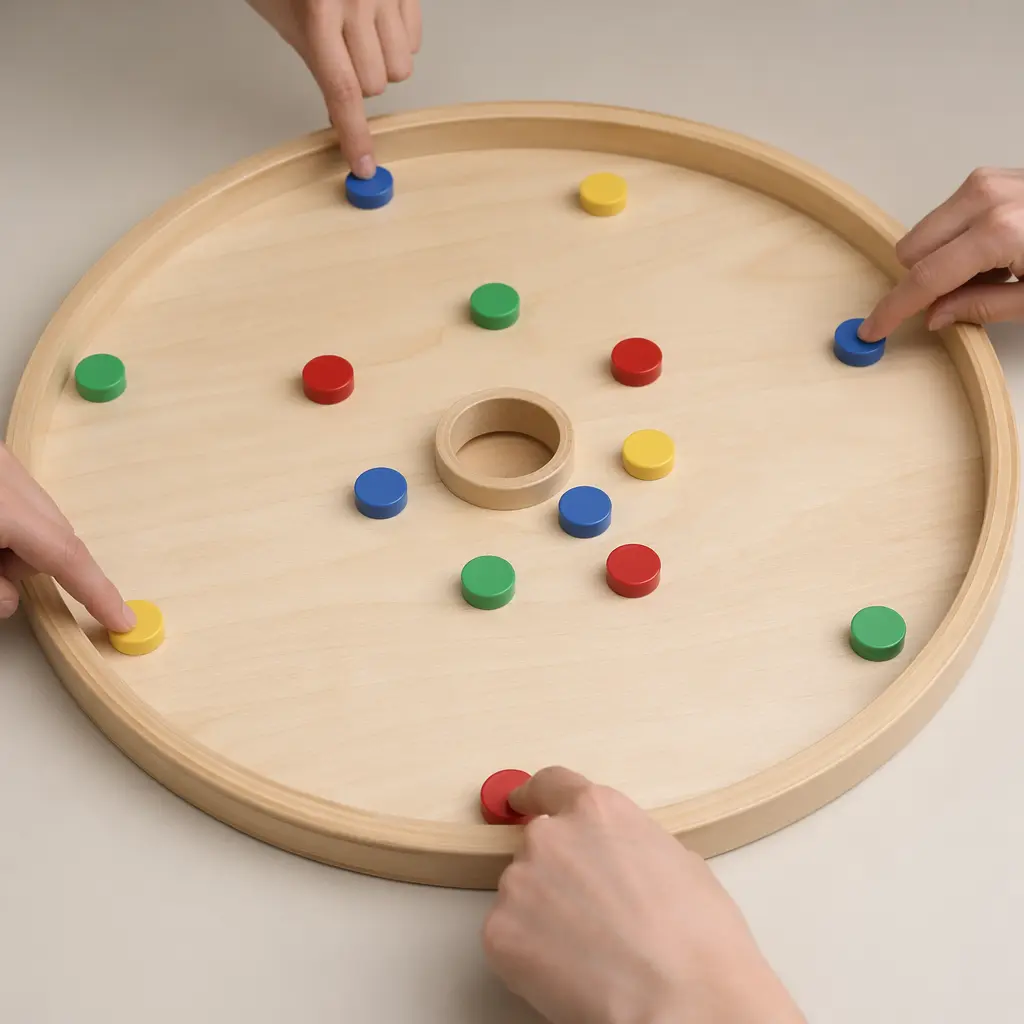
Tiddlywinks looks almost too simple to take seriously: a handful of small discs, a slightly larger disc, and a cup in the middle of the table. Yet behind that modest setup is a game that has entertained families, baffled first-time players, and even inspired organised competitions. It’s a quiet test of touch and foresight, where a gentle flick can be more powerful than brute force.
Where it came from
Tiddlywinks emerged in Britain in the late 19th century, during a period when parlour games were a staple of middle-class entertainment. Early versions were sold as light amusement for children, often packaged with playful illustrations that undersold the game’s potential depth. The basic idea was already there: flip small counters into a container using a larger one as a lever.
Over time, enthusiasts began to formalise the rules, particularly in university settings. By the mid-20th century, organised clubs and agreed standards had transformed Tiddlywinks into a recognised competitive game. What began as a simple diversion gradually earned a reputation as a test of precision and tactical thinking.
Why it works
At its heart, Tiddlywinks works because it rewards practice. The action is easy to learn—press down on one disc to make another pop into the air—but difficult to master. Success depends on understanding how force, angle, and surface friction interact, and on controlling your own impatience.
Unlike many games, there’s almost no hidden information. Everything is visible on the table, which means players must think ahead and adapt as the layout changes. That transparency makes every mistake feel fair—and every well-judged shot deeply satisfying.
- Simple components with no setup complexity
- Strong emphasis on fine motor skills
- Clear cause-and-effect physics
- Quick turns that keep all players engaged
- A low barrier to entry with surprising depth
Who it’s for
Tiddlywinks is often labelled a children’s game, but it comfortably spans generations. Younger players enjoy the physical action and quick feedback, while teens and adults appreciate the challenge of consistent accuracy. It’s well suited to families, classrooms, and anyone who prefers skill-based play over trivia or luck.
Variants and what to look for today
Modern Tiddlywinks sets tend to be fairly similar, but quality can vary. Look for discs made from durable plastic with smooth edges, as rough or warped pieces can affect how they flip. Some sets include a felt or rubber mat to create a consistent playing surface, which can make a big difference.
You may also encounter oversized versions aimed at younger children, or compact travel sets designed for portability. While novelty materials exist, the classic plastic discs remain the most predictable and widely used. Be cautious of very cheap sets where discs are too light or brittle to perform reliably.
Frequently asked questions
Is Tiddlywinks a game of luck?
Luck plays a minimal role. While the outcome of a single flick can be unpredictable for beginners, experienced players rely on repeatable techniques and positioning rather than chance.
How long does a typical game last?
Casual games can be over in 10 to 20 minutes. More structured matches, especially with scoring rules, may take longer but still fit comfortably into an evening.
Does it need special equipment?
No. A standard set includes everything required. Competitive players may prefer consistent surfaces, but casual play works well on most tables.
Can adults really enjoy it?
Absolutely. Many adults discover that the game becomes more engaging as they develop control and strategy, turning a childhood curiosity into a genuine hobby.
Tiddlywinks endures because it doesn’t try to impress. With no theme to age badly and no rules to memorise, it invites players to focus on a single, satisfying challenge. That quiet confidence is why it still earns a place on tables more than a century after it first appeared.