Tinkertoys: How simple sticks built a century of play
First sold in 1914, Tinkertoys turned wooden sticks and spools into one of the earliest open‑ended construction systems, proving that imagination could be the most important piece in the box.
Compare prices and availability
Check current prices and availability for this guide on eBay.
As an eBay Partner, we may be compensated if you make a purchase.
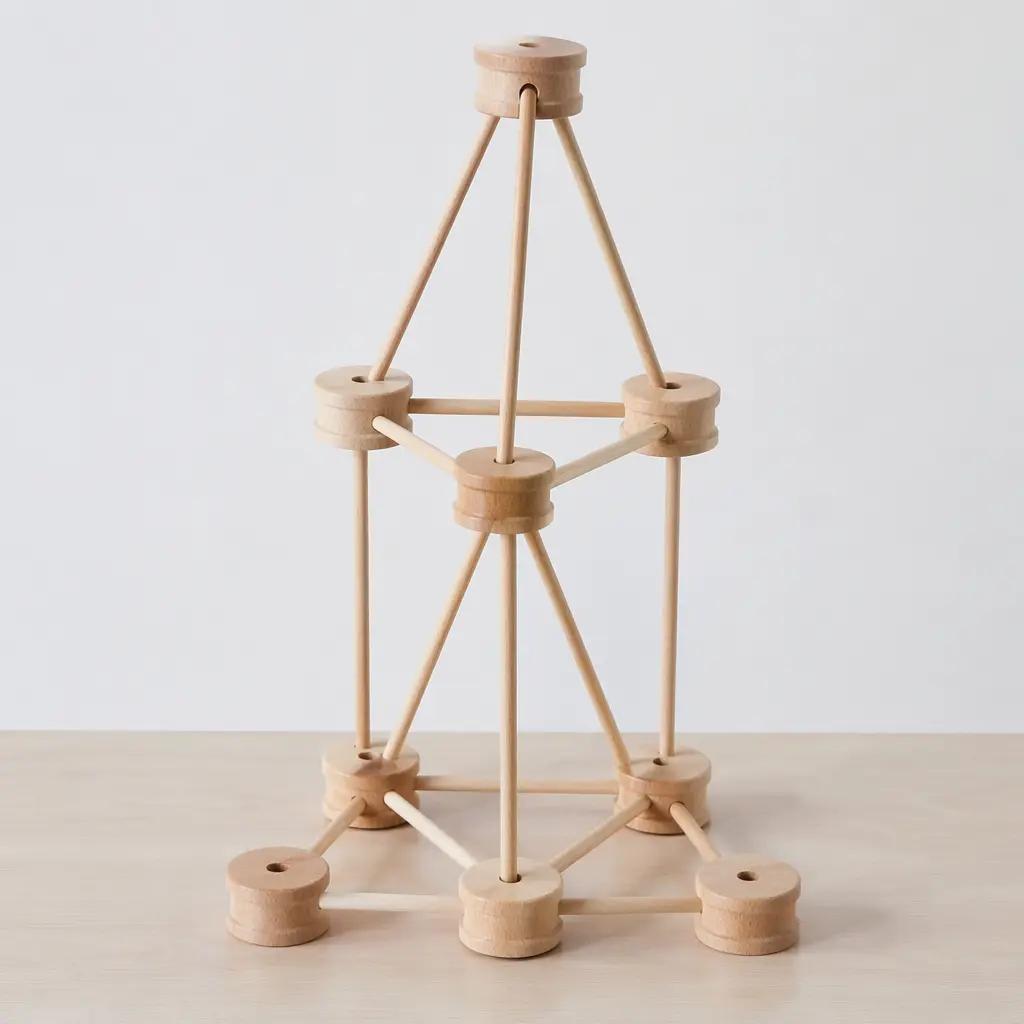
At first glance, Tinkertoys look almost too simple: wooden sticks, round spools, and not much else. But that spare design is exactly why they matter. Long before plastic bricks or screen-based building apps, Tinkertoys offered children a way to invent structures from scratch, with no instructions required. They are one of the earliest examples of an open-ended construction system, where the point isn’t to build a specific thing, but to explore how things fit together.
Where it came from
Tinkertoys were introduced in 1914 in the United States, created by Charles H. Pajeau and Robert Pettit. The idea reportedly came from watching children play with pencils and thread spools, improvising their own constructions. That observation led to a toy built entirely around connection points: holes drilled into wooden spools, matched with smooth wooden sticks that could be inserted and removed again and again.
Early sets were marketed not just as toys, but as educational tools. At a time when kindergartens and progressive education were gaining attention, Tinkertoys fit neatly into the belief that children learn best through hands-on exploration. Over the decades, the brand changed hands and materials evolved, but the core idea—a flexible system of parts that could become almost anything—remained intact.
Why it works
The genius of Tinkertoys lies in their restraint. With just a few basic components, children can experiment with balance, symmetry, and structural strength. There’s no fixed endpoint, which encourages trial and error rather than perfection. Pieces come apart easily, so mistakes feel temporary and safe.
Key features that make the system enduring include:
- Uniform connection points that allow pieces to join at multiple angles
- Lightweight wooden parts that are easy for small hands to handle
- A modular system that scales from simple shapes to complex builds
- An absence of prescribed outcomes, inviting imaginative play
Who it's for
Traditionally aimed at early elementary ages, Tinkertoys are accessible to younger children with supervision and still engaging for older kids. Their quiet, tactile nature also appeals to adults, particularly educators, designers, and parents who appreciate toys that slow play down rather than speed it up. As a shared activity, they work well across age groups, making them a natural fit for classrooms and family rooms alike.
Variants and what to look for today
Over the years, Tinkertoys have appeared in different sizes and materials, including plastic versions and themed sets. For many families, the wooden versions remain the most appealing, both for their durability and their sensory feel. When shopping today, it’s worth focusing on sets that emphasize compatibility and sturdy construction rather than novelty add-ons.
Look for smooth finishes, snug-fitting connections, and a mix of rod lengths. Be cautious with very lightweight or poorly finished knock-offs, which can splinter or fail to hold structures together. A well-made set should feel simple, solid, and endlessly reusable.
Frequently asked questions
Are Tinkertoys still educational by today’s standards?
Yes. While they predate modern STEM language, Tinkertoys naturally support spatial reasoning, problem-solving, and basic engineering concepts through play.
Do they require instructions?
Most sets include idea sheets, but instructions are optional. The system is designed to work without step-by-step guidance.
How durable are wooden sets?
Quality wooden pieces can last for decades if kept dry and stored properly, which is why many vintage sets are still in use.
Can different sets be mixed together?
Generally yes, as long as the connection sizes are compatible. This mix-and-match potential is part of the appeal.
More than a century after their debut, Tinkertoys remain a reminder that great toy design doesn’t have to be complex. By giving children a handful of well-considered parts and the freedom to explore, they set a template that countless construction toys have followed since—and few have improved upon.