The Hoberman Sphere: The expanding toy that made geometry playful
Invented in the mid‑1990s, the Hoberman Sphere turns complex geometry into a hands‑on surprise, expanding and collapsing with a single motion. It’s a STEM classic that still fascinates kids and adults alike.
Compare prices and availability
Check current prices and availability for this guide on eBay.
As an eBay Partner, we may be compensated if you make a purchase.
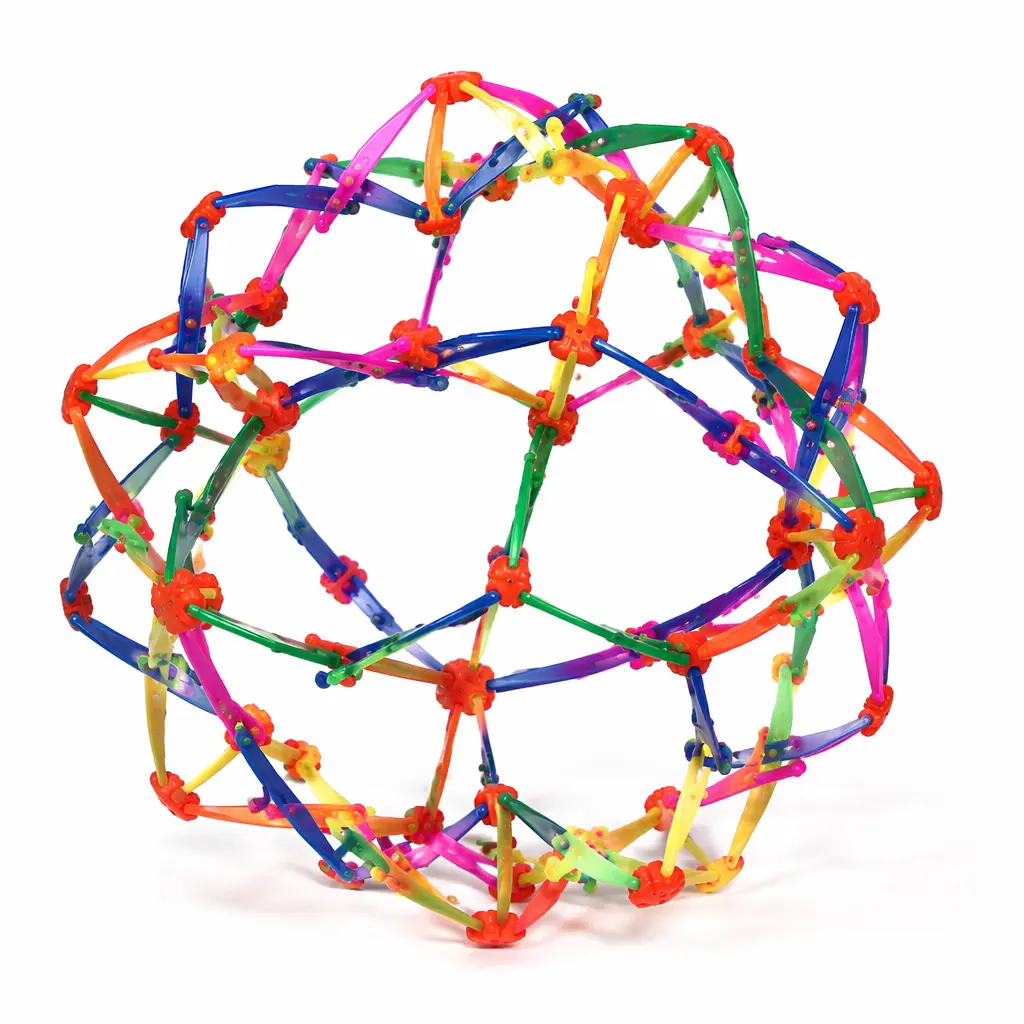
At first glance, the Hoberman Sphere looks like a piece of modern art. Then you touch it. With a gentle pull, the small ball blossoms into a much larger orb, its web of struts sliding smoothly into place. That single moment of transformation is the hook—and it’s why this unusual toy has held attention for three decades. It’s part fidget, part science lesson, and part magic trick, all wrapped into one expanding sphere.
Where it came from
The Hoberman Sphere traces back to inventor Chuck Hoberman, an engineer with a fascination for transforming structures. In the early 1990s, Hoberman was experimenting with scissor‑like linkages—mechanisms that could expand and contract while maintaining a stable overall shape. His work wasn’t originally aimed at toys at all; it was inspired by architecture and large‑scale deployable structures.
In 1995, that exploration reached the toy world. The expanding sphere was introduced as a hands‑on way to experience geometry, motion, and symmetry. It quickly stood out on shelves because it didn’t rely on characters, screens, or storytelling. Its appeal was purely mechanical and visual, and that made it feel timeless even from the start.
Why it works
The Hoberman Sphere works because it invites participation. You don’t just look at it—you manipulate it. The expansion feels smooth and deliberate, and the symmetry is instantly satisfying. Each movement reveals how the parts depend on one another, turning an abstract idea like geometry into something you can feel in your hands.
Its design balances complexity with approachability. You don’t need instructions, batteries, or prior knowledge to enjoy it. At the same time, curious minds can spend hours examining how the struts connect and move.
- Expands and contracts evenly from all sides
- Durable plastic struts connected by flexible joints
- Strong visual symmetry that reinforces geometric concepts
- Instant cause‑and‑effect feedback when handled
Who it’s for
Although often marketed as a children’s educational toy, the Hoberman Sphere has always had cross‑generational appeal. School‑age kids enjoy the simple action and bright colors, while teens and adults are drawn to the engineering behind it. Teachers use it as a classroom prop, and many adults keep one on a desk as a stress‑reliever or conversation starter. It’s best suited to children old enough to handle moving parts gently, but its real audience is anyone who enjoys hands‑on problem‑solving.
Variants and what to look for today
Over the years, the Hoberman Sphere has appeared in several sizes and color combinations. Smaller versions are easier for young hands and make good travel toys, while larger spheres emphasize the dramatic expansion that made the design famous. Some editions lean more educational, pairing the sphere with guides that explain the math and science behind it.
If you’re shopping today, focus on build quality. The hallmark of a good expanding sphere is smooth motion without sticking or creaking. Be cautious of very cheap imitations: poorly aligned joints can limit expansion or break under regular use. A well‑made version should feel sturdy even when fully expanded.
Frequently asked questions
Is the Hoberman Sphere really educational?
Yes, though its teaching is mostly hands‑on and intuitive. It demonstrates principles of geometry, symmetry, and mechanical linkage without formal lessons, making it a natural fit for exploratory STEM learning.
Does it require batteries or setup?
No. The sphere is entirely mechanical and works straight out of the box. That simplicity is part of its lasting appeal.
Can adults enjoy it too?
Absolutely. Many adults use it as a desk toy or teaching aid. Its calming, repetitive motion can also make it a satisfying fidget.
Is it safe for younger children?
It’s generally recommended for children who are past the toddler stage, as the moving joints can pinch if handled roughly. Supervision is a good idea for younger users.
In a toy world crowded with screens and sound effects, the Hoberman Sphere stands out by doing less—and doing it beautifully. Its enduring popularity comes from a simple promise: take something complex, make it tangible, and let curiosity do the rest. That’s a formula that hasn’t aged a day.