Skip Hop Activity Center: When baby gear became living-room friendly
Skip Hop’s activity centers helped turn baby gear into design-led play spaces—practical, modular, and easy on the eyes for modern homes.
Compare prices and availability
Check current prices and availability for this guide on eBay.
As an eBay Partner, we may be compensated if you make a purchase.
Baby activity centers have been around for decades, but for a long time they came with a trade‑off: lots of stimulation for babies, lots of visual clutter for parents. The Skip Hop Activity Center arrived as part of a newer wave of baby gear that tried to solve both sides of that equation. It wasn’t just about keeping little ones busy; it was about creating a play space adults could actually live with.
Where it came from
Skip Hop began as a parent‑founded brand focused on solving everyday problems with a bit more thought and style. By the time the Activity Center appeared, the company had already built a reputation for baby products that looked intentional rather than accidental—items designed to sit comfortably in a home, not be hidden away between uses.
The activity center concept itself is not new. These stationary play stations grew out of baby walkers and bouncers, reimagined to offer upright play without rolling around the house. Skip Hop’s take leaned into that safer, contained idea while adding a modern design language and a longer useful life than the typical single‑stage baby toy.
Why it works
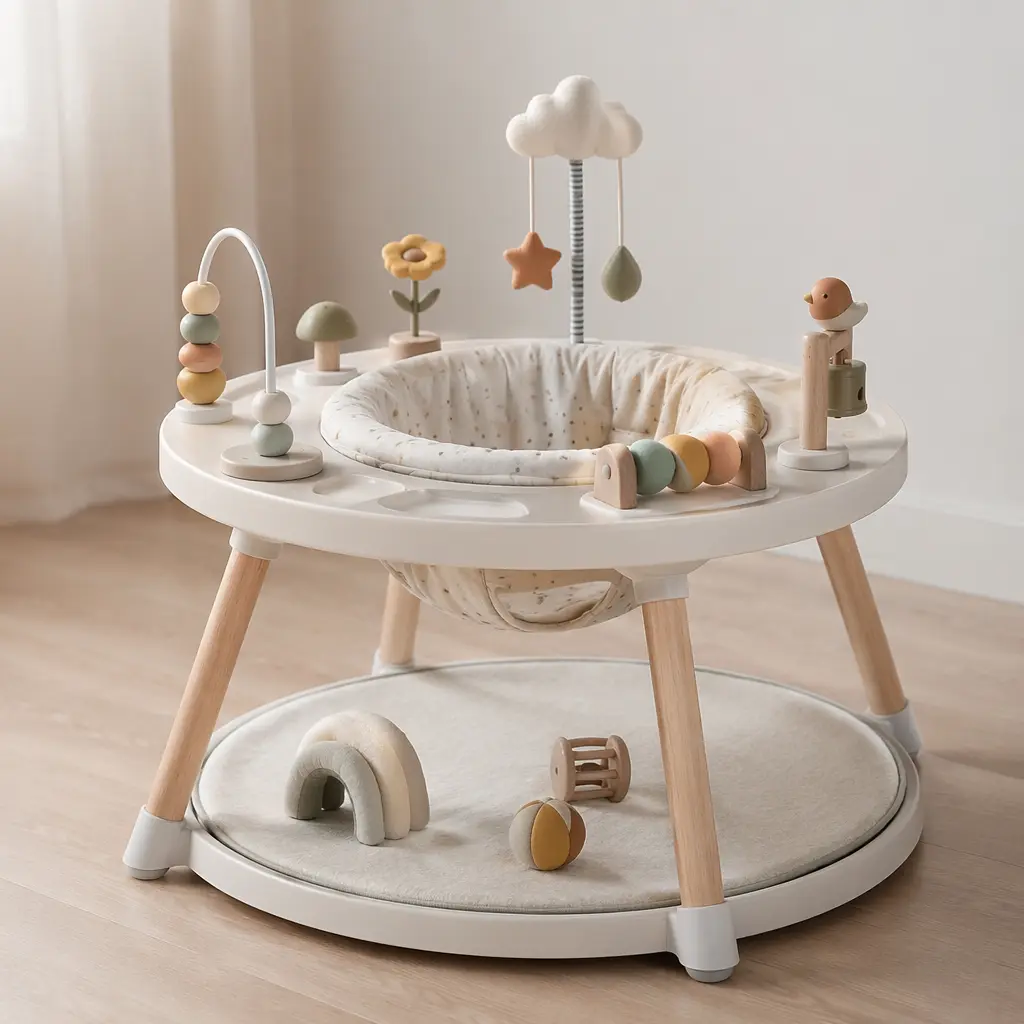
At its core, the Skip Hop Activity Center is about giving babies a supported place to explore movement, sound and texture. What made it stand out was how deliberately each element was chosen. Instead of flashing lights and loud electronics, the focus shifted to tactile play, cause‑and‑effect actions and simple visual contrasts.
The design also acknowledged that babies grow quickly. Rather than becoming obsolete after a few months, the structure adapts—changing heights or transforming into a toddler play table once the seat is removed. That sense of progression helped justify its place (and footprint) in family homes.
- A supportive seat that encourages upright posture and balance
- Detachable toys that can be repositioned or used separately
- A neutral, modern colour palette that blends into home décor
- Convertible design that extends use into the toddler years
Who it's for
The Skip Hop Activity Center is aimed at babies who can hold their heads up and are eager to explore the world from a standing position, typically in the middle of the first year. It also appeals strongly to parents who value design and don’t want their living space taken over by brightly coloured plastic. There’s an unexpected adult appeal here too: many parents enjoy the sense that this is a piece of furniture as much as a toy.
Variants and what to look for today
Today, Skip Hop activity centers are available in a small range of styles rather than dozens of versions. The differences usually come down to colour schemes and the mix of attached toys, not radical changes in function. That consistency is part of the appeal—it’s a product line that evolves gently rather than chasing trends.
When shopping now, it’s worth paying attention to build quality and adjustability. Look for sturdy legs, a stable base and clear instructions for height settings. Generic activity centers inspired by the look are common, but they don’t always offer the same longevity or materials. The original’s strength lies in how well it transitions from baby station to toddler table.
Frequently asked questions
Is an activity center the same as a baby walker?
No. Activity centers are stationary and designed to keep babies in one place, offering upright play without wheels. This makes them a different—and generally safer—category from traditional walkers.
How long can a baby use it each day?
Short, supervised sessions are best. Activity centers are a supplement to floor play, not a replacement, helping babies explore standing while still needing time to move freely.
Does it really convert into a toddler table?
Yes. Removing the seat turns the frame into a low table suitable for drawing, blocks or simple play, extending its usefulness beyond the baby stage.
Is it easy to clean?
Most fabric parts are removable, and the hard surfaces wipe clean easily—an important detail for any toy designed for teething babies.
The Skip Hop Activity Center represents a broader shift in how parents think about baby toys. It’s not just something to occupy a child for a few months; it’s a considered piece of early‑years equipment that respects both development and design. In that balance lies its lasting appeal.