Playground Parachute: The giant fabric game that taught teamwork
The playground parachute turned gyms and schoolyards into cooperative play spaces, using nothing more than a circle of fabric to teach timing, rhythm, movement, and shared fun.
Compare prices and availability
Check current prices and availability for this guide on eBay.
As an eBay Partner, we may be compensated if you make a purchase.
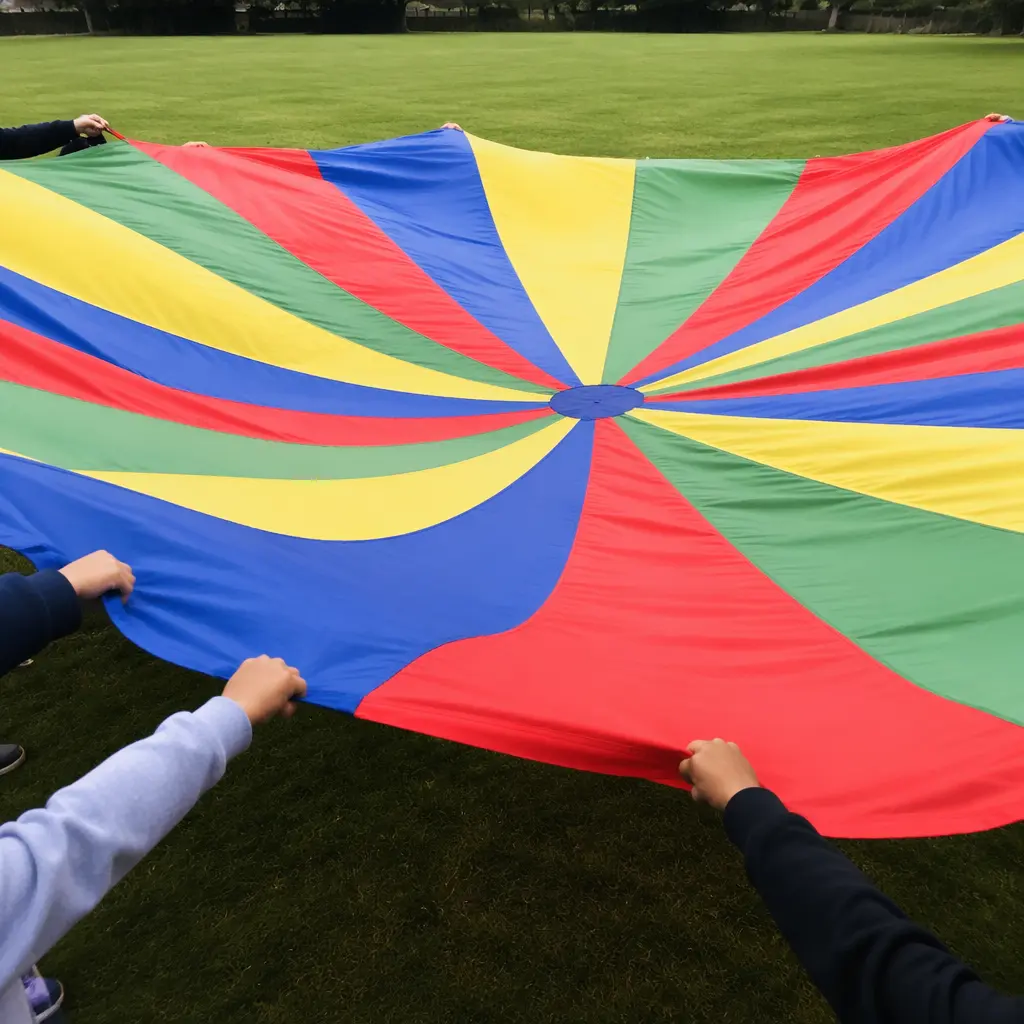
Few toys create instant cooperation the way a playground parachute does. A giant circle of lightweight fabric with handles around the edge, it turns a group of children into a team almost immediately. One child alone can shake it, but a dozen people working together can launch balls into the air, create rolling waves, or lift the fabric into a floating dome. The appeal is simple, physical, and surprisingly timeless.
Where it came from
The modern playground parachute grew out of both military surplus materials and physical education experiments in the mid-20th century. Large fabric parachutes had obvious practical origins, but teachers and recreation leaders quickly realized that lightweight circular cloth could become a tool for movement games and cooperative learning. By the 1960s and 1970s, parachute activities had become common in schools, camps, and youth programs.
Unlike many classic toys tied to a single inventor or company, the playground parachute evolved through group use. Physical education instructors adapted games, songs, and movement exercises around it, creating activities that encouraged participation instead of competition. That flexibility helped it spread widely through schools and community centers, where durability and group engagement mattered more than novelty.
Why it works
The parachute succeeds because it gives every participant a visible role. Children can immediately see how their movement affects the entire surface. Pull too hard and the rhythm breaks. Move together and the fabric rises smoothly like a wave. The feedback is instant, physical, and easy to understand, even for very young children.
It also scales unusually well across ages and abilities. Preschool groups use it for songs and simple motion games, while older children can coordinate more complex timing challenges. Teachers often value it because active participation happens naturally without requiring advanced athletic skill.
- Large circular fabric design encourages equal participation
- Bright segmented colors help with visual cues and group games
- Handles around the edge improve grip and coordination
- Works indoors or outdoors with minimal setup
- Supports cooperative rather than competitive play
- Can combine movement, music, rhythm, and simple exercise
Who it's for
Playground parachutes are most commonly associated with preschool and elementary-age children, but the format has broader appeal than many people remember. Camps, therapy programs, adaptive physical education classes, and even adult team-building activities still use them because the play style is accessible and low-pressure. Younger children enjoy the sensory movement and color, while older participants often respond to the challenge of timing and coordination. Families sometimes buy smaller versions for backyard gatherings, though larger parachutes remain most effective in schools or community spaces where bigger groups can participate.
Variants and what to look for today
Modern playground parachutes come in a wide range of sizes, from small family versions designed for a few children to oversized school models intended for entire classes. Most are made from lightweight polyester or nylon blends that balance durability with easy movement. Reinforced handles and stitched seams are usually the first signs of a better-quality version, especially for frequent school or camp use.
Some sets include accessories like foam balls for bouncing games or storage bags for transport. Smaller indoor-friendly parachutes are common for home use, while heavier-duty outdoor models are designed to handle repeated group activities. Extremely cheap versions can tear around the handles or use stiff fabric that does not ripple smoothly, so material flexibility matters almost as much as strength.
- Choose a size that matches the number of participants
- Look for reinforced stitching around handles
- Lightweight fabric creates smoother wave motion
- Machine-washable materials are useful for school settings
- Avoid overly stiff or thin fabric that snags easily
Frequently asked questions
What age is a playground parachute best for?
Most parachute activities are aimed at children between preschool age and about 10 years old, though older groups can still enjoy coordination games and team exercises. Simpler games work well for very young children because they rely more on rhythm and movement than rules.
Can playground parachutes be used indoors?
Yes. School gyms and multipurpose rooms are common indoor settings for parachute play. The key requirement is enough open space above and around the group so the fabric can rise safely without hitting lights or walls.
Why do schools still use playground parachutes?
They remain popular because they combine physical activity with cooperative learning. Teachers can involve an entire class at once, and children of different athletic abilities can participate together without the emphasis falling on winning or losing.
Are smaller home versions worth buying?
For families who regularly host group play or outdoor parties, smaller parachutes can work well. The experience becomes more engaging with more participants, though, so larger group settings still deliver the classic effect most people remember from school or camp.
The playground parachute endures because it turns a basic material into a shared experience. Long before apps and connected toys promised collaborative play, a circle of fabric already offered it in the simplest possible form. The movements are repetitive, the games are uncomplicated, and the results are immediate: laughter, rhythm, motion, and a group learning how to move together.