Fisher-Price See ’n Say: The pull-string that talked back
First sold in the mid-1960s, the Fisher-Price See ’n Say turned a simple pull-string into many children’s first ‘conversation,’ blending pictures, sounds, and cause-and-effect play.
Compare prices and availability
Check current prices and availability for this guide on eBay.
As an eBay Partner, we may be compensated if you make a purchase.
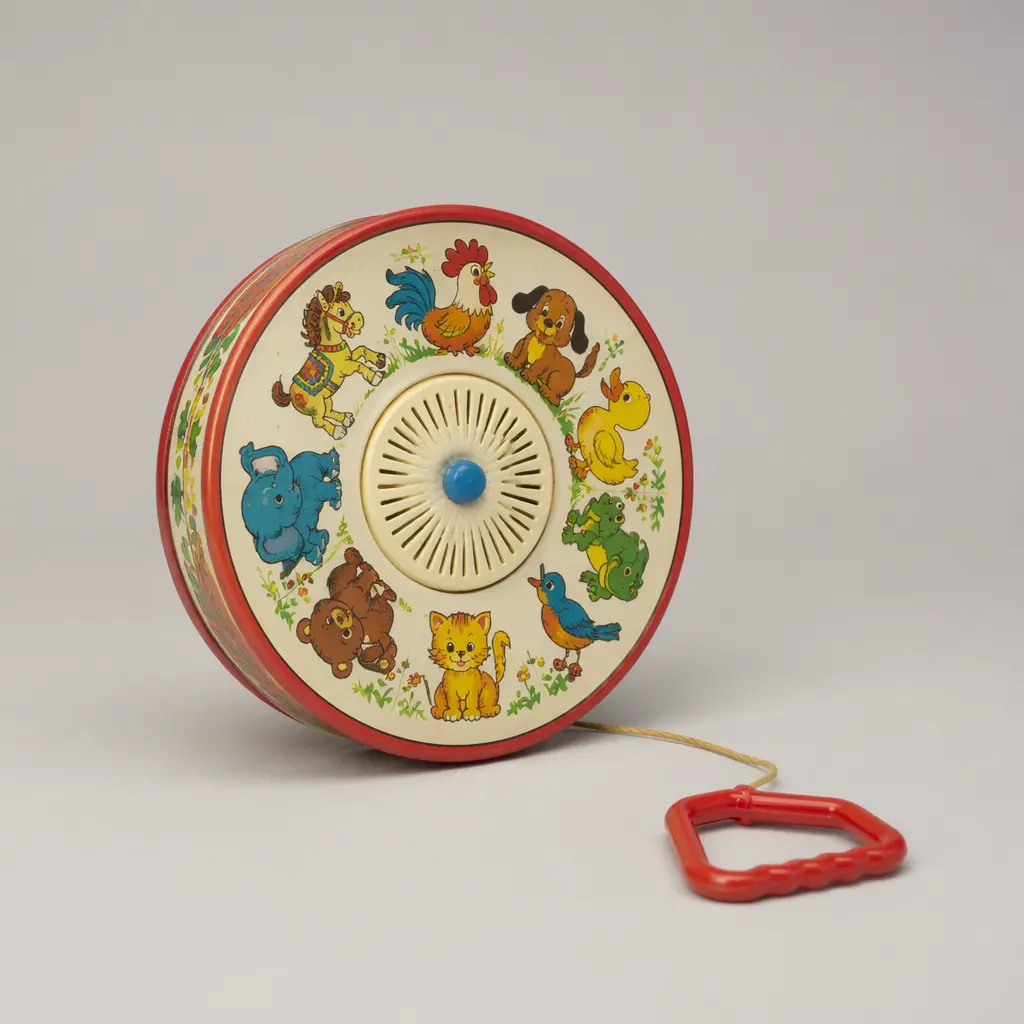
Before screens talked back, before batteries were expected, there was the See ’n Say. With a single pull of a string, this chunky plastic toy named what a child was pointing at, turning curiosity into sound. For many families, it became a baby’s first experience of call-and-response play — pull, listen, repeat — and a gentle introduction to language through toys.
Where it came from
The See ’n Say was introduced by Fisher-Price in 1965, during a period when the company was leaning heavily into toys designed around early childhood development. At the time, most sound-making toys relied on bells, whistles, or music boxes. Recorded speech in a durable, child-safe toy was still a novelty.
Its original purpose was simple and ambitious at the same time: help toddlers connect images with words. Early versions featured farm animals, with each pull of the string rotating an internal disc and triggering a short spoken phrase followed by a sound. It wasn’t about teaching full sentences, but about giving names to the world — cow, pig, sheep — in a way that felt playful rather than instructional.
Why it works
The genius of the See ’n Say is its clarity. One action leads to one result. Pull the string, hear the voice. Turn the arrow, choose what you want to hear next. That tight loop of cause and effect is exactly what young children are wired to explore, especially in the toddler years.
Design-wise, it also respects short attention spans. The sounds are brief, the images are bold, and the physical motion is satisfying without being frantic. There’s no need to swipe, tap, or navigate menus — just a mechanical interaction that feels almost conversational.
- Pull-string mechanism that encourages fine motor control
- Clear, isolated sounds that match a single image
- Sturdy, easy-to-grip shape sized for small hands
- No batteries required in classic versions
Who it’s for
Traditionally, the See ’n Say has been aimed at babies and toddlers, roughly from around 12 months up to preschool age. It works especially well for children just beginning to associate words with objects. That said, it also holds a strong nostalgic pull for adults. Many parents and grandparents recognise it instantly and enjoy sharing a toy that feels unchanged by time, even if the materials and sounds have evolved.
Variants and what to look for today
Over the decades, the See ’n Say family expanded far beyond the original farm theme. There have been versions focused on animals, letters, numbers, and even licensed concepts, all using the same basic interaction. Modern editions often use electronic sound modules instead of purely mechanical systems, but the play pattern remains the same.
If you’re looking for one today, focus less on nostalgia and more on build quality. A good See ’n Say should have a smooth pull action, clear audio that isn’t tinny or overly loud, and illustrations that are simple enough for a young child to decode quickly. Be cautious with very cheap imitations, which sometimes use stiff cords or unclear sound recordings that undermine the experience.
Frequently asked questions
Does the See ’n Say help with language development?
It can support early language skills by reinforcing word-object associations. While it’s not a teaching system on its own, it works well as part of everyday play and conversation with an adult.
Are modern versions different from the originals?
Yes. Early models relied more on mechanical sound production, while many newer versions use digital audio. The core interaction is the same, but the sound quality and internal construction have changed over time.
Is it safe for babies?
When age guidelines are followed, it’s generally considered safe. Parents should still inspect cords, seams, and battery compartments regularly, as with any infant toy.
Why has it lasted so long?
Because it does one thing very well. The See ’n Say doesn’t chase trends; it meets a basic developmental need with a clear, satisfying interaction.
More than sixty years after its debut, the See ’n Say remains a reminder that a toy doesn’t need to be flashy to be effective. Sometimes, a single string, a friendly voice, and a clear idea are enough to start a conversation that lasts a lifetime.