Grimm’s Wooden Rainbow: The quiet icon of open‑ended play
Simple curved wooden arcs, endless possibilities. Grimm’s Wooden Rainbow shows how open‑ended design became a modern symbol of imaginative, screen‑free play.
Compare prices and availability
Check current prices and availability for this guide on eBay.
As an eBay Partner, we may be compensated if you make a purchase.
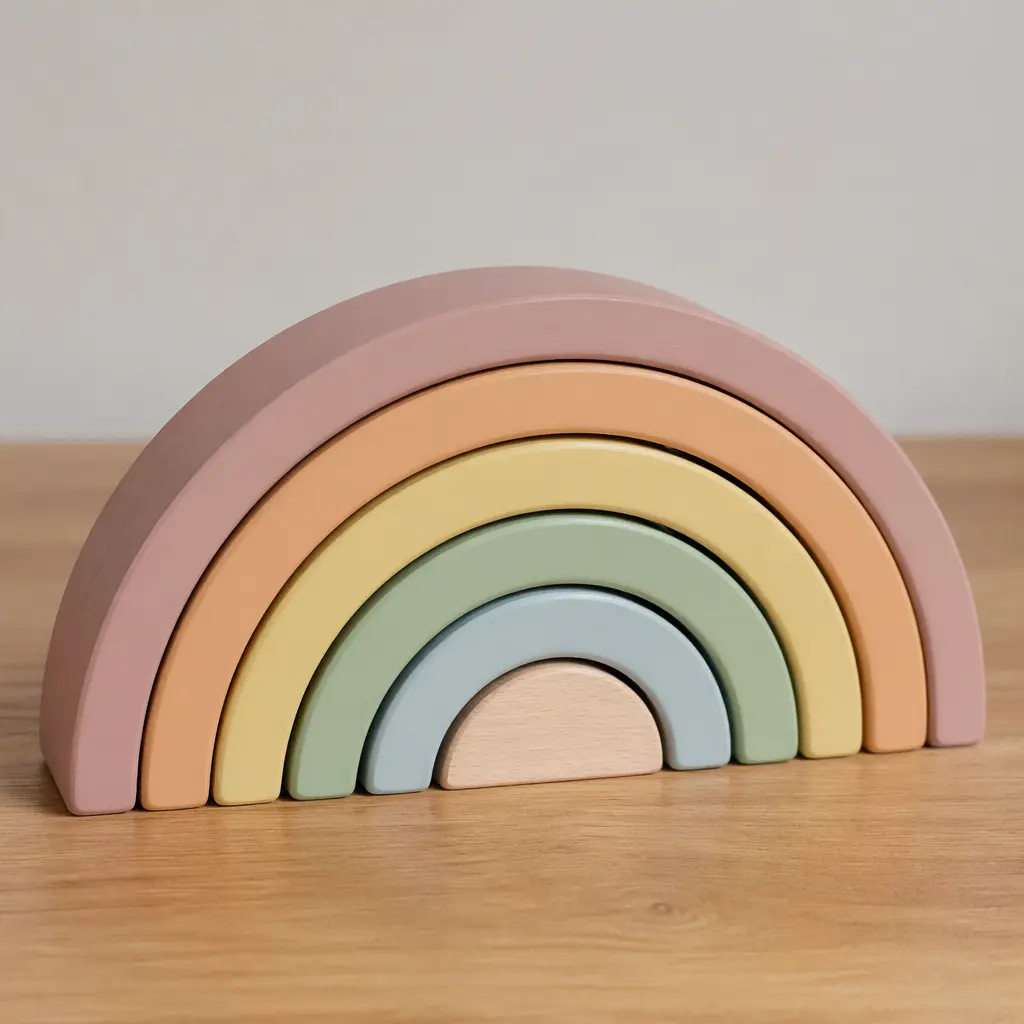
At first glance, Grimm’s Wooden Rainbow looks almost too simple to be a toy at all: a stack of smoothly sanded wooden arcs, painted in gentle colours. There are no instructions, no characters, no obvious game to win. And yet, over the past decade, it has become one of the most recognisable symbols of open‑ended play, turning up in nurseries, classrooms, and carefully curated playrooms around the world.
Where it came from
Grimm’s is a German family‑run toy maker rooted in European traditions of wooden craftsmanship. While wooden blocks have existed for centuries, the Wooden Rainbow reflects a more recent revival of interest in Waldorf‑inspired and Montessori‑adjacent play, where toys are designed to support imagination rather than direct it.
The rainbow form itself draws on classic stacking and nesting toys, but reimagines them as something deliberately ambiguous. Instead of teaching a single skill or outcome, the arcs were designed to invite children to decide what the object should be each time they pick it up. That philosophy—trusting children to lead their own play—helped the toy resonate with parents looking for alternatives to plastic, battery‑powered options.
Why it works
The appeal of the Wooden Rainbow lies in what it doesn’t do. There are no flashing lights or preset functions. Instead, the toy relies on shape, weight, colour, and balance. Children quickly discover that the arcs can stack, nest, topple, roll, and bridge gaps. Those simple physical properties create a surprisingly rich play pattern.
- Open‑ended shapes that can become anything from tunnels to mountains
- Graduated sizes that naturally introduce balance and proportion
- Smooth wooden surfaces that are pleasant to handle
- Muted colours that don’t overwhelm or dictate a storyline
Because the toy doesn’t suggest a single ‘right’ way to play, it grows with the child. Toddlers might stack and knock it over. Preschoolers build bridges for cars or animals. Older children incorporate the arcs into elaborate worlds. Even adults often find themselves absent‑mindedly rearranging the pieces, which hints at its broader appeal.
Who it’s for
The Wooden Rainbow is typically used from toddler age through early primary years, but its audience is wider than that. Younger children benefit from the sensory experience and gross‑motor experimentation, while older children use it as an architectural or imaginative prop. Parents and educators are drawn to it for its calm presence and durability, and it’s not unusual to see it kept out on a shelf as both a plaything and a piece of décor.
Variants and what to look for today
Today, the Wooden Rainbow concept comes in many sizes and colour palettes. Some sets are compact, designed for small hands and shelves, while larger versions make a statement and allow for more ambitious builds. You’ll also find variations in finish, from bright rainbow hues to softer, earth‑toned stains.
When shopping, it’s worth paying attention to the quality of the wood and finish. Well‑made sets feel substantial, with smoothly rounded edges and non‑toxic paints or stains. Cheaper imitations may look similar in photos but can be lighter, rougher, or less consistent in size, which affects how well the pieces stack and balance.
Frequently asked questions
Is it really educational?
Rather than teaching letters or numbers directly, the Wooden Rainbow supports skills like spatial awareness, balance, problem‑solving, and imaginative thinking. Its educational value comes from how children use it, not from built‑in lessons.
Does it get boring over time?
Many families find the opposite. Because there’s no fixed play pattern, children return to it in different ways as they grow. It often becomes a background staple, combined with other toys rather than used on its own.
Is it safe for young children?
Most versions are designed with young children in mind, using solid wood and child‑safe finishes. As with any wooden toy, supervision is important for very young toddlers, especially with larger, heavier pieces.
Why is it so popular on social media?
Its clean design photographs well, but the popularity also reflects a wider shift toward slower, more intentional play. For many parents, it represents a values‑driven choice as much as a toy.
In a market crowded with noise and novelty, Grimm’s Wooden Rainbow stands out by doing very little—and doing it well. Its lasting appeal isn’t about trends or technology, but about trusting children’s creativity. That quiet confidence is what turned a stack of curved wooden arcs into a modern classic.