Guess Who?: Why a yes-or-no face game still matters
First released in 1979, Guess Who? remains a staple of family game nights. Its simple yes-or-no format teaches logic, deduction, and social play in a way few board games manage.
Compare prices and availability
Check current prices and availability for this guide on eBay.
As an eBay Partner, we may be compensated if you make a purchase.
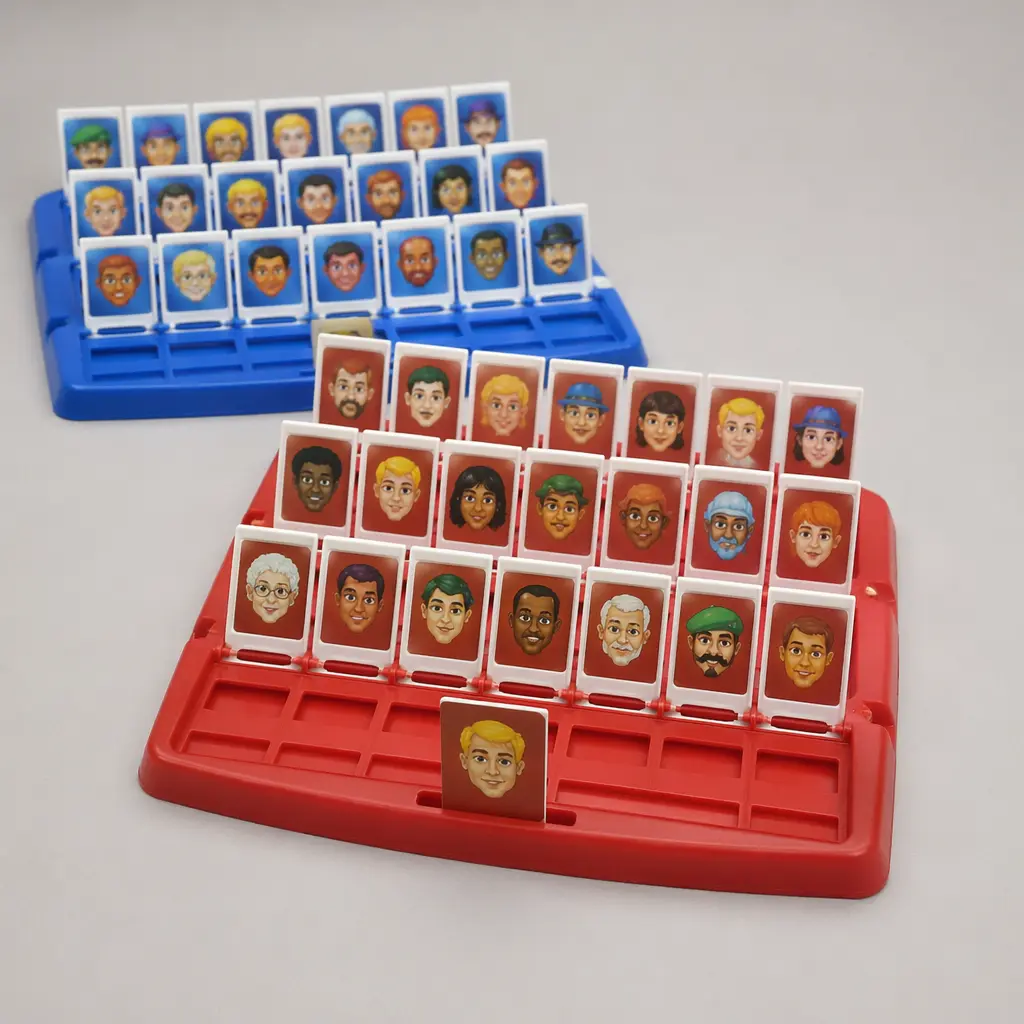
Guess Who? is one of those games many adults remember learning almost by accident. The rules are short, the setup is quick, and within minutes you’re asking careful yes-or-no questions while scanning a grid of faces. Since its arrival in the late 1970s, the game has become a quiet classic, valued not for flashy components but for how naturally it teaches logical thinking and conversation.
Where it came from
Guess Who? was originally created in 1979 by Israeli inventors Ora and Theo Coster, a husband-and-wife team known for developing accessible family games. Their aim was to create something that encouraged reasoning without feeling like a lesson. The concept was straightforward: each player secretly selects a character, then takes turns asking questions to eliminate possibilities.
The game found international success after being picked up by major toy publishers and adapted for different markets. Over time, the faces, packaging, and materials have changed, but the core idea has stayed remarkably consistent. That consistency is a big part of why Guess Who? is still recognizable decades later.
Why it works
At its heart, Guess Who? is about narrowing down information. Players learn to ask efficient questions, pay attention to details, and revise their assumptions based on answers. The yes-or-no structure keeps things fair and focused, while the visual grid gives constant feedback.
The design also supports social play. Turns are short, questions are spoken aloud, and reactions are immediate. For younger players, it’s often one of the first games where strategy feels real rather than abstract.
- Simple rules that can be explained in under five minutes
- Clear visual elimination mechanic
- Encourages careful questioning and listening
- Works equally well with adults and children
- Short play sessions that invite rematches
Who it's for
Guess Who? is typically suitable for children around six years and up, once they can reliably recognize visual features and form basic questions. It’s also a favorite with parents and grandparents because it levels the playing field—experience helps, but no one has a built-in advantage. Adults often enjoy it as a light, nostalgic game that still rewards thoughtful play.
Variants and what to look for today
Over the years, Guess Who? has appeared in many forms. Some editions refresh the character artwork, while others adjust the board design to be more compact or travel-friendly. You may also find versions that replace faces with other categories, such as animals or objects, while keeping the same deduction structure.
When choosing a version today, look for sturdy hinges on the flip-up tiles and clear, durable character cards. Cheaper knock-offs can warp easily or use flimsy materials that don’t stand up to repeated play. The classic two-player format remains the most satisfying, especially for first-time players.
Frequently asked questions
How long does a typical game take?
Most games of Guess Who? last between 10 and 15 minutes, depending on how carefully players ask questions. This short playtime makes it easy to fit into busy family schedules.
Does Guess Who? really teach logic skills?
Yes. Players practice categorization, deduction, and hypothesis testing. While it feels like casual fun, the mental process behind each question mirrors basic logical reasoning.
Is it suitable for classroom or educational use?
Many teachers use Guess Who? in small groups to support language development and critical thinking. Its conversational format works well in educational settings.
Can adults still enjoy it?
Absolutely. While the game is simple, the satisfaction of asking the perfect question never really fades, especially when playing with children or revisiting it for nostalgia.
More than four decades after its debut, Guess Who? remains relevant because it respects the player’s intelligence. It doesn’t rely on trends or technology—just faces, questions, and the pleasure of narrowing chaos into clarity. That’s a formula that still works.