Jenga: Why pulling one wooden block never stops being tense
Since the early 1980s, Jenga has turned a simple wooden tower into one of the most nerve‑wracking games ever made, proving that balance, patience, and shaky hands can be endlessly entertaining.
Compare prices and availability
Check current prices and availability for this guide on eBay.
As an eBay Partner, we may be compensated if you make a purchase.
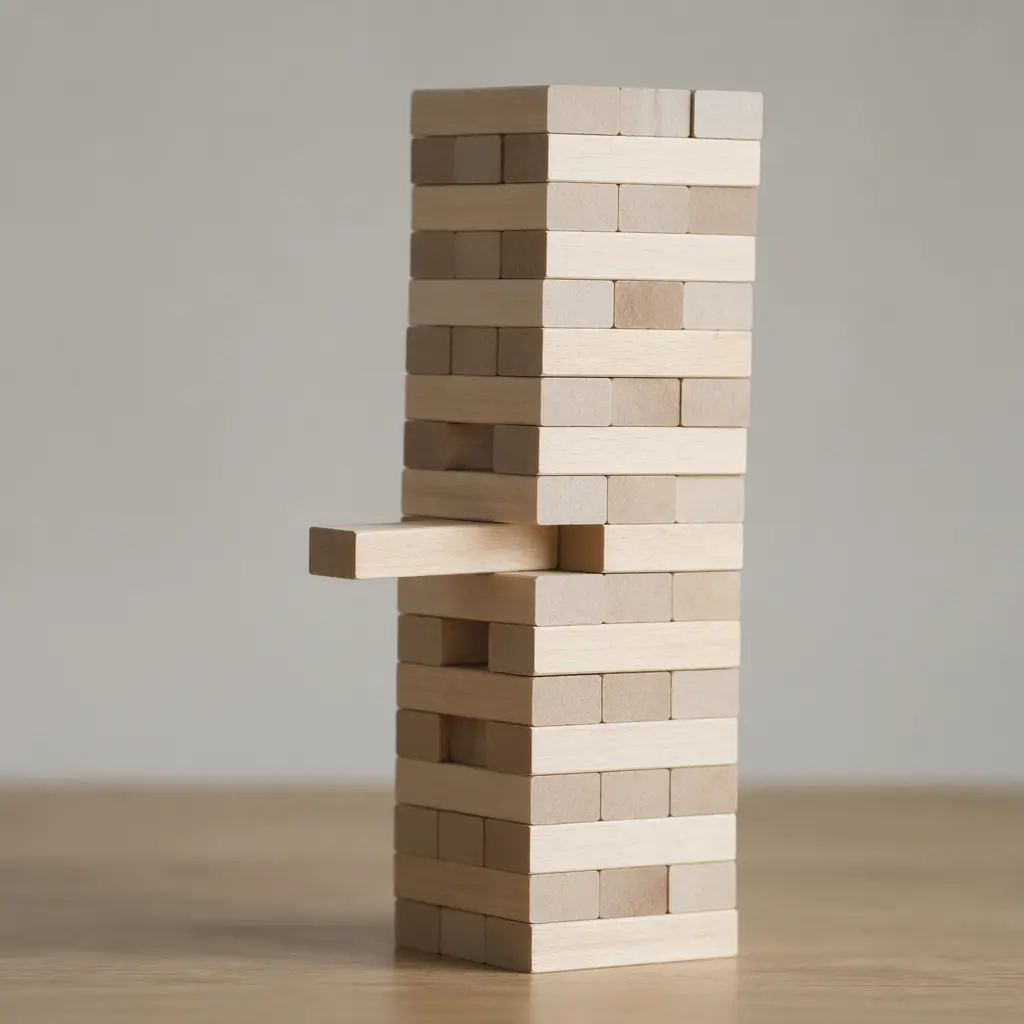
Jenga is one of those rare games that needs almost no explanation. A tower of wooden blocks. One block removed at a time. Don’t let it fall. And yet, decades after its debut, the tension it creates still feels fresh. The silence around the table, the slow slide of a block, the collective flinch when the tower wobbles — it’s a shared experience that works just as well at a family kitchen table as it does at a party.
Where it came from
Jenga traces its roots to 1983, inspired by a stacking game played with wooden blocks in Ghana. British game designer Leslie Scott developed the modern version after playing the game with her family, refining the rules and structure into something that could be shared more widely.
The name itself comes from a Swahili word meaning “to build,” which neatly captures both the physical act and the quiet irony of the game. Although it entered the market during a period crowded with board games and electronic toys, Jenga stood out by doing almost nothing flashy at all.
Why it works
At its core, Jenga is a lesson in restraint. Players are asked to make the smallest possible action — sliding out a single block — while dealing with increasingly dramatic consequences. Every move subtly changes the balance of the tower, and because gravity is unforgiving, the game never lies about how well you’re doing.
The design succeeds because it combines physical skill with psychological pressure. You’re not just testing your hands; you’re watching other players, second‑guessing yourself, and deciding whether a risky move is worth it.
- Simple materials: plain wooden blocks with no moving parts
- Clear cause and effect: every move affects the whole structure
- Escalating tension as the tower grows taller
- Short turns that keep all players engaged
Who it’s for
Jenga is often labelled a family game, and that’s accurate — children can grasp the rules quickly and enjoy the physical challenge. At the same time, adults find plenty to enjoy, especially as the game becomes more about nerve than dexterity. It works across generations, requires no reading, and doesn’t rely on pop culture references that might date it.
Variants and what to look for today
Over the years, Jenga has appeared in many forms, from travel‑sized sets to oversized garden versions designed for outdoor play. While the core idea remains unchanged, the feel of the blocks matters more than most people realise. Smooth, evenly cut wood gives more predictable friction, while rougher blocks can make the game feel erratic.
If you’re shopping today, look for solid wooden blocks with consistent dimensions and a stable starting frame. Avoid sets that feel unusually light or uneven, as these can collapse prematurely and undercut the slow build‑up of tension that defines the game.
Frequently asked questions
Is Jenga a board game or a puzzle?
It sits somewhere in between. There’s no board and no pieces to solve, but it shares a puzzle’s focus on problem‑solving and precision, combined with the social element of a party game.
Does skill matter more than luck?
Skill matters, especially early on. As the tower grows unstable, luck plays a bigger role — which is part of what keeps everyone watching, even when it’s not their turn.
Can younger children play safely?
Younger children can play with supervision. The blocks are solid wood and can hurt if the tower falls from height, so it’s best to play at table level rather than on the floor or raised surfaces.
Why hasn’t Jenga changed much over time?
Because it doesn’t need to. The core idea — testing balance under pressure — is timeless, and any major change risks diluting what makes the game so effective.
Jenga endures because it trusts a simple idea and lets physics do the rest. With no screens, no batteries, and no complicated rules, it continues to create moments of suspense that feel surprisingly intense for a stack of wooden blocks.