KAPLA Blocks: How identical planks unlocked endless builds
KAPLA’s identical wooden planks prove that limits can spark creativity. Since 1987, this minimalist building set has invited kids and adults to think like architects—no studs, no connectors, just balance and imagination.
Compare prices and availability
Check current prices and availability for this guide on eBay.
As an eBay Partner, we may be compensated if you make a purchase.
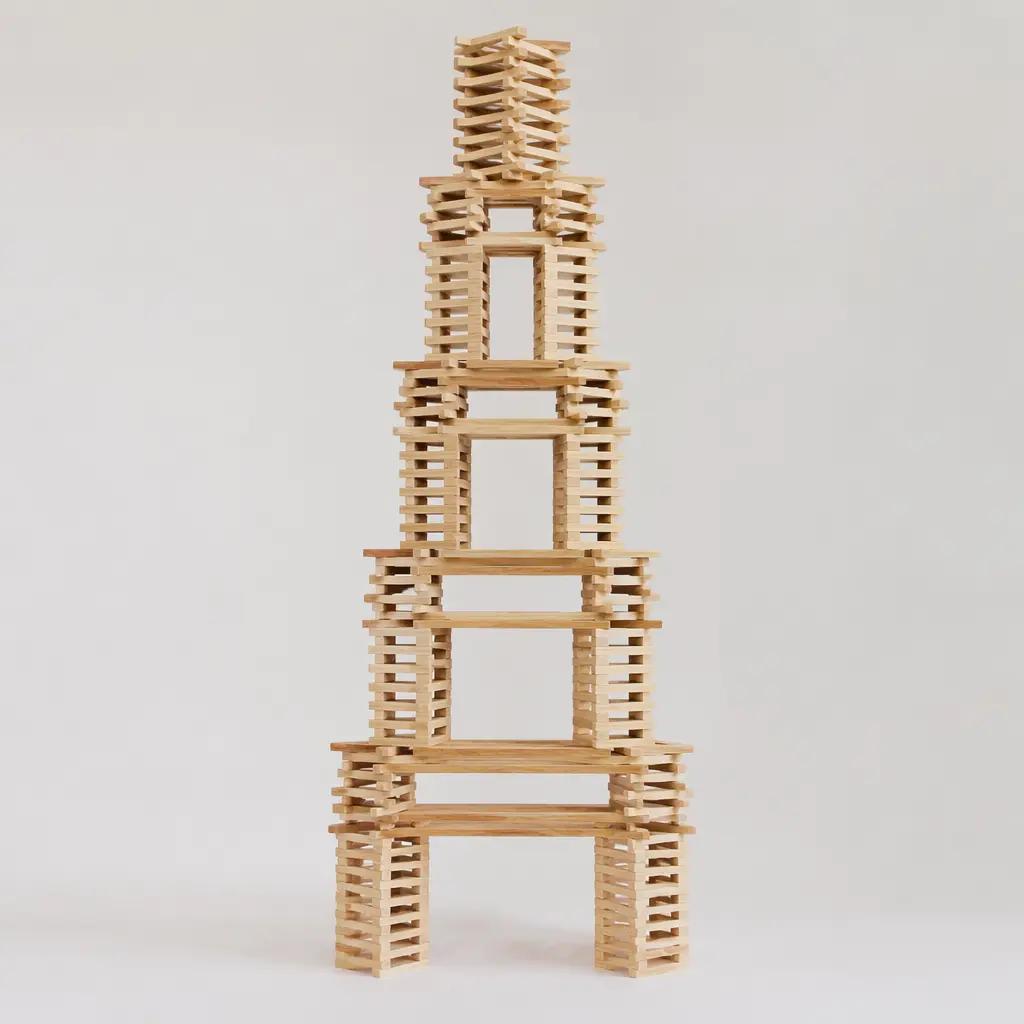
At first glance, KAPLA Blocks don’t look like much: just slim, identical wooden planks. No pegs, no magnets, no colour coding. And yet, in classrooms, living rooms, and museums around the world, these simple pieces have been turned into towers, bridges, animals, domes, and entire miniature cities. KAPLA’s quiet appeal lies in a bold idea—that creativity doesn’t need variety, only possibility.
Where it came from
KAPLA was created in 1987 by Dutch art historian and architect Tom van der Bruggen. While working on restoring a French castle, he needed a simple way to explain architectural balance and proportion to clients. Instead of sketching, he reached for small wooden slats, cutting them to a precise ratio that allowed them to stack and span reliably without glue or fasteners.
The name KAPLA comes from the Dutch phrase “Kabouter Plankjes,” roughly translating to “gnome planks.” Van der Bruggen refined the dimensions until every piece was exactly the same, then introduced the concept as a toy. What began as a professional demonstration tool quickly found an audience among educators and parents who saw how naturally children engaged with the system.
Why it works
KAPLA’s power comes from restraint. Every plank is identical in size, shape, and weight, which removes decision fatigue and shifts focus to structure. Builders must think about gravity, friction, symmetry, and load distribution. Success feels earned, and collapse—when it happens—is dramatic but instructive.
Unlike interlocking bricks, KAPLA pieces rely entirely on balance. That makes the play slower and more deliberate, but also deeply absorbing. The system scales beautifully: a small stack can become a simple bridge, while hundreds of planks can form complex architectural forms that feel closer to model-making than toy play.
- Identical planks encourage focus on balance and proportion
- No connectors mean infinite ways to stack and span
- Natural wood adds weight and tactile feedback
- Mistakes lead to learning through visible cause and effect
Who it's for
KAPLA is often recommended for children aged three and up, but its real audience is broader. Younger kids enjoy stacking and knocking down simple builds, while older children begin to experiment with patterns and stability. Teens and adults—especially those drawn to design, engineering, or mindfulness activities—often find KAPLA surprisingly compelling. It’s a rare toy that feels equally at home in a playroom and a studio.
Variants and what to look for today
At its core, KAPLA remains unchanged: smooth, unfinished wooden planks in large quantities. Sets are typically differentiated by piece count rather than complexity. Some modern collections introduce coloured planks or themed instruction books, but the fundamental building experience stays the same.
When looking for KAPLA-style planks today, consistency matters. The magic depends on uniform size and flatness; poorly milled copies can warp or vary just enough to frustrate larger builds. Smooth edges and evenly dried wood make a noticeable difference, especially as structures grow taller and more ambitious.
Frequently asked questions
Are KAPLA Blocks educational?
Yes. While they don’t advertise lessons, KAPLA naturally supports learning in physics, geometry, problem-solving, and patience. Many schools use them for hands-on demonstrations of balance and structure.
Do you need instructions to use them?
Not at all. Instruction books can offer inspiration, but free building is where KAPLA shines. Most builders learn through experimentation and observation.
How many planks are enough?
A small set works for basic structures, but the system becomes more rewarding as the collection grows. Larger builds benefit from having plenty of identical pieces to repeat patterns and reinforce structures.
Is it safe for young children?
The planks are smooth and generally safe, but they are not chew-proof and can fall from height. Supervision is recommended for younger builders, especially during taller constructions.
In a toy world crowded with lights, sounds, and scripted play, KAPLA Blocks stand apart. Their success suggests that children—and adults—don’t always want more features. Sometimes, a single well-considered idea, repeated hundreds of times, is enough to build something remarkable.