Montessori Busy Boards: Why simple switches beat flashing lights
Busy boards turn everyday hardware—latches, zippers, switches—into absorbing toddler play. Here’s where they came from, why they work, and what to look for today.
Compare prices and availability
Check current prices and availability for this guide on eBay.
As an eBay Partner, we may be compensated if you make a purchase.
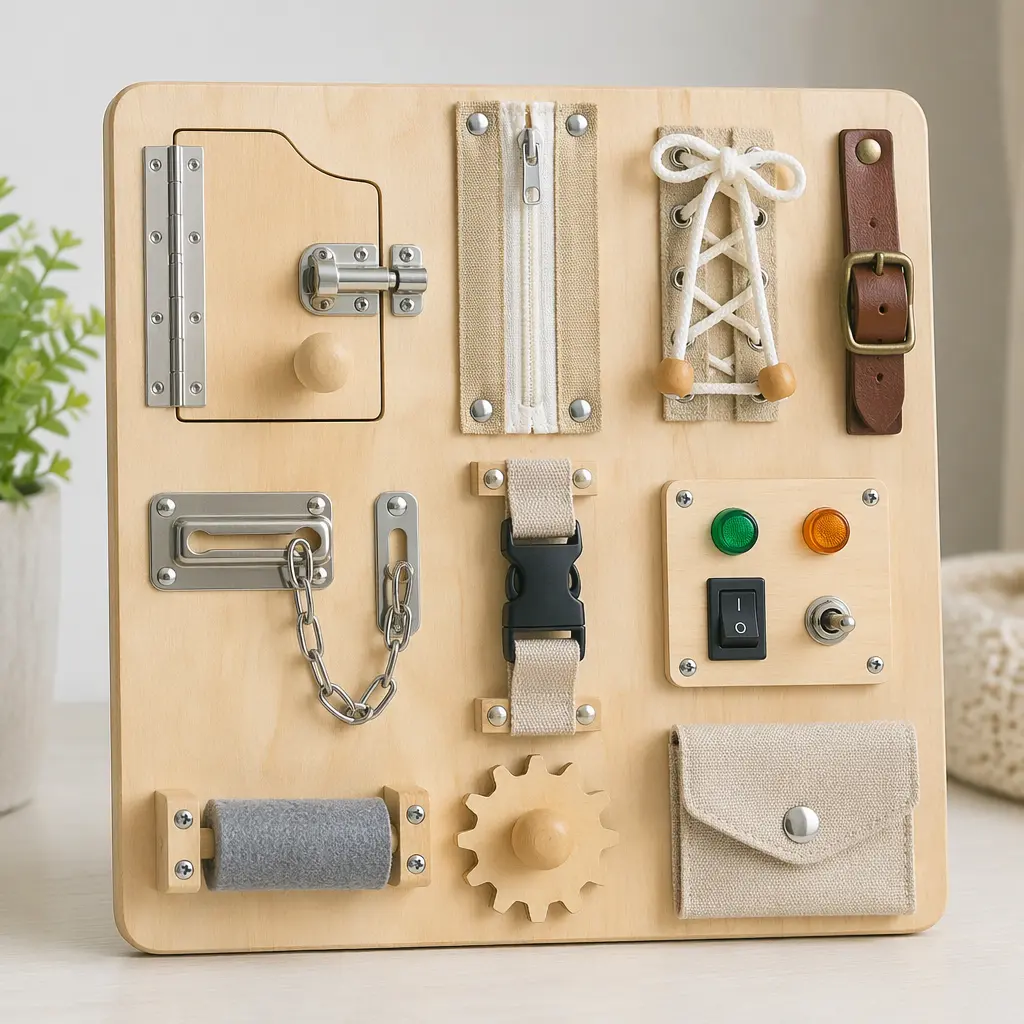
Give a toddler a toy that lights up and plays a song, and they’ll enjoy it—for a while. Hand them a board with a real latch, a zipper, and a light switch, and they may not look up for half an hour. Montessori busy boards have become a quiet staple of modern nurseries because they tap into something toddlers are already desperate to do: copy the real world. Instead of distracting children with spectacle, these boards invite them to practice the motions they see adults perform every day.
Where it came from
Busy boards are rooted in Montessori education, a child-led approach developed in the early 20th century by Italian physician and educator Maria Montessori. Her classrooms emphasized practical life skills—pouring, fastening, opening, and closing—as a foundation for independence and concentration. The original materials were often handmade, using real household objects scaled for small hands.
The modern busy board is a contemporary adaptation of those ideas. As parents noticed toddlers gravitating toward cupboards, keys, and door handles, makers began mounting safe versions of those items onto sturdy boards. Social media and the rise of home-based learning during the past decade helped spread the format, but the core idea hasn’t changed: children learn by doing real things, not by pressing a button and watching something happen.
Why it works
Busy boards work because they respect how toddlers learn. At around one to three years old, children are in a sensitive period for fine motor development and cause-and-effect thinking. A latch that opens when you pull it the right way offers immediate, logical feedback. There’s no script, no right order, and no performance—just repetition and mastery.
Unlike many electronic toys, busy boards don’t tell children what to do next. That open-endedness encourages focus and problem-solving, while the familiar hardware connects play to daily life. Over time, these small successes build confidence and independence.
- Real-world hardware like latches, buckles, and switches
- Clear cause-and-effect without lights or sound cues
- Open-ended play with no fixed outcome
- Supports fine motor control and hand strength
- Encourages concentration and self-directed learning
Who it’s for
Montessori busy boards are typically best suited to toddlers from about 12 months to three years, though many children revisit them beyond that window. Younger toddlers enjoy the sensory exploration, while older ones focus on mastering specific fastenings. There’s also a surprising adult appeal: parents often appreciate a toy that keeps a child engaged quietly and mirrors real-life skills rather than screen-based entertainment.
Variants and what to look for today
Today’s busy boards come in several formats. Classic wall-mounted boards are sturdy and long-lasting, while portable boards and fabric-based versions are designed for travel. Some focus on dressing skills, others on mechanical parts, and many mix both.
When choosing one, materials matter. Solid wood boards with securely fixed hardware tend to age better than thin plastic. Look for smooth edges, firmly attached parts, and finishes appropriate for young children. It’s also worth checking that the board offers a range of difficulty—simple switches alongside trickier latches—so it grows with your child.
Frequently asked questions
Are busy boards really Montessori?
They’re inspired by Montessori principles rather than official classroom materials. A well-made busy board aligns with the philosophy by using real, functional objects and encouraging independent exploration.
Do busy boards replace other toys?
No. They’re best seen as one element of a varied play environment. Busy boards complement pretend play, books, and outdoor activity rather than replacing them.
Are electronic features a problem?
Not necessarily, but many parents choose boards without lights or sounds to keep the focus on hands-on problem solving. Simple battery-free designs are often more durable and calming.
Can you make your own?
DIY busy boards are popular, but they require careful attention to safety. Commercial boards are usually tested for durability and finish, which can offer peace of mind.
Montessori busy boards endure because they don’t chase trends. By turning ordinary objects into tools for discovery, they meet toddlers where they are—curious, capable, and eager to do things for themselves. In a toy world full of noise, their quiet confidence is exactly the point.