Othello: How one flipped disc can change everything
First published in 1971, Othello looks simple but hides deep strategy. With just black-and-white discs and a clean grid, it remains a family game that rewards patience, timing, and foresight.
Compare prices and availability
Check current prices and availability for this guide on eBay.
As an eBay Partner, we may be compensated if you make a purchase.
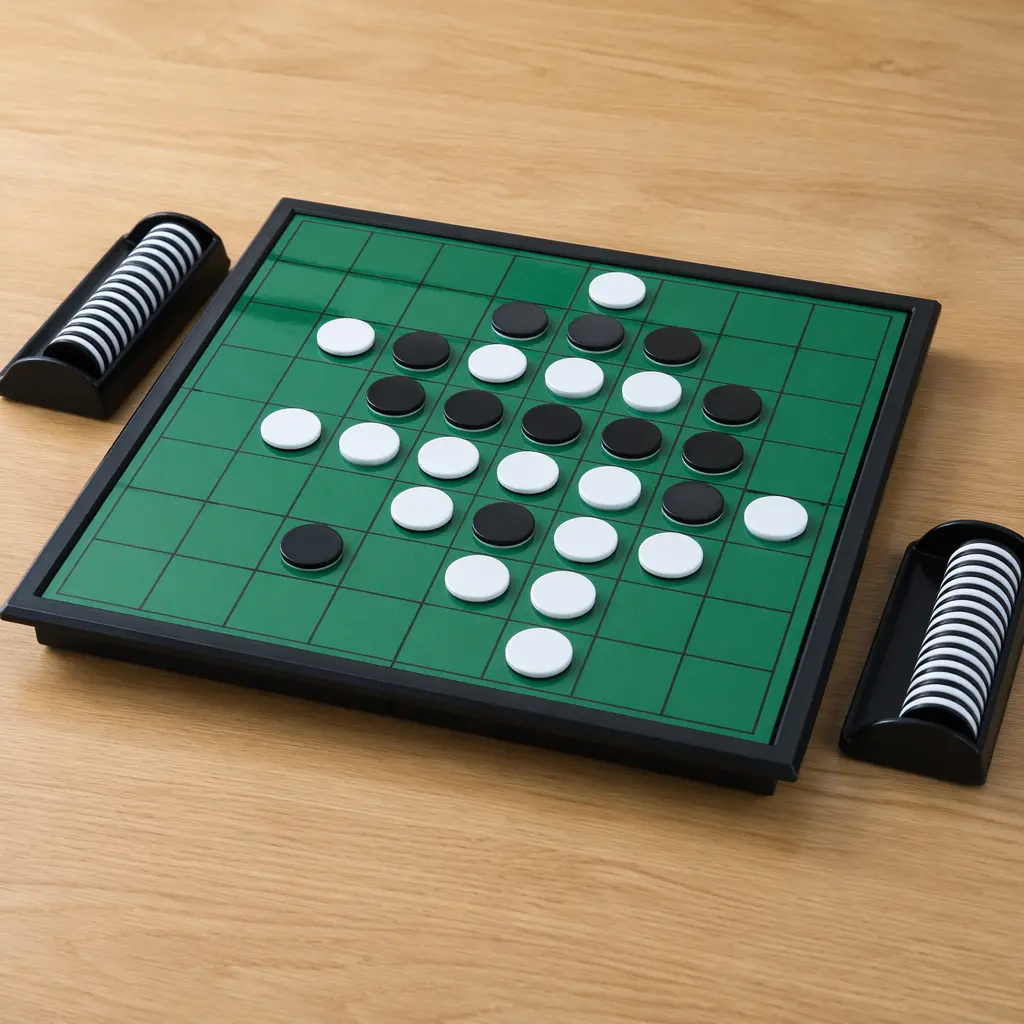
At first glance, Othello barely looks like a challenge. The board is simple. The pieces are identical discs, black on one side and white on the other. Yet one move can suddenly reverse half the board and completely change who’s winning. That tension—between apparent simplicity and genuine depth—is why Othello has stayed relevant for more than 50 years.
Where it came from
Othello was first released in 1971 by Japanese game designer Goro Hasegawa. It was based on an older strategy game known as Reversi, which dates back to 19th-century England. Hasegawa refined the rules, standardized the starting position, and gave the game its dramatic name—borrowed from Shakespeare—to suggest the theme of reversal and betrayal.
The game spread quickly beyond Japan, helped by its compact size and easy-to-learn rules. By the late 1970s and 1980s, Othello was a common sight in family homes, classrooms, and clubs. Unlike many classic board games tied to a specific era, it never felt dated—partly because it avoided heavy themes or components that could go out of style.
Why it works
Othello works because it delivers meaningful decisions from the very first turn. Every move must flip at least one opposing disc, which means you’re always changing the board for both players at once. Early moves that look strong can turn into liabilities later, while quiet, defensive placements can set up a dramatic comeback.
The design strips strategy down to its essentials. There’s no luck once the game begins, no hidden information, and no long rulebook to master. Instead, the challenge comes from timing, spatial awareness, and resisting the urge to grab easy points too soon.
- Reversible discs that make progress visible and satisfying
- A fixed grid that rewards planning ahead
- Rules that take minutes to learn but years to master
- Short playtime that encourages rematches and improvement
Who it's for
Othello is typically suitable for children around 7 or 8 and up, once they’re comfortable thinking a few moves ahead. It works just as well for adults, especially those who enjoy chess, draughts, or other abstract strategy games. Because it’s a two-player game with no reading required, it also appeals to grandparents, teens, and anyone looking for a quiet but competitive shared activity.
Variants and what to look for today
Modern editions of Othello stay close to the original formula. Most use a sturdy folding board with recessed squares to keep discs from sliding. Some versions are travel-sized, while others use larger pieces for easier handling. Digital versions have also helped introduce the game to new audiences, but many fans still prefer the tactile snap of flipping a physical disc.
When buying today, look for solid construction and clearly defined grid spaces. Generic reversible disc games inspired by Othello can vary in quality, so it’s worth avoiding very thin boards or lightweight discs that don’t flip cleanly.
Frequently asked questions
Is Othello the same as Reversi?
They are closely related. Othello is a standardized version of Reversi with a fixed starting position and tournament rules, which helped it gain international recognition.
How long does a game usually take?
Most games last between 10 and 20 minutes, depending on how quickly players make decisions and how competitive the match is.
Is it good for teaching strategy to kids?
Yes. Othello is often used in schools and clubs because it teaches planning, consequence, and pattern recognition without complex rules.
Does going first guarantee a win?
No. While the first move has an advantage at high levels of play, skill and decision-making matter far more in casual games.
Othello endures because it respects the player’s intelligence. It doesn’t rely on flashy components or constant updates to stay interesting. Instead, it trusts that flipping a single disc—at just the right moment—can still feel dramatic, surprising, and deeply satisfying, even after decades of play.