Pictionary: How drawing turned family game night into a show
Since the mid‑1980s, Pictionary has made ordinary players into performers, turning quick sketches, wild guesses, and shared laughter into one of the most enduring party games ever made.
Compare prices and availability
Check current prices and availability for this guide on eBay.
As an eBay Partner, we may be compensated if you make a purchase.
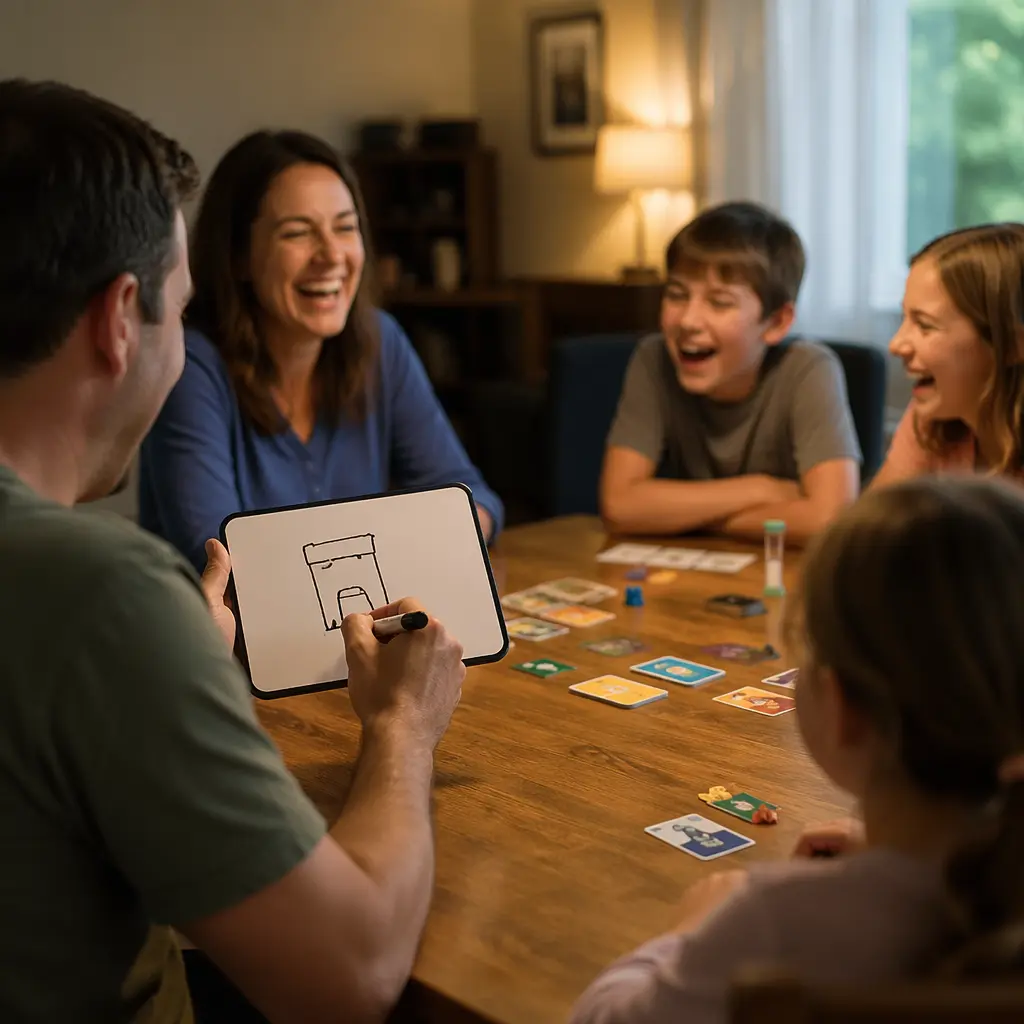
Some games reward strategy. Others reward knowledge. Pictionary rewards bravery. From the moment someone picks up the marker, the game shifts from quiet thinking to full performance, where stick figures, wild gestures, and shouted guesses become the entertainment. That mix of creativity and chaos is why Pictionary has remained a staple of family and party game nights for decades.
Where it came from
Pictionary began in the mid‑1980s, created by Canadian game designer Robert Angel. The original idea was simple: one player draws a word or phrase while their team tries to guess it, all under time pressure. Early versions were handmade and shared among friends before the concept was licensed and produced commercially in 1985.
The timing mattered. Board games in the 1980s were increasingly social and fast‑moving, and Pictionary fit right in. It didn’t require trivia knowledge, acting skills, or complicated rules. If you could hold a marker, you could play. That accessibility helped the game spread quickly from family living rooms to classrooms, offices, and party shelves.
Why it works
At its core, Pictionary works because it turns communication into a shared problem. Drawing strips language down to its basics, forcing players to think visually and guess boldly. The result is a game that produces laughter even when nobody is winning.
Unlike many competitive games, the fun in Pictionary isn’t tied to skill. In fact, bad drawings often make the experience better. The pressure of the timer adds urgency, while the team format keeps everyone involved, even when it’s not their turn to draw.
- Simple rules that can be explained in minutes
- Team‑based play that encourages shouting and collaboration
- No artistic skill required—stick figures are enough
- A built‑in time limit that keeps rounds fast and lively
Who it's for
Pictionary is usually labeled as a family game, but its real strength is flexibility. Children can play using easier word sets, while teens and adults enjoy the absurdity of harder prompts. It also works well for mixed‑age groups, since guessing and laughing together matters more than winning. Adults often rediscover it later as a party game, where confidence and quick thinking matter more than neat drawings.
Variants and what to look for today
Over the years, Pictionary has appeared in many forms, from travel‑sized sets to versions designed for younger players. Modern editions often streamline components, replacing boards with pads or erasable surfaces and adjusting word lists to feel more contemporary.
When looking for a version today, focus less on branding and more on how you plan to play. Families may appreciate editions with age‑graded word cards, while frequent hosts might prefer sturdier components that stand up to repeated use. As with many popular games, generic drawing‑and‑guessing knock‑offs exist, but they can suffer from unclear rules or poorly balanced word lists.
Frequently asked questions
Do you need to be good at drawing to play?
Not at all. Pictionary is designed so that simple shapes and symbols work just as well as detailed drawings. In many groups, the least artistic players become the most entertaining.
How many people does it work best with?
The game scales well, but it shines with two teams of at least two players each. Larger groups can rotate drawers or form bigger teams for a louder, more chaotic experience.
Is it suitable for classrooms or work events?
Yes, with the right word selection. Many educators and facilitators use drawing games to encourage teamwork and creative thinking, especially when prompts are adjusted for the audience.
Does it still hold up compared to modern party games?
It does, largely because its core mechanic is timeless. While newer games add apps or elaborate components, Pictionary relies on human imagination, which hasn’t gone out of style.
Decades after its debut, Pictionary remains a reminder that games don’t need complexity to create memorable moments. A marker, a timer, and a willingness to look a little silly are enough to turn an ordinary evening into a shared performance—and that’s a formula that rarely ages.