Pikler Triangle Climbing Sets: How a 100-year idea climbed indoors
Pikler triangle climbing sets bring a century-old child‑led philosophy into modern homes, offering open-ended climbing, balance and confidence-building play that grows with kids.
Compare prices and availability
Check current prices and availability for this guide on eBay.
As an eBay Partner, we may be compensated if you make a purchase.
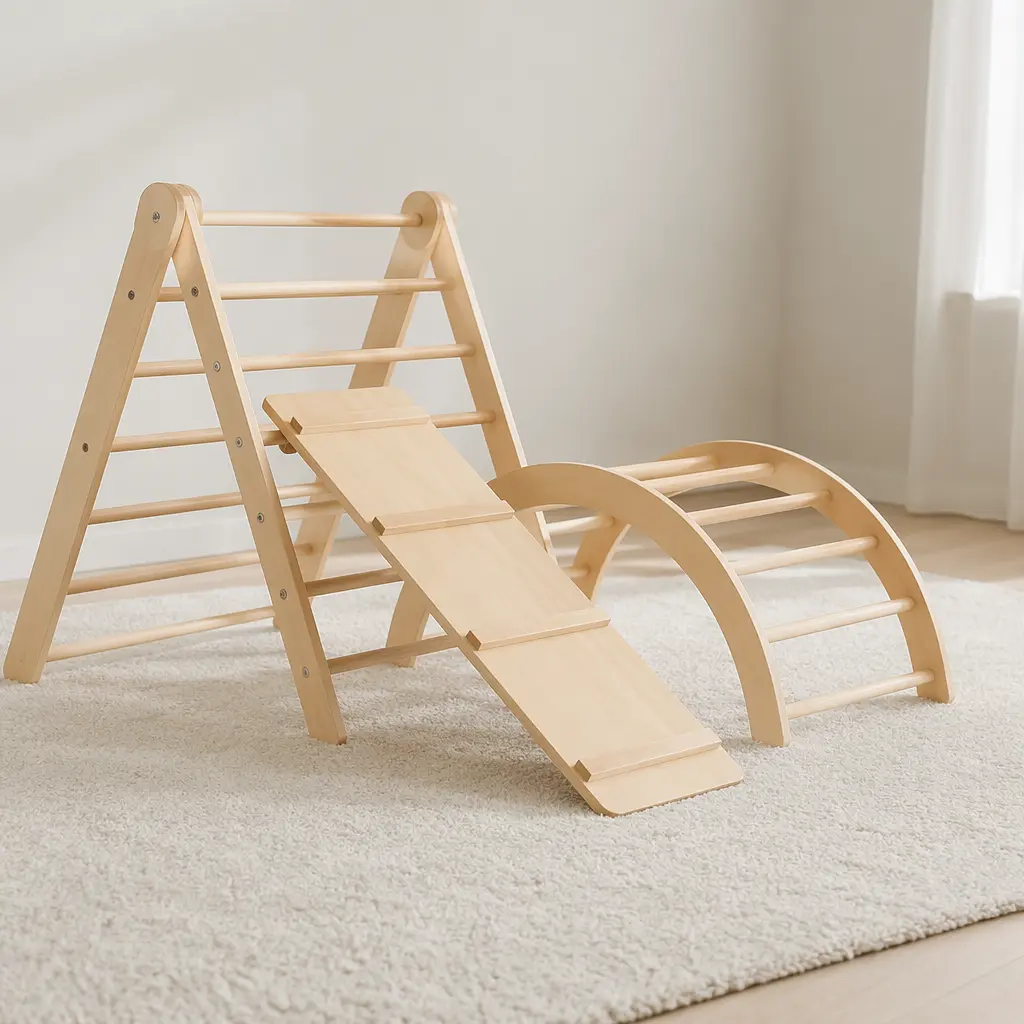
At first glance, a Pikler triangle looks almost too simple to be a modern hit: a wooden triangle, a few rungs, maybe a ramp. Yet this unassuming climbing frame has become a staple in contemporary playrooms. Its appeal isn’t about flash or features—it’s about trusting children to move, explore and build confidence at their own pace.
Where it came from
The Pikler triangle traces back to Dr. Emmi Pikler, a Hungarian pediatrician working in the early 20th century. Her approach challenged common assumptions about child development. Rather than positioning babies or directing their movements, Pikler encouraged adults to provide a safe environment and let children discover movement on their own.
The climbing triangle emerged as a practical tool within this philosophy. Designed to support self-initiated movement—pulling up, climbing, turning, and eventually descending—it wasn’t meant as a toy in the conventional sense. It was equipment for learning how a body works. Decades later, parents seeking Montessori- and Pikler-inspired homes have rediscovered it, adapting the idea for modern interiors.
Why it works
The effectiveness of a Pikler triangle lies in what it doesn’t do. There are no lights, sounds or instructions. Children decide when and how to engage, repeating movements until they master them. This repetition builds strength and coordination, but also patience and self-trust.
Because the structure is open-ended, play evolves over time. A toddler may crawl under or pull up on the rungs. An older child might climb, flip the ramp into a slide, or turn the triangle into a fort or obstacle course. The toy grows with the child rather than being outgrown quickly.
- Child-led movement with no prescribed ‘right’ way to play
- Supports balance, coordination and core strength
- Simple wooden design that blends into home spaces
- Adaptable play as children develop new skills
Who it’s for
Pikler triangle sets are typically used from around 6–12 months, once a child is confidently pulling up, through the preschool years. They’re equally appealing to parents who value quiet, purposeful play and minimal clutter. While designed for young children, many adults appreciate the philosophy behind them—and the fact that they don’t feel like a typical plastic play structure dominating the room.
Variants and what to look for today
Today’s Pikler-inspired sets often expand beyond the original triangle. Many include add-ons like ramps that double as slides, arches that can be flipped into rockers, or modular pieces that connect in different ways. These variations keep the core idea intact while adding flexibility for different spaces and ages.
When shopping, materials and construction matter more than extras. Look for solid wood, smooth finishes, and sturdy joints. Adjustable or foldable designs can be useful for smaller homes. Be cautious of poorly made knock-offs that compromise stability or use rough finishes—these undermine the very safety and confidence the design is meant to support.
Frequently asked questions
Is a Pikler triangle the same as Montessori equipment?
They’re closely related. While the triangle comes from Pikler’s work, both philosophies emphasize independence, respect for the child, and learning through self-directed activity.
How much space do you need?
A clear area of a few square metres is usually enough. Many families keep the triangle out daily, treating it like a piece of furniture rather than a temporary toy.
Can it be used outdoors?
Some wooden sets can be used outside occasionally, but most are designed for indoor use. Moisture and weather can shorten the life of untreated wood.
When should a child stop using it?
There’s no fixed cutoff. Many children naturally move on as their interests change, while others keep using it imaginatively well into the early school years.
The enduring popularity of Pikler triangle climbing sets isn’t about trends—it’s about trust. By giving children a simple, sturdy structure and the freedom to explore, these sets turn everyday movement into meaningful play, just as their creator intended a century ago.