The PlaySkool Busy Box: How cause and effect became play
First sold in the 1960s, the PlaySkool Busy Box turned latches, doors, and switches into a lesson on cause and effect. Its simple design shows why tactile baby toys still matter.
Compare prices and availability
Check current prices and availability for this guide on eBay.
As an eBay Partner, we may be compensated if you make a purchase.
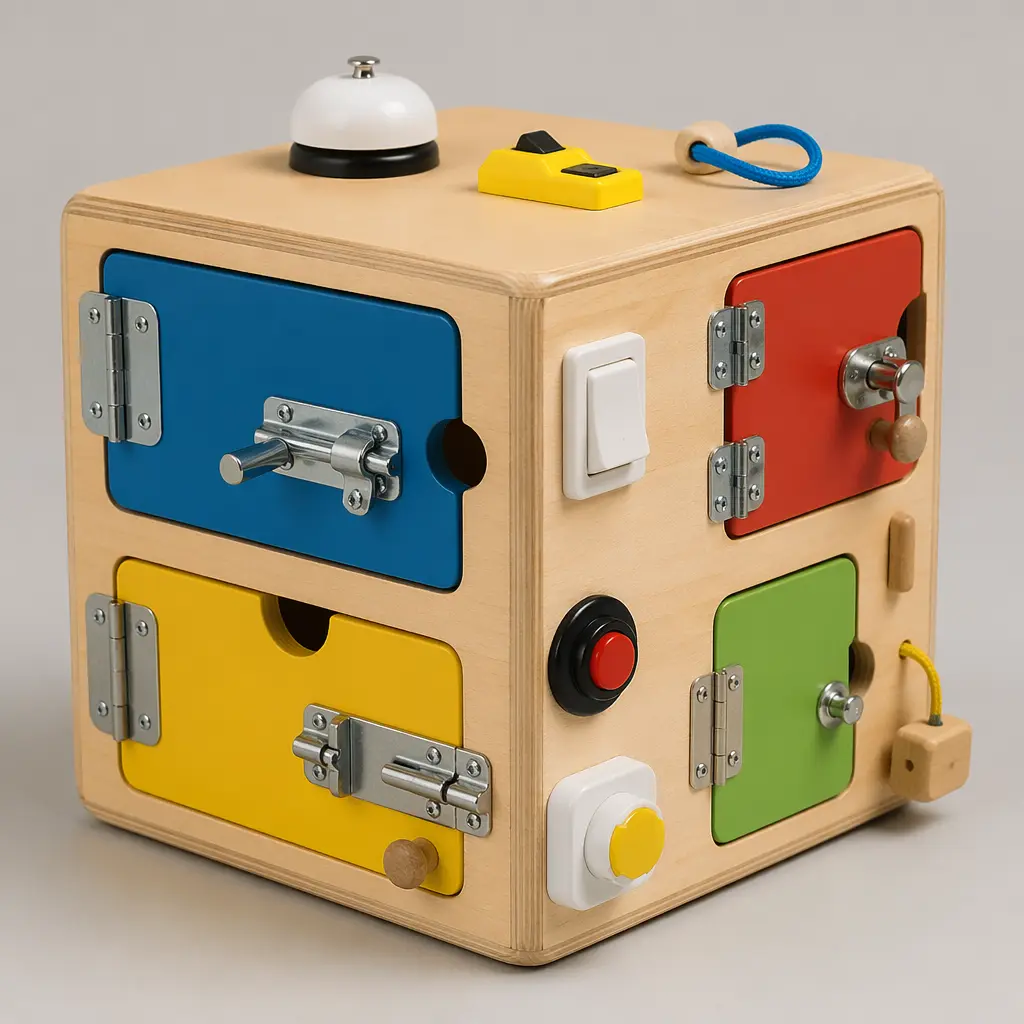
At first glance, the PlaySkool Busy Box looks almost too simple to be important. It’s just a box with doors to open, latches to flip, and switches to toggle. But for generations of babies and toddlers, that box has been a first lesson in how the world works. Push this, something happens. Open that, something is revealed. The Busy Box didn’t just entertain young children — it quietly taught them cause and effect at a moment when their brains were primed to learn it.
Where it came from
The Busy Box emerged in the mid-1960s, a period when toy makers were beginning to take early childhood development more seriously. PlaySkool, already known for preschool-focused toys, introduced the Busy Box in 1965 as a hands-on learning tool for very young children. Instead of flashing lights or characters, it focused on everyday mechanisms: doors, locks, hinges, and switches.
The idea was inspired by a familiar observation: babies love household objects more than their own toys. Cupboard doors, light switches, and mailboxes were irresistible. The Busy Box brought those real-world interactions into a safe, child-sized format. It was designed less as a game to be “won” and more as an exploration tool, something a child could return to again and again.
Why it works
The genius of the Busy Box lies in its restraint. Each side offers a small problem to solve, and the solution is immediate and visible. A latch opens a door. A switch flips. A knob turns. There’s no wrong way to play, and no instructions are needed. That kind of open-ended interaction is especially powerful for infants and toddlers, who learn best through repetition and sensory feedback.
Because the actions are physical and slightly challenging, the Busy Box also builds fine motor skills and hand–eye coordination. It rewards persistence without overstimulation. Key design features include:
- Realistic mechanisms like latches, hinges, and switches
- Multiple sides offering varied challenges
- Durable construction meant for repeated handling
- Clear cause-and-effect responses to every action
Who it's for
The Busy Box is aimed squarely at babies and young toddlers, typically from around 9 months to 2 years. That’s the stage when children are learning that their actions can change their environment. It’s also a toy adults tend to appreciate. Parents and grandparents often recognise the value of a calm, absorbing toy that doesn’t rely on batteries or screens, and many remember playing with a Busy Box themselves.
Variants and what to look for today
Over the years, the Busy Box concept has been reinterpreted many times. Some versions stick closely to the original cube shape with simple hardware. Others expand into larger activity houses or boards with added textures and sounds. Modern materials often replace metal with chunky plastic, and some designs include lights or soft sounds.
When looking for a Busy Box-style toy today, focus on build quality and age-appropriate complexity. Doors and latches should move smoothly but not too easily, and all parts should be securely attached. Be cautious of very cheap knock-offs that use flimsy hardware or small components. The best versions still prioritise tactile realism over novelty.
Frequently asked questions
Is the Busy Box still relevant in a world of electronic toys?
Yes. Many child development experts argue that simple, mechanical toys like the Busy Box offer learning benefits that electronic toys can’t replicate. The focus stays on physical interaction and problem-solving rather than passive stimulation.
What skills does a Busy Box help develop?
Busy Boxes support fine motor skills, hand–eye coordination, concentration, and an early understanding of cause and effect. They also encourage independent play.
Are vintage Busy Boxes safe to use?
Vintage versions can be safe if they’re in good condition, but they should be carefully checked for sharp edges, worn parts, or outdated materials. When in doubt, modern reproductions may be a safer choice.
How long will a child stay interested in it?
Interest often comes in waves. A child may explore one feature intensely for a period, move on, and then rediscover the toy weeks later. That return value is part of its appeal.
More than half a century after its introduction, the PlaySkool Busy Box remains a quiet success story. It proves that you don’t need characters, screens, or complexity to capture a child’s attention. Sometimes, a well-made box and a few moving parts are enough to open the door to learning.