Spirograph: The drawing toy that turned maths into art
Invented in the 1960s, Spirograph turned simple gears and pens into looping artwork. Here’s how it works, why it endured, and what to look for if you want one today.
Compare prices and availability
Check current prices and availability for this guide on eBay.
As an eBay Partner, we may be compensated if you make a purchase.
Spirograph is one of those rare toys that feels quietly clever. At first glance it’s just plastic rings and wheels, but set a pen in motion and it produces looping, lace-like drawings that look far more complex than the effort required. Part art kit, part maths lesson, Spirograph has spent decades surprising children — and plenty of adults — with what a simple mechanism can do.
Where it came from
Spirograph was introduced in 1965, developed by British engineer Denys Fisher and later popularised through a partnership with a major American toy company. Fisher was inspired by the mathematical curves known as hypotrochoids and epitrochoids — the paths traced by a point attached to a rolling circle — and wondered whether they could be turned into something playful.
The original idea was not about teaching maths, but about discovery. Children could experiment with different gear combinations and pen positions and see what happened. The toy arrived at a moment when hands-on, creative play was gaining traction, and its blend of precision and freedom struck a chord. Within a few years, Spirograph sets were a familiar sight in homes and classrooms.
Why it works
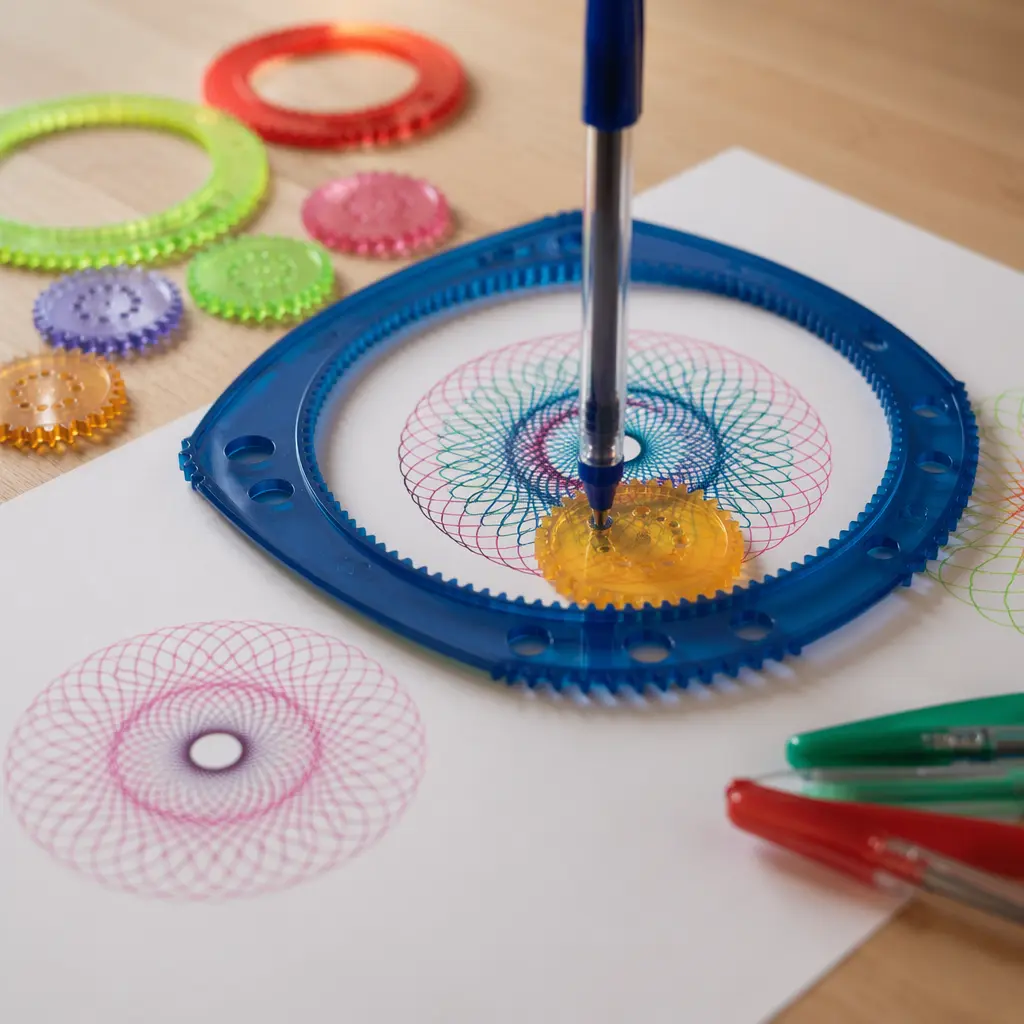
At the heart of Spirograph is a beautifully simple system: a toothed wheel rolls inside or around a ring, carrying a pen as it goes. Because the teeth control the motion, the pen never slips, and the resulting lines are smooth, repeatable, and surprisingly elegant. You don’t need to know the maths to enjoy the outcome, but the logic is always there beneath the surface.
- Mechanical precision that guarantees clean, continuous lines
- Open-ended play with thousands of possible patterns
- A balance of control and creativity — mistakes are rare, experimentation is encouraged
- Immediate visual reward that keeps attention focused
Unlike freehand drawing, Spirograph removes the fear of ‘getting it wrong’. That’s a big part of its appeal. Children can concentrate on colour choices and pattern layering, while adults often find the repetitive motion calming, almost meditative.
Who it’s for
Spirograph is typically aimed at children around five and up, once they have the fine motor control to hold a pen steady and follow a groove. That said, its appeal stretches well beyond childhood. Teenagers use it for design experiments, teachers use it to illustrate geometry, and adults rediscover it as a low-pressure creative outlet. It’s one of those toys that doesn’t talk down to its audience.
Variants and what to look for today
Modern Spirograph sets stay close to the original concept, but vary in size, materials, and extras. Some focus on portability with compact cases, while others add more gears or specialised shapes to increase pattern variety. You’ll also see versions that include coloured pens, markers, or even paper guides.
When choosing a set today, it’s worth checking that the gears fit snugly and don’t slip — loose tolerances can spoil the experience. Thicker plastic tends to last longer, especially if the set will be shared between siblings or used in a classroom. Generic imitations exist, but the best sets maintain crisp teeth and smooth edges, which make a noticeable difference in use.
Frequently asked questions
Is Spirograph educational or just for fun?
It’s both. While children experience it primarily as an art toy, it naturally introduces ideas about symmetry, ratios, and repetition. Many schools use it to make abstract maths concepts more tangible.
Does it require batteries or screens?
No. Spirograph is entirely manual. That simplicity is part of its lasting appeal, offering focused, screen-free play that doesn’t rely on power or updates.
Can younger children use it?
Younger children can enjoy it with help, but they may find keeping the gears in place tricky. For under-fives, supervision and patience are key.
Why do the patterns always close neatly?
Because the gear teeth are evenly spaced, the rolling motion eventually returns the pen to its starting point. That built-in order is what creates the satisfying, complete designs.
More than half a century on, Spirograph still feels fresh. It doesn’t chase trends or technology; it simply does one thing very well. In a world of noisy toys and fleeting apps, its quiet combination of logic and beauty continues to earn a place at the table.