Brain Flakes: The rise of a simple open-ended building toy
Brain Flakes turned lightweight interlocking discs into a flexible building system that rewards experimentation, quiet focus, and open-ended creativity for kids and adults alike.
Compare prices and availability
Check current prices and availability for this guide on eBay.
As an eBay Partner, we may be compensated if you make a purchase.
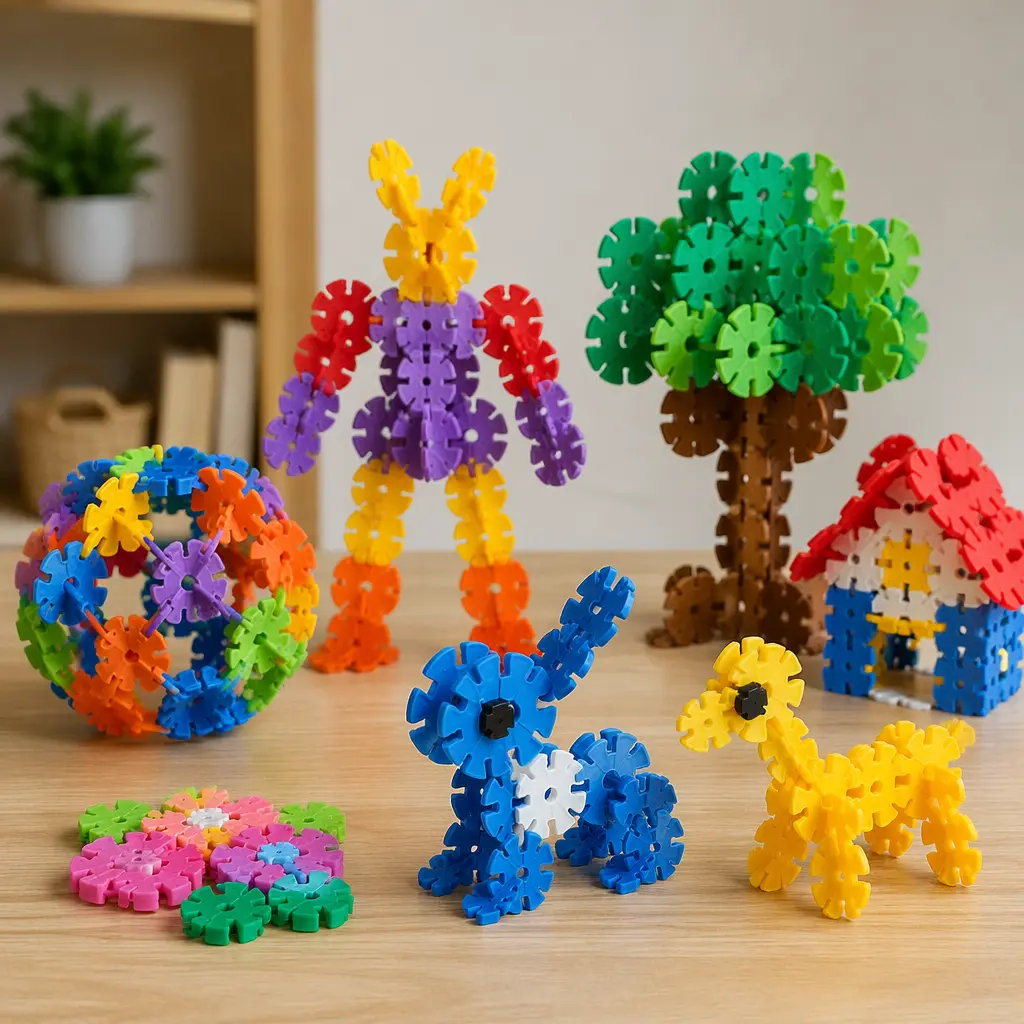
Brain Flakes arrived during a period when many construction toys were becoming more specialized, screen-connected, or tied to entertainment brands. The appeal of these small interlocking discs went in the opposite direction. They are simple, lightweight, and intentionally open-ended. A child can snap together a flat mosaic, a rolling ball, a wearable bracelet, or a surprisingly sturdy creature using the same handful of pieces. That flexibility helped Brain Flakes become a quiet success in homes, classrooms, and therapy settings where creative play mattered more than following instructions.
Where it came from
Brain Flakes appeared in the mid-2010s as part of a broader wave of STEM-oriented toys that emphasized experimentation over scripted play. Introduced around 2014, the toy family centered on a very old idea: repeated shapes that connect in many directions. Instead of bricks or magnetic tiles, Brain Flakes used thin plastic discs with evenly spaced slots that could slide together from multiple angles.
The concept was not entirely new. Interlocking disc toys have existed in different forms for decades, often in classrooms and educational supply catalogs. What helped Brain Flakes stand out was accessibility. Large tubs packed with hundreds of pieces encouraged free building immediately, without sorting complicated parts or learning a system. Teachers and parents also noticed that the discs supported spatial reasoning and fine motor practice while still feeling playful rather than academic.
Why it works
The design succeeds because the pieces are simple enough to understand instantly but flexible enough to reward experimentation. Every disc is roughly the same size and shape, which removes the pressure of hunting for the “correct” piece. Builders can focus on patterns, balance, symmetry, and structure instead. The discs also connect loosely enough for younger children to manipulate them without excessive force.
Unlike construction systems built around exact replicas or rigid instructions, Brain Flakes encourage improvisation. Children often discover techniques accidentally: curved structures emerge from angled connections, and layered discs create surprisingly strong shapes. The lightweight pieces also make large builds practical without requiring a huge play area.
- Uniform disc pieces simplify building and cleanup
- Multiple connection points allow flexible shapes and movement
- Bright colors encourage pattern-making and sorting
- Lightweight plastic supports large creations without heavy structures
- Open-ended play works for solo building or group activities
Who it's for
Brain Flakes are generally aimed at children old enough to handle smaller plastic pieces safely, though the building style scales well across age groups. Younger kids tend to enjoy stacking, sorting, and making simple shapes, while older children often move into geometric designs, vehicles, and sculptures. Adults sometimes use them as desk toys or casual creative tools because the repetitive snapping motion can be relaxing and tactile. The toy also gained popularity in classrooms, occupational therapy spaces, and after-school programs where cooperative building and fine motor development are useful.
Variants and what to look for today
Modern Brain Flakes-style sets are available in many sizes, from travel-friendly containers to large classroom tubs with thousands of pieces. Some sets include wheels, axles, storage cases, or idea booklets, though the core experience remains centered on the interchangeable discs themselves. Transparent and pastel color mixes have also become common alongside the original bright rainbow palette.
When shopping today, it is worth paying attention to plastic quality and connection consistency. Well-made discs snap together firmly without cracking or bending excessively. Very cheap alternatives sometimes use brittle plastic or uneven molding that makes building frustrating. Storage matters too. Since the pieces are small and numerous, sturdy containers can make cleanup much easier for families and classrooms.
- Large tubs work well for collaborative building
- Smaller travel sets are easier for car rides and waiting rooms
- Look for smooth edges and flexible but durable plastic
- Idea guides can help hesitant builders get started
- Avoid poorly molded pieces that separate too easily
Frequently asked questions
Are Brain Flakes educational?
They are often used in educational settings because they encourage spatial reasoning, pattern recognition, problem-solving, and fine motor coordination. Most children simply experience them as a creative building toy first.
Do you have to follow instructions?
No. Many sets include idea booklets, but the toy is designed around freeform construction. The same pieces can become flat mosaics, wearable items, moving structures, or abstract sculptures.
How durable are the pieces?
Quality sets hold up well to repeated snapping and pulling apart. Over time, heavy use can loosen some connections, especially in lower-quality versions, but the simple design generally ages better than toys with hinges or electronics.
Why do adults like them too?
The repetitive building process has a calm, hands-on quality that many adults enjoy. Some use the discs for casual creative breaks, classroom demonstrations, or collaborative office activities.
Brain Flakes succeeded by making construction play feel approachable again. There are no batteries, character tie-ins, or complicated systems to learn. Just a pile of colorful discs that can become almost anything with enough experimentation. In an era crowded with highly programmed toys, that simplicity turned out to be a lasting advantage.