Chinese Checkers: How a simple board became a family staple
Chinese Checkers looks simple, but its hop-based play and social board design helped it spread from Europe to living rooms worldwide—and keep families playing for generations.
Compare prices and availability
Check current prices and availability for this guide on eBay.
As an eBay Partner, we may be compensated if you make a purchase.
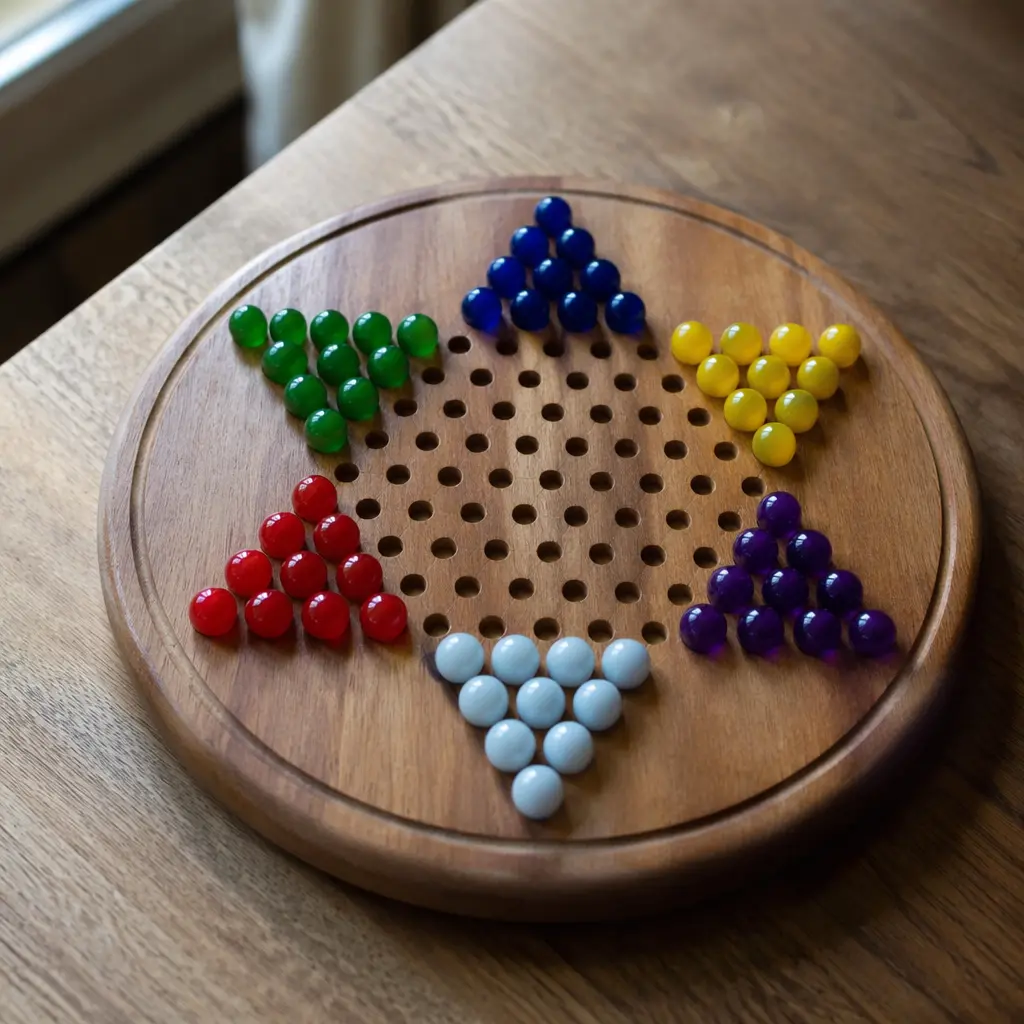
At first glance, Chinese Checkers barely looks like a strategy game at all. There’s no dice, no cards, and no obvious conflict—just a star-shaped board and a handful of brightly coloured marbles. And yet, for more than a century, this quiet little game has managed to cross borders, generations, and cultures, becoming a familiar sight in family cupboards around the world.
Its appeal lies in a clever contradiction. Chinese Checkers is easy enough for young children to grasp in minutes, but open-ended enough to reward planning, patience, and a bit of social intuition. It’s the kind of game grandparents can teach without a rulebook, and one that still feels satisfying to pull out on a rainy afternoon.
Where it came from
Despite its name, Chinese Checkers did not originate in China. The game traces its roots to Europe in the early 20th century, where it evolved from an older strategy game sometimes known as Halma. The star-shaped board and marble-based movement were refinements intended to make the game more accessible and visually appealing.
When the game spread internationally, a more exotic-sounding name helped it stand out in shops, particularly in English-speaking countries. Over time, the name stuck, even as the game itself became untethered from any specific culture. What mattered most was that it was portable, durable, and simple enough to play almost anywhere.
Why it works
Chinese Checkers works because it strips strategy down to its essentials. Every player starts in a corner of the star and aims to move all their pieces to the opposite point. On your turn, you can slide a marble into an adjacent space or hop over other marbles in a chain. That’s it—but those hops can stack into surprisingly clever moves.
The game encourages forward thinking without punishing mistakes too harshly. There’s no direct capturing, so competition feels friendly rather than cutthroat. At the same time, shared spaces mean players are constantly influencing each other’s options, whether they realise it or not.
- Simple rules that can be taught in minutes
- Bright, tactile marbles that invite hands-on play
- Flexible player counts, from two up to six
- Strategic depth that emerges naturally over time
Who it’s for
Chinese Checkers is often recommended for children around age six and up, largely because younger players need a bit of patience and fine motor control. That said, adults frequently rediscover the game with fresh appreciation. It’s calm, social, and low-pressure—ideal for mixed-age groups where not everyone wants an intense competition.
For adults, the appeal is often nostalgic. For kids, it’s colourful and physical. For families, it sits comfortably in the middle as a game everyone can enjoy without adjusting rules or handicaps.
Variants and what to look for today
Modern Chinese Checkers sets haven’t changed much—and that’s part of the charm. You’ll still find the classic six-point star board, usually made from wood or sturdy plastic, with marbles in six distinct colours. Some sets are larger, designed to stay on a coffee table, while others fold up for travel.
When choosing a set today, focus on build quality rather than novelty. Boards with shallow wells can make marbles slip too easily, and very lightweight plastic can feel flimsy. The best sets feel solid, with smooth grooves and marbles that roll cleanly without sticking.
Frequently asked questions
Is Chinese Checkers hard to learn?
Not at all. Most players understand the basics after one or two turns. Mastery comes later, as players learn how to chain hops and anticipate opponents’ moves.
How many people can play?
The standard board supports two to six players. With fewer players, some points of the star are left empty, which slightly changes the flow but keeps the game balanced.
How long does a game usually take?
A typical game lasts around 20 to 40 minutes, depending on the number of players and how much time is spent planning moves.
Is the name culturally accurate?
Despite the name, the game is not Chinese in origin. The title is a historical marketing choice rather than a reflection of where the game was invented.
Chinese Checkers endures because it doesn’t try to be more than it is. It’s a friendly race across a shared space, dressed up in colour and symmetry. In a world of increasingly complex games, its simplicity feels refreshing—and that may be why it keeps finding its way back onto the table.