The Hobby Horse: Why riding pretend has lasted for centuries
A stick, a horse’s head, and a lot of imagination. The hobby horse is one of childhood’s oldest toys—and it still works because it turns movement into make-believe.
Compare prices and availability
Check current prices and availability for this guide on eBay.
As an eBay Partner, we may be compensated if you make a purchase.
Few toys are as instantly understandable as the hobby horse. Hand a child a stick with a hint of a horse’s head and they know exactly what to do: run, ride, and imagine. There are no rules to learn and no batteries to charge. It’s play reduced to its essentials—movement, rhythm, and story—and that simplicity is why the hobby horse keeps showing up in childhood, generation after generation.
Where it came from
The hobby horse predates modern toy manufacturing by centuries. Versions appear in medieval Europe as both children’s playthings and folk-dance props, often called "hobby horses" or "stick horses." At its most basic, it was a branch or pole—sometimes with a carved or sewn head—used to mimic the most important form of transport of the time.
As real horses shaped daily life, children naturally copied what they saw. Riding pretend wasn’t just fantasy; it was rehearsal. Over time, the toy shifted from handmade household object to something produced by craftsmen and, later, factories. But the core idea never changed: give children a way to embody motion and adventure using their own bodies.
Why it works
The hobby horse succeeds because it invites active play. Unlike toys that keep kids still, it encourages running, jumping, and balance. It also leaves plenty of room for imagination. There’s no fixed storyline, no right way to play, and no endpoint. One day it’s a racehorse, the next a trusty companion on a long journey.
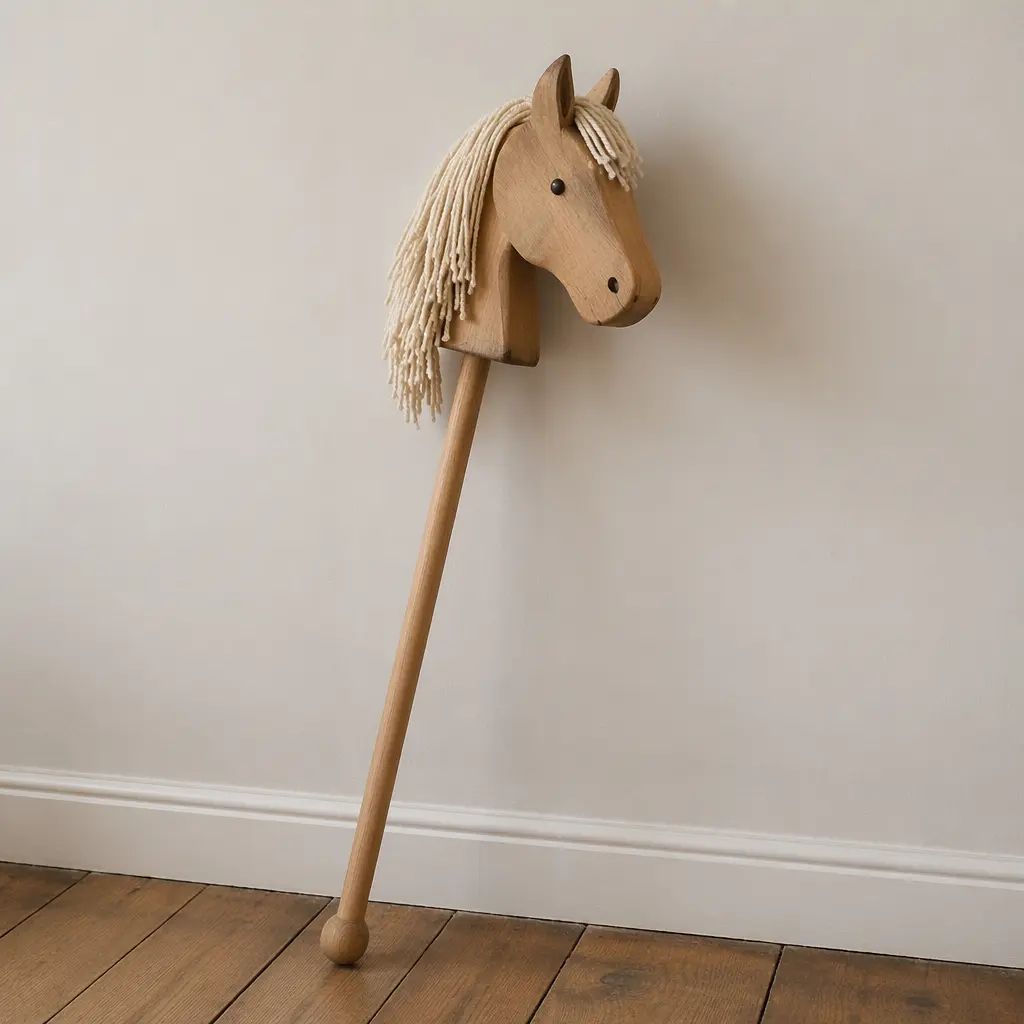
Design-wise, it’s a masterclass in doing more with less. A few visual cues are enough to unlock a whole world. Standout features include:
- A long stick or pole that naturally fits a child’s stride
- A lightweight head that suggests a horse without over-detailing
- A mane or reins that add texture and something to hold
- Durable materials that can survive energetic indoor and outdoor play
Who it's for
Hobby horses are typically aimed at preschool and early primary-age children, when imaginative and physical play peak. That said, their appeal doesn’t end there. Older kids often incorporate them into games, performances, or even organised hobby-horsing activities. Adults, meanwhile, tend to appreciate them as nostalgic objects—sometimes as decor, sometimes as heirloom toys passed down through families.
Variants and what to look for today
Modern hobby horses range from very traditional to surprisingly contemporary. You’ll find classic wooden versions with painted details, soft plush heads designed for younger children, and minimalist fabric styles that echo Scandinavian design. Some are deliberately plain, trusting kids to fill in the gaps.
When choosing one today, focus on build quality rather than decoration. The stick should be smooth and sturdy, the head securely attached, and any fabric elements firmly sewn. Be cautious with very cheap versions where parts can loosen quickly. The best hobby horses are the ones that feel ready for years of galloping, not just a quick novelty.
Frequently asked questions
Is a hobby horse safe for indoor play?
Generally yes, provided there’s space to move and the toy is well made. Clear fragile objects out of the way and supervise younger children, especially on hard floors.
What age is a hobby horse best for?
Most children start enjoying hobby horses around age two or three, when they can walk confidently and engage in pretend play. Interest often lasts well into early school years.
Do kids get bored of such a simple toy?
Simplicity is actually the strength. Because there’s no fixed function, the toy adapts to a child’s changing imagination rather than being outgrown quickly.
Are plush or wooden hobby horses better?
Neither is inherently better. Plush styles suit younger children and indoor play, while wooden versions often appeal to older kids and stand up well outdoors.
In a world of flashing lights and programmed responses, the hobby horse feels almost radical. It asks children to supply the action and the story themselves. That invitation—to move, to imagine, to become something else for a while—is why this humble toy has never really gone away.