K’NEX: The living‑room lab that made engineering click
Since the early 1990s, K’NEX has turned bright plastic rods into hands‑on lessons in forces, motion, and structure—inviting kids and adults to build, test, and rebuild real engineering ideas at home.
Compare prices and availability
Check current prices and availability for this guide on eBay.
As an eBay Partner, we may be compensated if you make a purchase.
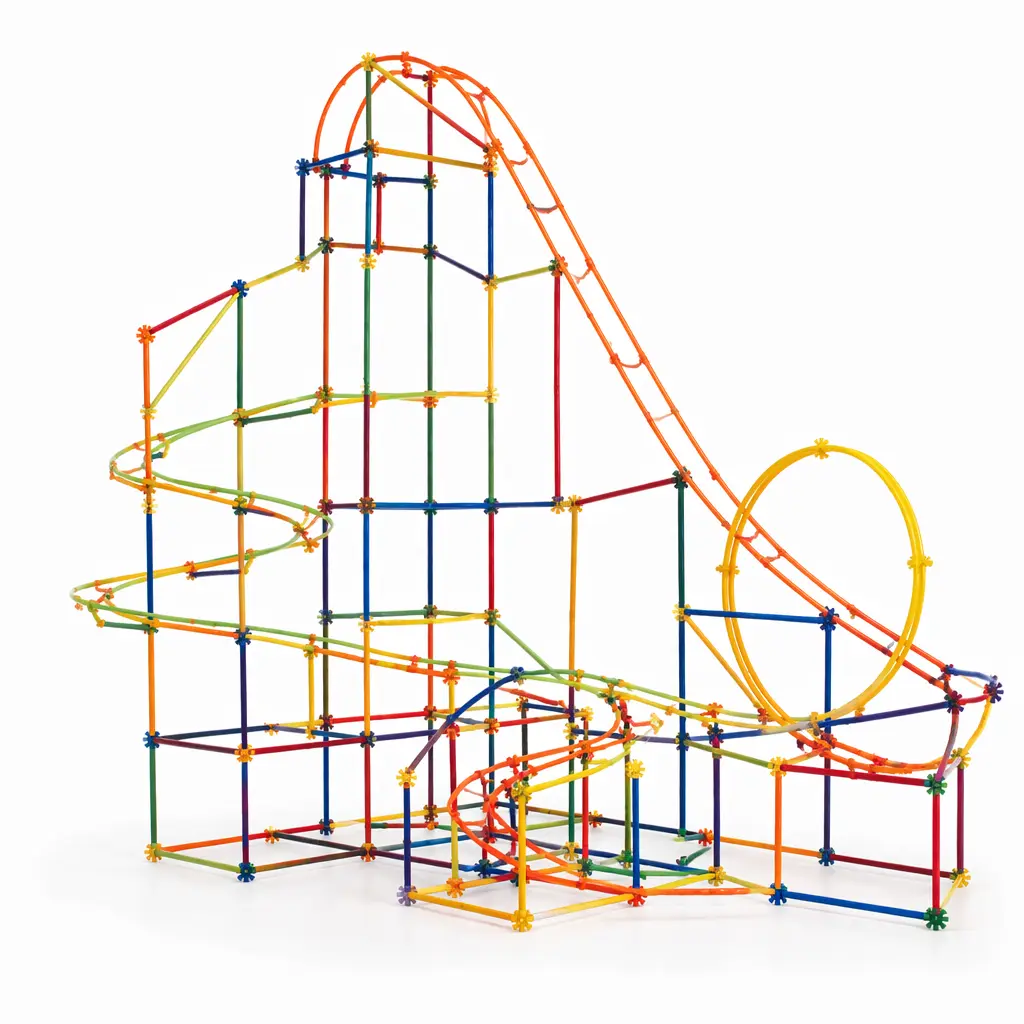
K’NEX sits in that sweet spot between toy and tool. To a child, it’s a box of bright sticks and connectors that can become a tower, a crane, or a looping coaster. To a parent—or an engineer—it’s a hands‑on way to see physics come alive on the living‑room floor. Few construction toys have leaned so openly into real‑world engineering principles while still feeling playful, flexible, and open‑ended.
Where it came from
K’NEX was introduced in 1992 by inventor Joel Glickman in the United States. The origin story is famously modest: the idea reportedly came from noticing how drinking straws could snap together and form sturdy shapes. Glickman developed a system of plastic rods and connectors that locked at fixed angles, allowing builders to create rigid, load‑bearing structures rather than loose stacks.
From the start, K’NEX positioned itself a little differently from other building toys. It wasn’t about bricks or miniatures; it was about frameworks. Early sets emphasized bridges, towers, and mechanical builds, and classrooms quickly noticed. The toy found a second life as an educational tool, used to demonstrate geometry, tension, compression, and later, motion and energy through gears and tracks.
Why it works
At the heart of K’NEX is a simple but powerful idea: rods handle the length, connectors handle the angles. This division makes structural thinking intuitive. If something wobbles, you add a brace. If it sags, you shorten a span or change the geometry. Builders quickly learn by doing, and failure is part of the fun—collapse just means redesign.
The system also scales well. Small builds teach balance and shape, while larger projects—like roller coasters—introduce momentum, gravity, and sequencing. That flexibility is why K’NEX has stayed relevant across decades.
- Interlocking rods and connectors that create rigid frameworks
- Fixed angles that naturally teach geometry and triangulation
- Expandable system that supports very large builds
- Compatibility across many generations of sets
- Emphasis on real forces like tension, compression, and motion
Who it’s for
K’NEX is typically aimed at school‑age children, roughly 7 and up, when fine motor skills and patience are better developed. That said, it’s one of those toys that quietly attracts adults. Parents often find themselves helping with a tricky section, only to stay for the problem‑solving. It’s also popular with teens and grown‑ups who enjoy mechanical puzzles or architectural challenges.
Variants and what to look for today
Over the years, K’NEX has expanded far beyond basic building sets. Modern collections often focus on themed experiences—most notably roller coasters—where tracks, supports, and moving cars combine into complex kinetic builds. There are also motorized options that add continuous motion, making builds feel more like machines than sculptures.
If you’re buying today, look for sets that emphasize open building rather than one‑off models. Larger piece counts offer better value and more creative freedom. Compatibility is generally good across eras, but very old pieces can be looser from wear. Generic look‑alike systems exist, and while some work fine, inconsistent connector tolerances can lead to frustratingly unstable builds.
Frequently asked questions
Is K’NEX more educational than other building toys?
K’NEX leans heavily into structural and mechanical concepts. While many building toys support creativity, K’NEX is especially good at illustrating forces, stability, and motion in a very direct way.
Do pieces from old sets still work with new ones?
In most cases, yes. The core rod‑and‑connector system has remained consistent. Older pieces may show wear, which can slightly reduce grip, but they’re usually compatible.
How long does a typical build take?
Simple models can be built in under an hour, while large roller coasters or mechanical builds can take several sessions. That longer time investment is part of the appeal for many builders.
Is K’NEX suitable for classroom use?
Yes. Many educators use it for STEM activities because it’s durable, reusable, and effective at demonstrating abstract concepts in a physical way.
More than three decades on, K’NEX remains a reminder that toys don’t have to choose between fun and learning. By turning engineering principles into something you can snap together, test, and rebuild, it continues to invite curiosity—one rod and connector at a time.