Laser Tag Sets: How a battle game made tech feel active
From mall arenas to living rooms and back gardens, laser tag sets turned futuristic tech into energetic play that gets kids (and adults) moving.
Compare prices and availability
Check current prices and availability for this guide on eBay.
As an eBay Partner, we may be compensated if you make a purchase.
Laser tag sets sit at a rare crossroads in toy history: part video game, part sport, part imaginative role-play. They promise the thrill of a sci‑fi battle without screens, controllers, or physical contact. For decades, they’ve turned living rooms, gardens, and parks into temporary arenas where running, hiding, and teamwork matter as much as quick reflexes.
Where it came from
Laser tag traces its roots to the mid‑1980s, when arcade-style arena games began appearing in North America and Europe. Inspired by military training systems and the pop‑culture fascination with science fiction, these early experiences used infrared beams and body sensors to simulate combat in a safe, non-contact way. The idea was simple: capture the excitement of high-tech battles without the risks of physical projectiles.
Home versions followed soon after. By the late 1980s and 1990s, toy companies had adapted the arena concept into affordable, battery-powered sets for families. As electronics became cheaper and more robust, laser tag sets moved from novelty gadgets to mainstream active toys, especially appealing to parents looking for alternatives to screen-based gaming.
Why it works
The appeal of laser tag lies in how it blends technology with physical movement. The rules are easy to grasp—aim, tag, and avoid being tagged—but the play patterns are endlessly variable. A sofa becomes cover, a hedge becomes a base, and every match tells a slightly different story depending on who’s playing and where.
Unlike many electronic toys, laser tag sets reward movement and awareness. Players have to run, crouch, communicate, and strategise. The tech fades into the background, acting as an invisible referee while imagination fills in the rest.
- Infrared play that’s safe and non-contact
- Clear feedback through lights, sounds, or vibrations
- Team and solo modes that scale to group size
- Simple rules that encourage creative scenarios
Who it’s for
Laser tag sets are typically aimed at school-age children, often starting around six or seven, when kids can understand basic rules and handle the equipment comfortably. That said, they’re famously cross-generational. Teenagers enjoy the competitive edge, while adults often rediscover the thrill through family games or parties. The lack of physical impact makes laser tag accessible to a wide range of ages and fitness levels.
Variants and what to look for today
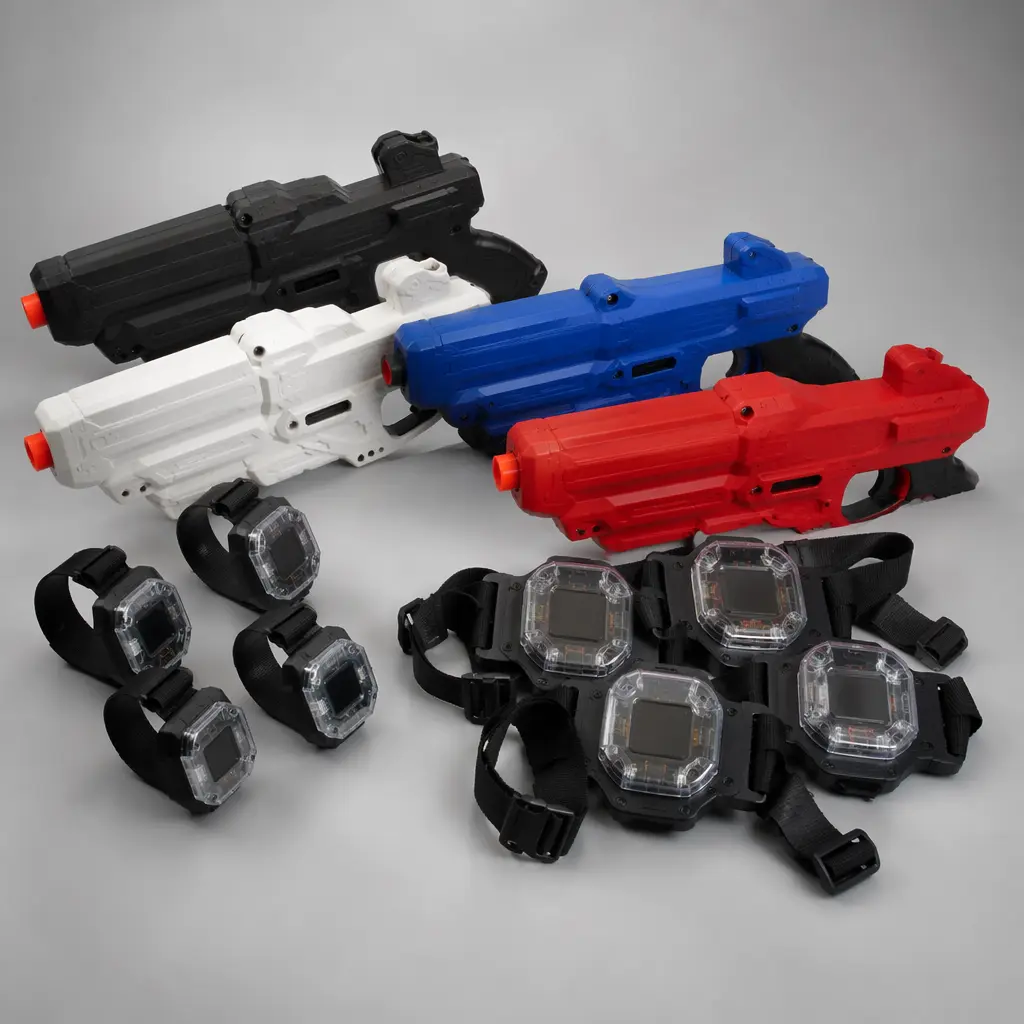
Modern laser tag sets vary widely in style and sophistication. Some focus on simplicity, with straightforward blasters and basic hit detection, while others add layers like multiple weapon modes, scoring systems, or app connectivity. Outdoor-friendly sets tend to prioritise range and durability, while indoor sets often emphasise compact design and quieter sound effects.
When shopping today, it’s worth paying attention to build quality and clarity of feedback. Reliable sensors and obvious hit indicators reduce arguments mid-game. Generic knock-offs can look impressive but may struggle with accuracy or consistency, which can break the flow of play.
Frequently asked questions
Is laser tag safe for indoor play?
Yes, laser tag uses infrared light, not visible lasers, and doesn’t involve projectiles. The main safety concern indoors is the environment—clear obstacles and establish no-running zones if space is tight.
How many players do you need?
Most sets work with as few as two players, but the experience improves with four or more. Team modes, in particular, shine with larger groups.
Do laser tag sets work in daylight?
Many do, but performance can vary. Bright sunlight can interfere with infrared sensors, so shaded areas or evening play often deliver better results.
Is it just for kids?
Not at all. Laser tag’s mix of strategy and movement makes it popular for teens, adults, and even corporate or social events.
At their best, laser tag sets show how technology can enhance, rather than replace, active play. By turning everyday spaces into arenas and encouraging movement, teamwork, and imagination, they’ve earned their place as a modern classic in the world of toys.