Rush Hour: How a traffic jam puzzle became solo-play gold
Since the mid‑1990s, Rush Hour has turned a simple grid of cars into a thinking game parents trust and kids return to. Here’s why this traffic jam puzzle became a logic classic.
Compare prices and availability
Check current prices and availability for this guide on eBay.
As an eBay Partner, we may be compensated if you make a purchase.
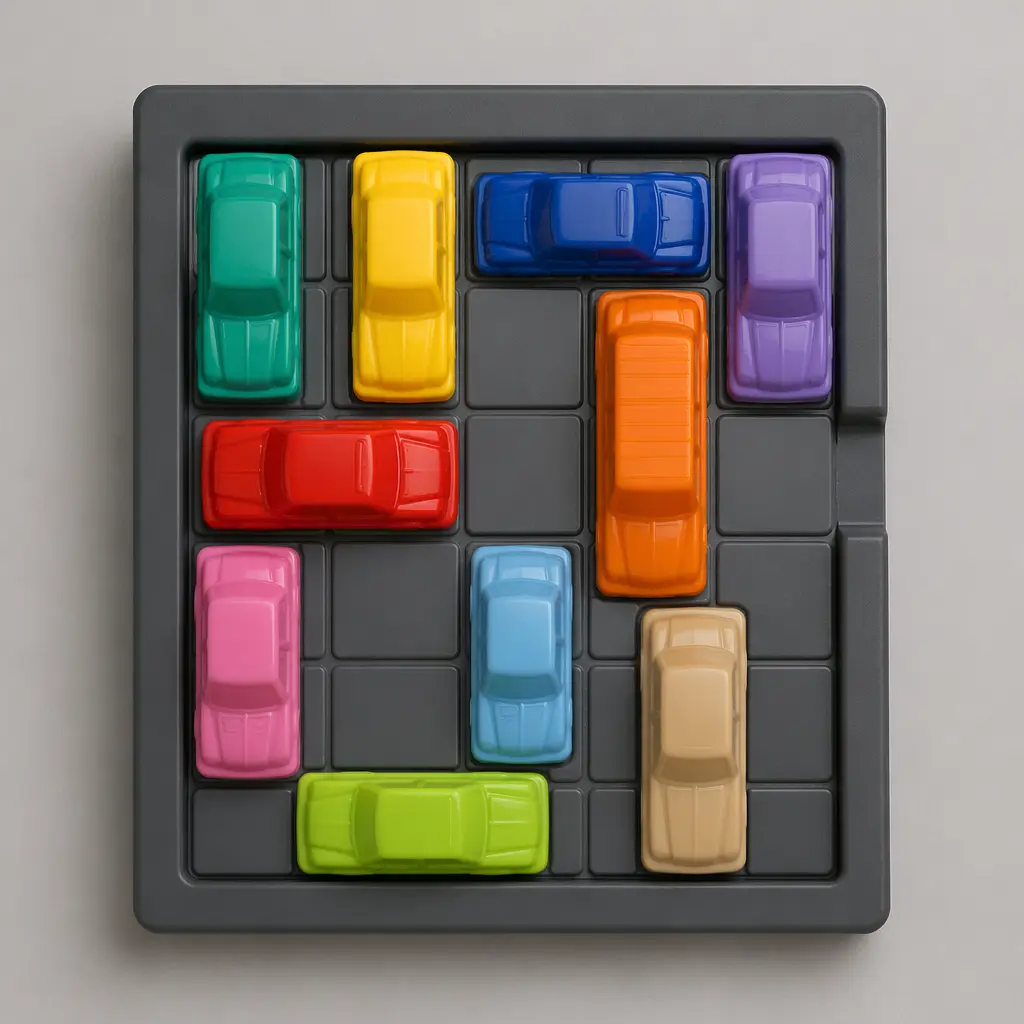
At first glance, Rush Hour looks almost too simple: a small grid, a handful of cars, and one red vehicle stuck in traffic. Yet for nearly three decades, this unassuming puzzle has become a benchmark for solo logic play. It’s the kind of toy that lives on coffee tables and classroom shelves alike, quietly challenging players to think several moves ahead.
Where it came from
Rush Hour was introduced in 1996 by ThinkFun, a company that built its reputation around educational games that don’t feel like homework. The idea was straightforward: translate the familiar frustration of a traffic jam into a hands-on logic problem that could be solved alone.
Instead of numbers or abstract shapes, the puzzle uses cars and trucks constrained to move only forward or backward. The goal is always the same—clear a path for the target car to exit the grid—but the challenge scales through dozens of setups. This combination of a fixed objective with endlessly variable starting conditions helped Rush Hour stand out in a crowded puzzle market.
Why it works
The genius of Rush Hour lies in how much thinking it demands from such a small physical footprint. Each move feels minor, yet one careless slide can force you to backtrack several steps. The puzzle teaches planning, pattern recognition, and cause-and-effect without ever explaining those concepts out loud.
Because every car is limited to a single direction of movement, players quickly learn to visualize the board as a system rather than a collection of pieces. The learning curve is gentle, but the later challenges can stump adults just as easily as kids.
- Clear, single objective that’s easy to understand
- Constraints that encourage logical thinking over guesswork
- Progressive difficulty that rewards persistence
- Compact design suited to quiet, independent play
Who it's for
Rush Hour is typically aimed at school-age children, but its appeal stretches far beyond that bracket. Younger players enjoy the tactile sliding and recognizable car theme, while teens and adults appreciate the brain-bending later challenges. It’s also a favorite among parents and educators looking for screen-free activities that still feel mentally engaging.
Variants and what to look for today
Over the years, Rush Hour has expanded into a small family of puzzles. There are junior-friendly versions with larger pieces and fewer cars, as well as advanced editions that introduce more complex layouts. Some sets swap cars for other themes, but the core sliding mechanic remains unchanged.
When shopping today, it’s worth checking that the puzzle includes a sturdy board and clearly defined challenge cards or guides. Poorly made copies can have pieces that stick or warp, which undermines the logic experience. The best versions feel smooth to slide and durable enough to survive repeated play.
Frequently asked questions
Is Rush Hour educational?
Yes, though it doesn’t advertise itself as a lesson. The puzzle naturally builds logical reasoning, sequencing, and problem-solving skills through play rather than instruction.
Can adults enjoy it too?
Absolutely. Many adults find the higher-difficulty challenges genuinely taxing, making it a satisfying brain teaser regardless of age.
Does it require a lot of space?
No. One of Rush Hour’s strengths is its compact size. It can be played on a small table, desk, or even a tray during travel.
Is it replayable once solved?
Very much so. With dozens of starting configurations, the puzzle offers fresh challenges long after the first solution is found.
Rush Hour endures because it respects the player’s intelligence. It doesn’t rush you, distract you, or talk down to you. Instead, it presents a problem and trusts that, given time and patience, you’ll find your way out of the jam.