The 15-Puzzle: How a sliding grid sparked a 19th‑century craze
Invented in 1874, the 15‑Puzzle turned simple sliding tiles into one of history’s first puzzle manias—blending math, patience, and a design that still captivates today.
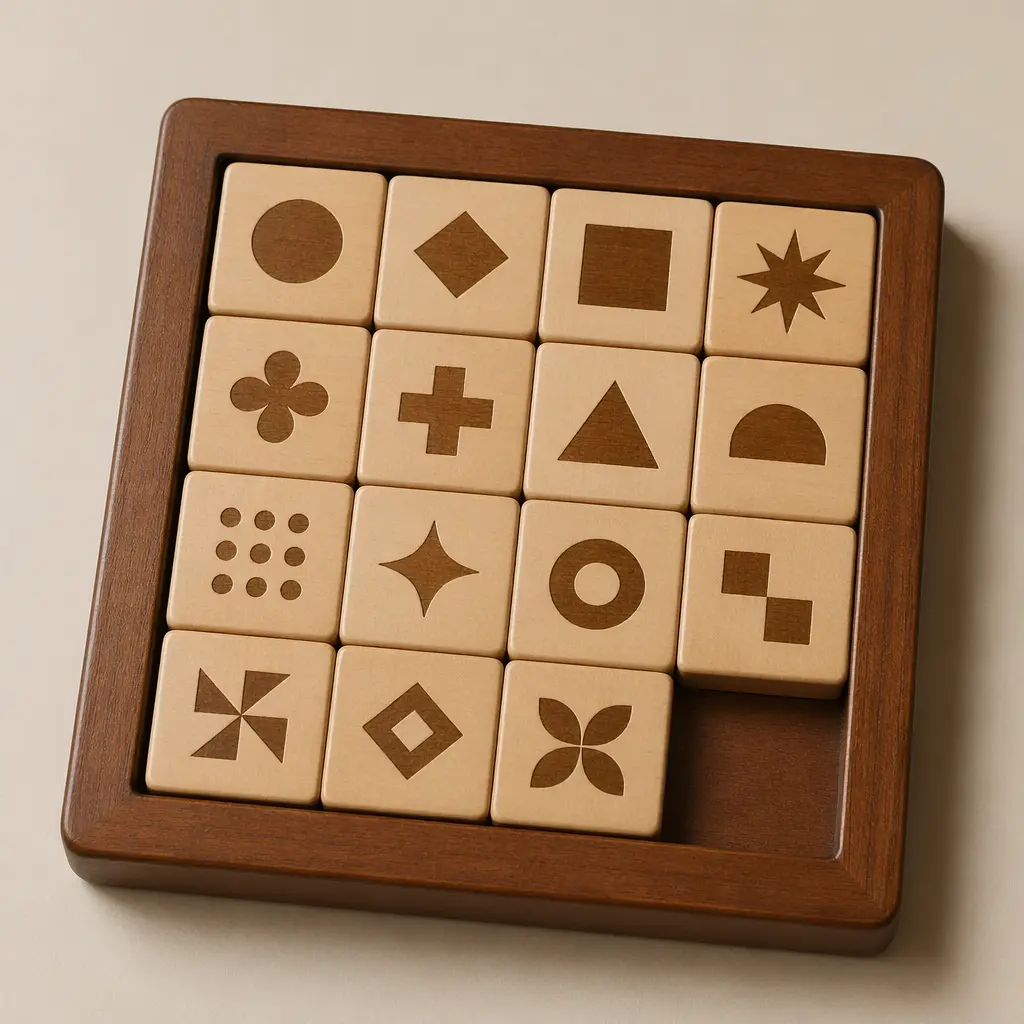
Compare prices and availability
Check current prices and availability for this guide on eBay.
As an eBay Partner, we may be compensated if you make a purchase.
The 15‑Puzzle looks modest: a small square frame, a handful of tiles, and one empty space. Yet this simple grid helped ignite one of the first global puzzle crazes. In the late 1800s, people crowded parlours, shops, and newspapers trying to solve it. More than a century later, the same basic challenge still shows up in classrooms, apps, and toy boxes—proof that a good idea doesn’t need much decoration to endure.
Where it came from
The 15‑Puzzle is usually traced to 1874, when American puzzle maker Noyes Chapman produced an early version of the sliding tile game. It consisted of 15 square tiles in a 4×4 frame, leaving one space empty so tiles could slide. The goal was to arrange the tiles into a specific order using only sliding moves.
The real explosion came a few years later, when similar puzzles were mass‑produced and widely promoted. Newspapers printed challenges, friends wagered money, and shops couldn’t keep the puzzles in stock. For many players, the appeal wasn’t just solving it—it was the promise that anyone, with enough thought, might crack a problem that seemed deceptively close to finished.
Why it works
At its core, the 15‑Puzzle is a lesson in constraints. You’re never overwhelmed with options, but you’re never free to do exactly what you want either. Every move affects the next, and progress often means temporarily making things look worse. That tension is what keeps players engaged.
The design also quietly introduces mathematical ideas—permutations, parity, and planning ahead—without requiring any formal knowledge. You feel the rules through play. Standout features include:
- A single empty space that limits and defines every move
- Clear, visual goals that are easy to understand
- Short play sessions that invite repeated attempts
- A difficulty curve that emerges naturally from the rules
Who it’s for
The 15‑Puzzle suits a wide age range. School‑age children can enjoy sliding pieces and spotting patterns, while teens and adults tend to appreciate the deeper challenge and logic. It’s also a favourite with adults who enjoy classic puzzles or want a screen‑free way to keep their hands and minds busy. Because there’s no reading required, it’s accessible across languages and generations.
Variants and what to look for today
Today’s sliding tile puzzles come in many forms. Traditional wooden frames remain popular, but you’ll also find plastic travel versions, oversized floor puzzles for younger children, and abstract designs using colours or shapes instead of numbers. Digital versions mimic the same rules, though many fans still prefer the tactile feel of real tiles.
When choosing one, look for tiles that slide smoothly without sticking, a sturdy frame that keeps pieces aligned, and a finish that won’t chip easily. Very cheap versions can warp or snag, which adds frustration unrelated to the actual puzzle.
Frequently asked questions
Is the 15‑Puzzle always solvable?
No. Only certain arrangements can be solved using legal sliding moves. This fact famously frustrated 19th‑century players and is now a classic teaching example in mathematics.
How long does it take to learn?
Most people grasp the rules in minutes. Developing efficient strategies—such as solving one row at a time—can take longer, but that learning curve is part of the appeal.
Is it suitable for young children?
Yes, with supervision. Larger versions with chunky pieces are best for younger kids, while the classic 4×4 grid suits older children and adults.
Why has it lasted so long?
Because it balances simplicity and depth. The rules never change, but the challenge always feels fresh, making it easy to revisit over decades.
The 15‑Puzzle’s legacy isn’t about flashy design or branding. It’s about how a small, thoughtful constraint can create endless fascination. From Victorian parlours to modern coffee tables, this sliding grid continues to remind us that the best puzzles don’t shout—they quietly invite you to try one more move.