Turing Tumble: The marble-powered computer that teaches logic
Turing Tumble is a hands-on, marble-powered computer that lets kids and adults build real logic circuits. No screens, no coding—just gravity, gates, and satisfying problem-solving.
Compare prices and availability
Check current prices and availability for this guide on eBay.
As an eBay Partner, we may be compensated if you make a purchase.
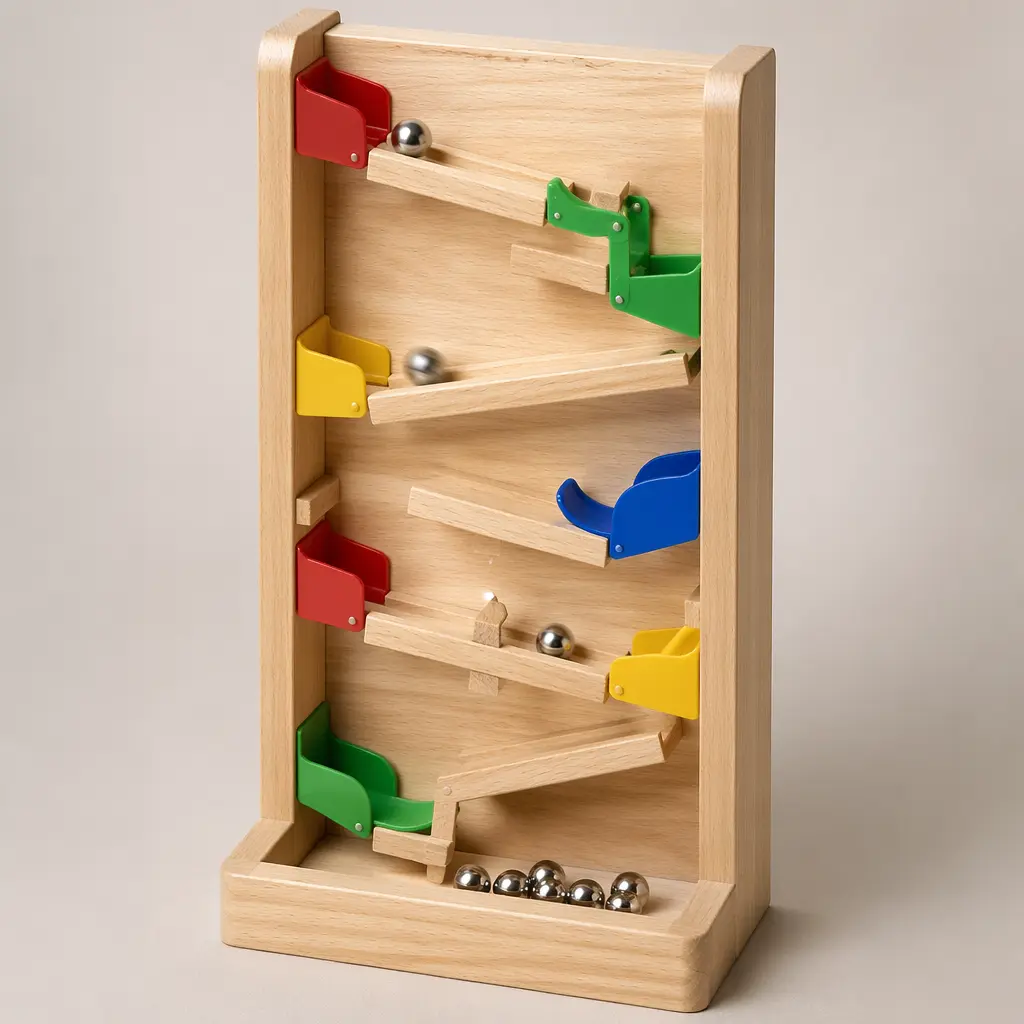
Turing Tumble looks, at first glance, like a wooden marble run mounted on a board. Drop in a few steel balls, flip some plastic gates, and watch gravity do the rest. But spend a few minutes with it and you realise it’s something rarer: a physical computer you can see thinking. Instead of code on a screen, logic unfolds through switches, bits, and marbles clacking their way to an answer.
Where it came from
Turing Tumble launched in 2017 after a successful crowdfunding campaign led by game designer Paul Boswell and educator Chris Boswell. Their goal was ambitious: teach the fundamentals of computer science—logic, algorithms, and even memory—without using a screen or requiring any prior coding knowledge.
The name is a nod to Alan Turing, whose theoretical machines underpin modern computing. Turing Tumble turns that abstract idea into something tangible. Instead of symbols and syntax, players work with bits that flip, ramps that redirect, and marbles that represent data moving through a system. It was designed for kids, but with enough depth to keep adults genuinely challenged.
Why it works
The genius of Turing Tumble is that it slows computing down. Every operation is visible. When a solution fails, you don’t get an error message—you see exactly where a marble went the wrong way. That makes debugging intuitive, even for players who’ve never heard the term before.
Play is structured around challenge cards that start simple and gradually introduce complex ideas like conditional logic, loops, and memory. Because everything is powered by gravity, there’s a built-in sense of cause and effect that screens often hide.
- Binary bits that physically flip between states
- Logic gates that mimic AND, OR, and NOT behavior
- Marbles that act as data moving through a program
- Progressive challenges that build real computer science concepts
- No batteries, screens, or apps required
Who it's for
Turing Tumble is officially aimed at kids around 8 and up, but that only tells part of the story. Younger children can enjoy the marble-run aspect with guidance, while tweens and teens often dive deep into the logic challenges. Adults—especially parents, engineers, and puzzle fans—frequently find themselves just as hooked. It works best as a solo puzzle experience, though it’s also well suited to collaborative problem-solving at the table.
Variants and what to look for today
Turing Tumble remains a fairly focused product rather than a sprawling toy line. The core set is the main experience, supported by optional expansion packs that add new pieces and more advanced challenges. These extend the system’s ability to model complex programs without changing its fundamental feel.
When shopping today, look for a complete set with sturdy components and clear challenge cards. The physical precision matters—smooth-moving bits and well-aligned ramps make the difference between satisfying logic and frustrating misfires. As with many educational hits, there are generic marble puzzles on the market, but they usually lack the structured progression that makes Turing Tumble feel like a real computer rather than a toy.
Frequently asked questions
Does Turing Tumble teach real coding?
It doesn’t teach a programming language, but it teaches the logic behind all of them. Concepts like conditionals, loops, and memory are experienced physically, which can make later coding much easier to grasp.
Is it more of a toy or a puzzle?
It’s closer to a puzzle system. Each challenge has a correct solution, and progress depends on reasoning rather than imagination or free play.
How long does it keep kids engaged?
Many families report weeks or months of intermittent play. Challenges can be tackled one at a time, making it easy to return to without losing momentum.
Do adults really enjoy it?
Yes. The later challenges are genuinely demanding, and the tactile nature of the system appeals to adults who enjoy logic puzzles or engineering-style thinking.
In a world crowded with flashy STEM toys, Turing Tumble stands out by being quietly confident. It trusts players to think, experiment, and fail forward. By turning computation into something you can hold, hear, and see, it makes abstract ideas feel approachable—and that’s a trick even many digital tools haven’t quite mastered.