Best UK AI Robot Pets Without Ooongoing Subscriptions
A parent-focused guide to AI robot pets in the UK that stay useful without monthly fees, cloud credits or app lock-ins. Learn which features matter for ages 6–8 and what trade-offs to expect.
Compare prices and availability
Check current prices and availability for this guide on eBay.
As an eBay Partner, we may be compensated if you make a purchase.
AI robot pets sit somewhere between traditional soft toys and app-connected gadgets. For children aged 6 to 8, they can offer interactive play without the responsibility of a real animal, but the buying decision is often less about the robot itself and more about what happens after setup. Some connected pets rely heavily on cloud services, paid credits or app subscriptions for voice interactions and updates. Others work mostly offline once charged and switched on. Parents looking for a toy that remains useful over time usually benefit from choosing robot pets with built-in behaviours, local voice responses and simple controls rather than toys that depend on ongoing accounts or paid AI features.
What to look for
The most practical AI robot pets for this age group balance novelty with reliability. Marketing often uses terms like AI, smart learning or emotional interaction loosely. In many toys, the intelligence is limited to sensors, pre-programmed responses or simple voice recognition rather than advanced generative AI. That is not necessarily a drawback. Younger children often enjoy predictable interactions more than complex chatbot-style systems, especially when the toy works consistently without an internet connection.
- Look for toys that keep core play features available offline after initial setup.
- Check whether the toy needs a companion app for daily use or only for optional settings and updates.
- Battery type matters for convenience. Rechargeable units reduce ongoing costs, while replaceable batteries can be easier on longer trips.
- Consider microphone and camera features carefully. Some robot pets include always-listening voice controls or image recognition.
- Review privacy information from the manufacturer, especially if accounts, cloud storage or voice recordings are involved.
- Noise levels vary widely. Some pets bark, sing or respond loudly during repeated interactions.
- Storage size and durability matter for everyday play. Hard plastic robot animals can crack if dropped frequently.
- Parental controls are useful when toys connect to Wi‑Fi or Bluetooth-enabled apps.
- Check regional support in the UK, including app availability and whether features depend on servers remaining active.
- Subscription-free does not always mean completely future-proof. Some toys still rely on manufacturer apps for updates or advanced modes.
Age suitability
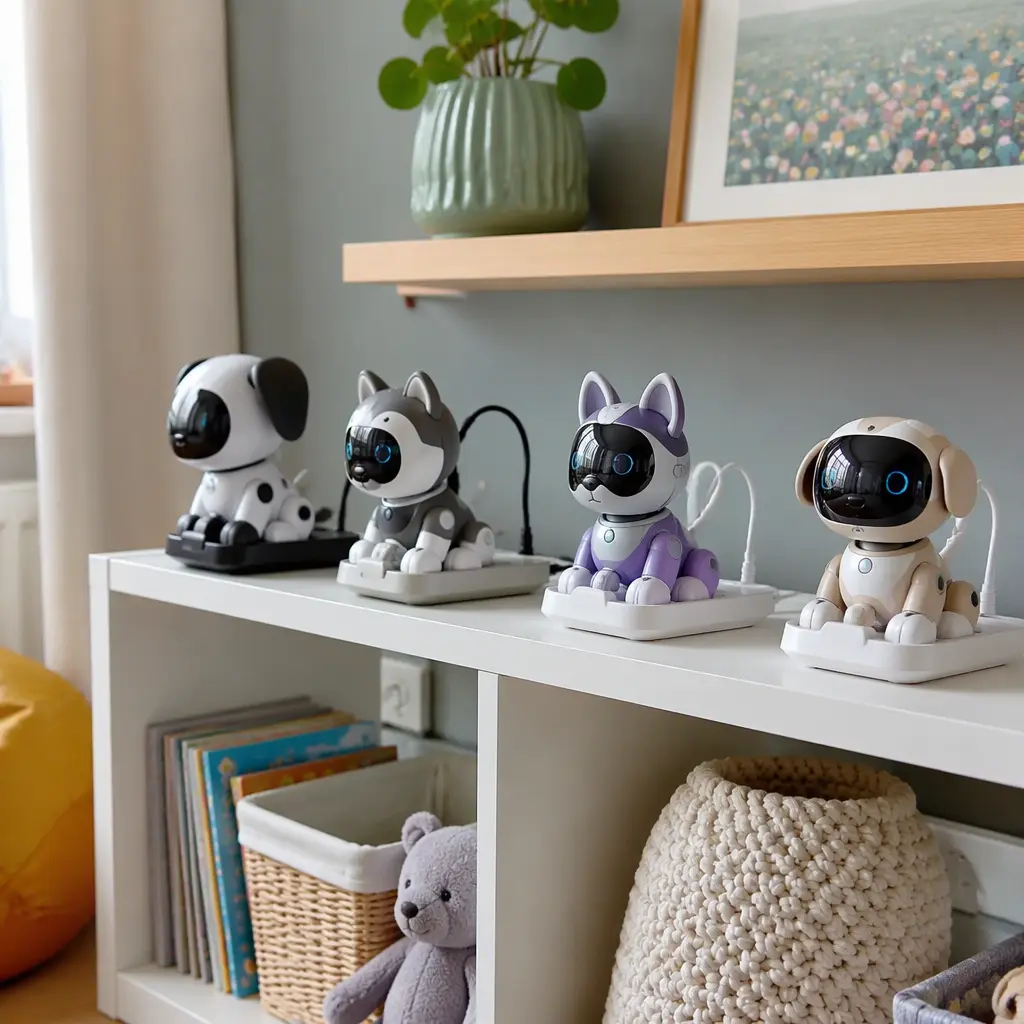
Children aged 6 to 8 are usually at the ideal stage for interactive robot pets because they can follow charging routines, understand simple controls and engage in imaginative roleplay. Younger children may become frustrated by setup steps or voice commands that do not work consistently. Older children sometimes lose interest quickly if the robot's behaviour feels repetitive. At this age, the strongest options are usually pets that combine movement, sound and touch sensors with open-ended play rather than toys focused mainly on app interaction. A robot pet that can dance, respond to petting or follow simple commands often stays entertaining longer than one that requires constant screen use. Families with limited storage space may prefer compact tabletop pets over larger robotic dogs with charging bases and accessories.
Options compared
Robot pets without ongoing subscriptions generally fall into three broad categories. The first is offline animatronic pets. These use touch sensors, movement and pre-programmed sounds without requiring apps or accounts. They are usually the simplest choice for families wanting low-maintenance play. The trade-off is limited variety. Responses can become predictable after a few weeks, although younger children may still enjoy the routine interactions.
The second category is app-connected robot pets with optional online features. These often connect by Bluetooth and may offer training games, personality settings or firmware updates through a smartphone app. The best versions still function well when disconnected from the app. This category suits families comfortable with occasional device setup but wanting to avoid recurring payments. Parents should check whether advanced voice features, cloud AI conversations or extra content packs are locked behind subscriptions before buying.
- Offline animatronic pets: lowest maintenance, no accounts needed, usually quieter and easier to hand down between siblings.
- Bluetooth-connected pets: more customisation and updates, but may depend on phone compatibility over time.
- Voice assistant-style robot pets: often the most impressive initially, but more likely to rely on cloud services, accounts or subscriptions.
- Coding-focused robot pets: useful for STEM learning and simple programming tasks, though some children mainly interested in pretend pet play may lose interest.
- Plush interactive pets: softer and easier to cuddle, usually less durable mechanically but more comforting for quieter play.
- Hard-shell robotic pets: often include movement and tricks, but can be noisier on hard floors and require more careful charging routines.
Known product families in this category include interactive pets from brands such as WowWee, furReal, Miko and LivingAI. Some products marketed as AI companions offer cloud-based conversation features that may evolve over time or require online accounts. Others mainly use local speech recognition and sensor responses. Manufacturer descriptions should clarify whether advanced interactions happen directly on the device or through internet-connected services. For buyers trying to avoid future costs, simpler systems with strong offline play value are often the safer long-term choice.
Frequently asked questions
Do AI robot pets work without Wi‑Fi?
Many do, at least for core functions like movement, sounds and touch responses. However, some toys require internet access for setup, software updates or advanced voice conversations. A good subscription-free option should remain entertaining even when disconnected.
Are subscription-free robot pets safer for privacy?
They can be simpler from a data perspective because fewer cloud services are involved, but privacy still depends on the manufacturer. Toys with microphones, cameras or companion apps may still collect usage information. Parents should review permissions and account requirements carefully.
How long do children usually stay interested in robot pets?
Interest varies by child and by the depth of interaction. Toys that support imaginative play, tricks or routines tend to last longer than novelty-focused gadgets. For ages 6 to 8, combining the robot pet with storytelling or pretend-care play often helps extend use.
Are coding robot pets better for learning?
Coding-focused pets can introduce sequencing, logic and basic programming concepts in an approachable way. However, they are not automatically more engaging for every child. Some children prefer emotional interaction and roleplay over structured activities.
What happens if the manufacturer stops supporting the app?
This is one of the biggest risks with connected toys. If a toy depends heavily on cloud servers or app-based features, functionality may shrink over time. Choosing a robot pet with useful offline features reduces the impact if support eventually ends.
For most families shopping in the UK, the safest long-term choice is usually a robot pet that offers strong built-in play features first and connected extras second. Toys that rely less on subscriptions, cloud processing and ongoing credits are often easier to share, resell or pass down later. A simpler interactive pet may not sound as advanced in marketing materials, but it is often the option that stays usable longest without extra costs or account management.