Paddle Ball: Why missing is the whole point
Simple, stubborn, and strangely addictive, Paddle Ball turns repetition into play. A look at how a wooden paddle and a ball on a string became a lasting lesson in patience.
Compare prices and availability
Check current prices and availability for this guide on eBay.
As an eBay Partner, we may be compensated if you make a purchase.
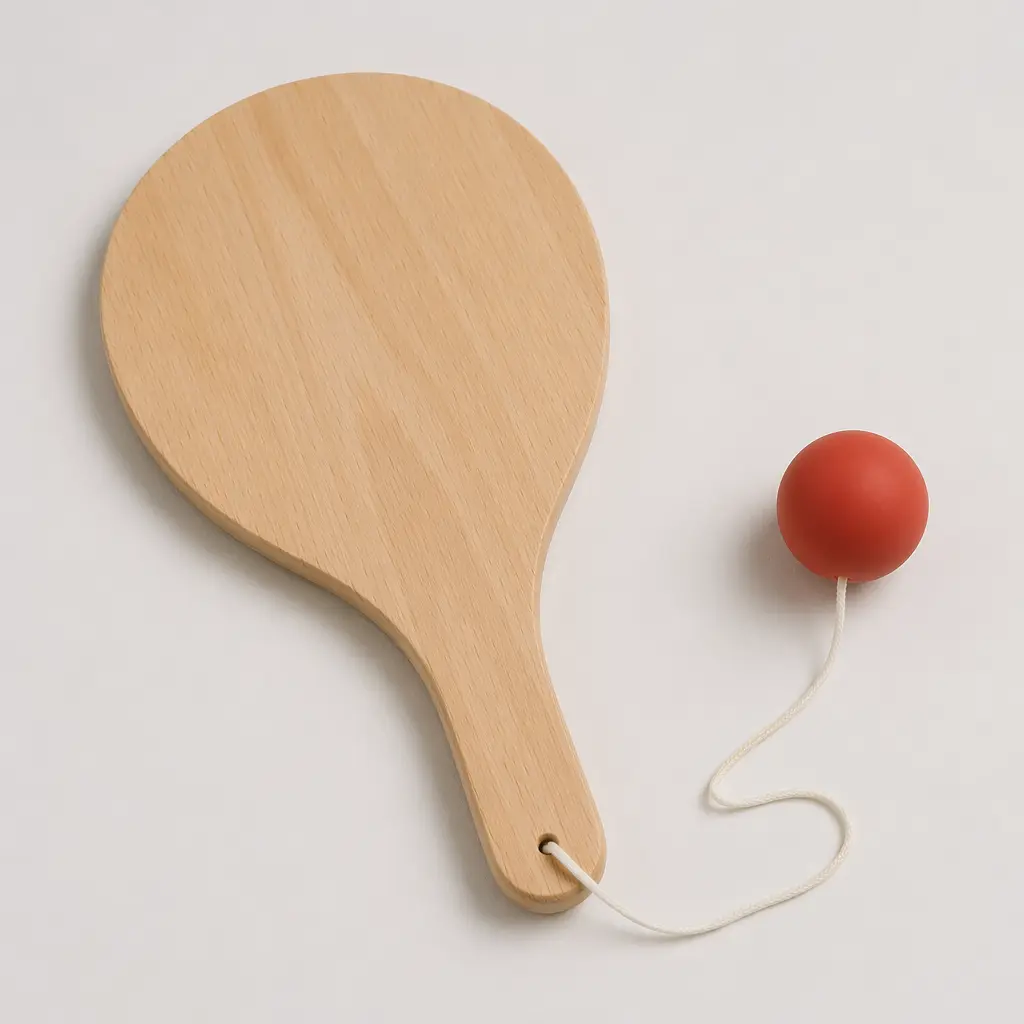
Few toys announce their intentions as clearly as Paddle Ball. It’s a flat paddle, a stretchy string, and a ball that seems determined to miss. There are no levels, no scores, and no clear win condition. And yet, people keep picking it up, swinging again, and trying just one more time. The frustration is part of the design. Paddle Ball isn’t about mastering a game so much as learning to live inside repetition.
Where it came from
Paddle Ball as most people recognize it emerged in the mid-20th century, during a boom in inexpensive, physical toys meant to get kids moving. The concept is older than that—ball-on-a-string games appear in different cultures going back centuries—but the modern paddle version became a staple of fairs, boardwalks, and toy counters.
Its appeal was practical as much as playful. Paddle Ball was cheap to make, easy to explain, and hard to break. Parents didn’t need instructions, and kids didn’t need batteries. It fit perfectly into an era when outdoor play was the default and boredom was something you were expected to solve yourself.
Why it works
At first glance, Paddle Ball looks almost too simple. But the design creates a tight feedback loop: swing, miss, adjust, repeat. The elastic string ensures the ball always comes back, while the flat paddle demands timing rather than strength. Success is possible, but never guaranteed, which keeps the challenge alive.
What makes it endure is that the toy quietly teaches coordination and persistence without ever announcing itself as educational.
- Immediate feedback with every swing
- A difficulty curve controlled by the player, not the toy
- No setup, rules, or reset required
- Durable materials that invite rough use
Who it's for
Paddle Ball is typically aimed at school-age kids, but its real audience is broader. Younger children enjoy the motion and sound, even before they can hit the ball reliably. Older kids turn it into a personal challenge, counting consecutive hits. Adults often rediscover it as a desk toy or a nostalgia piece, surprised by how quickly it pulls them in.
Variants and what to look for today
While the classic version is a wooden paddle with a rubber ball, modern Paddle Balls come in a range of materials. Plastic paddles are lighter and cheaper, while foam or soft rubber balls make indoor play more forgiving. Some versions swap the paddle for a racket-style frame, subtly changing the challenge.
If you’re buying one today, look for sturdy string attachment points and a ball that has some weight to it. Ultra-light balls tend to tangle or behave unpredictably, turning challenge into annoyance. Very thin strings wear out faster and can snap under repeated use.
Frequently asked questions
Is Paddle Ball supposed to be this hard?
Yes. The difficulty is intentional. The toy is designed so that improvement comes slowly, through rhythm and timing rather than brute force.
Does it ever get boring?
For some players, yes—and that’s okay. Paddle Ball isn’t meant to replace complex games. It’s a short-burst toy, best enjoyed in minutes rather than hours.
Can it be played indoors?
It can, especially with softer balls, but indoor play increases the chances of bumps and broken items. Open space is always better.
Is there a ‘right’ way to play?
Not really. Some people aim for consecutive hits, others experiment with angles or hand switches. The lack of rules is part of the appeal.
Paddle Ball survives because it refuses to change. In a world of flashing screens and constant updates, it offers something refreshingly stubborn: a simple task that asks for your attention and nothing else. Miss, swing again, and learn to enjoy the process.