Best Starter Science Kits With No Adult Setup
A parent-friendly guide to science kits for ages 9–12 that work with minimal setup, limited mess, and clear instructions. Compare chemistry, engineering, crystal-growing, and coding-free STEM options.
Compare prices and availability
Check current prices and availability for this guide on eBay.
As an eBay Partner, we may be compensated if you make a purchase.
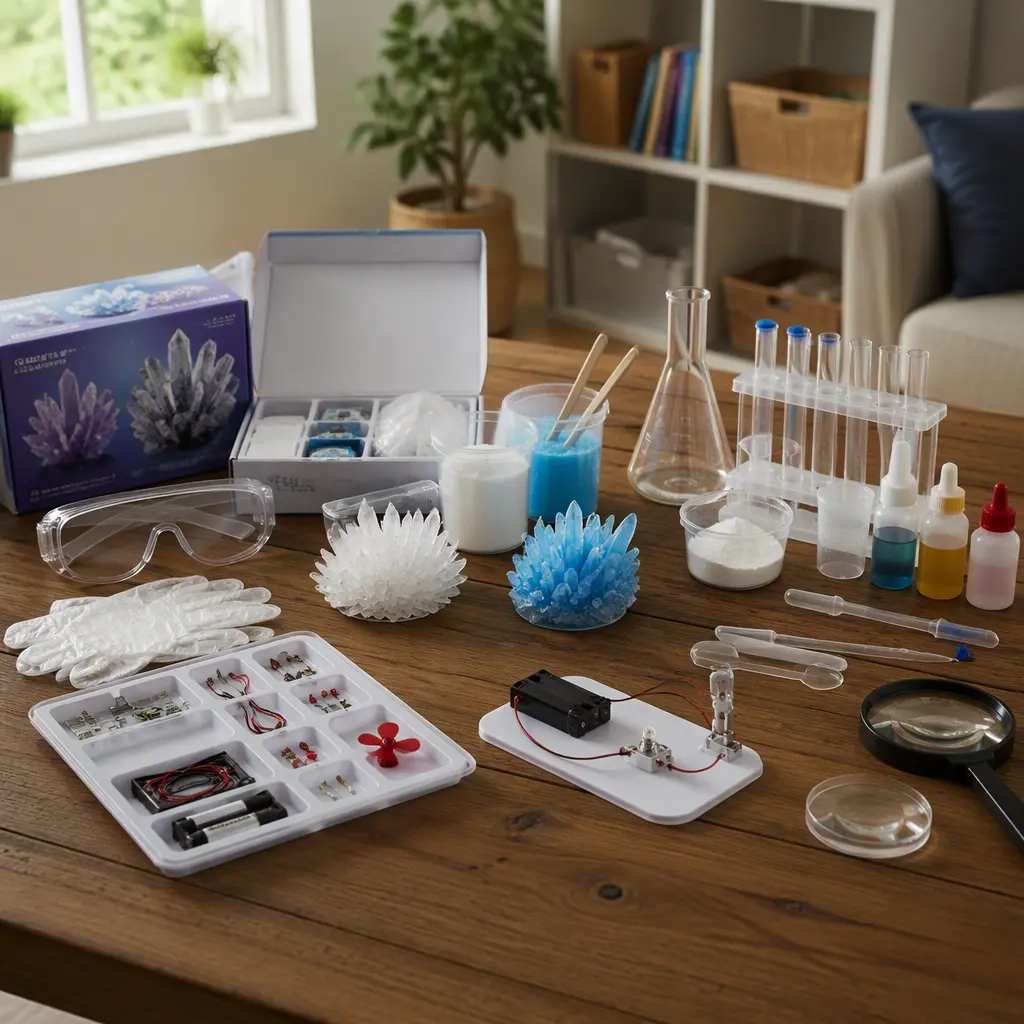
Science kits can be a good way for children ages 9 to 12 to explore chemistry, engineering, physics, or nature study without needing a full craft cupboard or constant adult involvement. The challenge for many families is finding kits that are genuinely independent rather than projects that quietly depend on parents for setup, measuring, cleanup, or supervision every few minutes. The most practical starter kits for this age group use pre-measured materials, clear illustrated instructions, and contained activities that can be completed on a kitchen table without creating major mess. Kits that balance independence with realistic safety limits also tend to stay interesting longer, especially for children who want to experiment on their own after school or during weekends.
What to look for
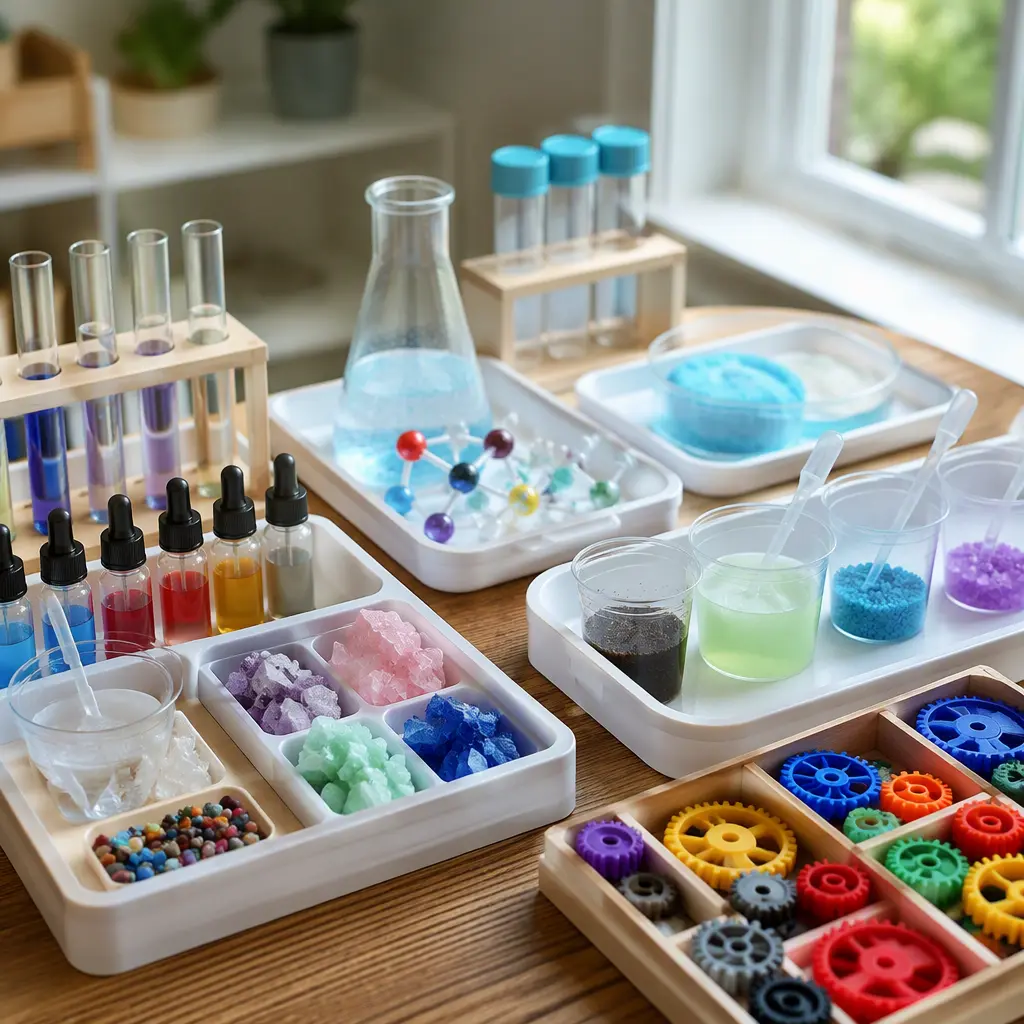
For ages 9 to 12, the best beginner science kits are usually the ones that remove friction. Children are more likely to return to a kit when they can open the box, understand the instructions quickly, and complete experiments without waiting for an adult to gather household supplies. Kits marketed to older children sometimes include complicated chemical handling or require smartphone apps, while younger kits may feel too simplistic. A good middle ground combines real experimentation with practical limits on mess, noise, and supervision.
- Choose kits with pre-portioned materials and reusable trays to reduce spills and cleanup.
- Look for heavily illustrated instructions rather than dense text blocks.
- Contained experiments such as crystal growing, magnetism, simple circuits, and mechanical building are usually easier to manage independently than open-ended chemistry sets.
- Check whether common household items are required. Frequent extra materials can turn a simple activity into a parent-led project.
- Consider storage. Modular boxes or compartment cases are easier to keep organized between sessions.
- Avoid kits that rely heavily on phone apps or online accounts if screen-free play is the goal.
- If siblings may share the kit, choose activities with repeatable experiments rather than one-time reactions.
Age suitability
The 9 to 12 age range covers a wide span of attention levels and confidence. Younger children in this group often do best with highly structured kits where each experiment is clearly separated into steps and uses sturdy tools that are difficult to break or lose. Older children may prefer more open-ended engineering or physics projects that allow modification and repeated experimentation. Children who enjoy collecting, organizing, or observing details often engage well with geology, crystal-growing, or microscope kits. Kids who prefer active problem-solving may stay interested longer with mechanical engineering sets, snap-together circuits, or chain-reaction builds. Families with limited space may want compact tabletop kits rather than large construction systems that spread across floors for days.
Options compared
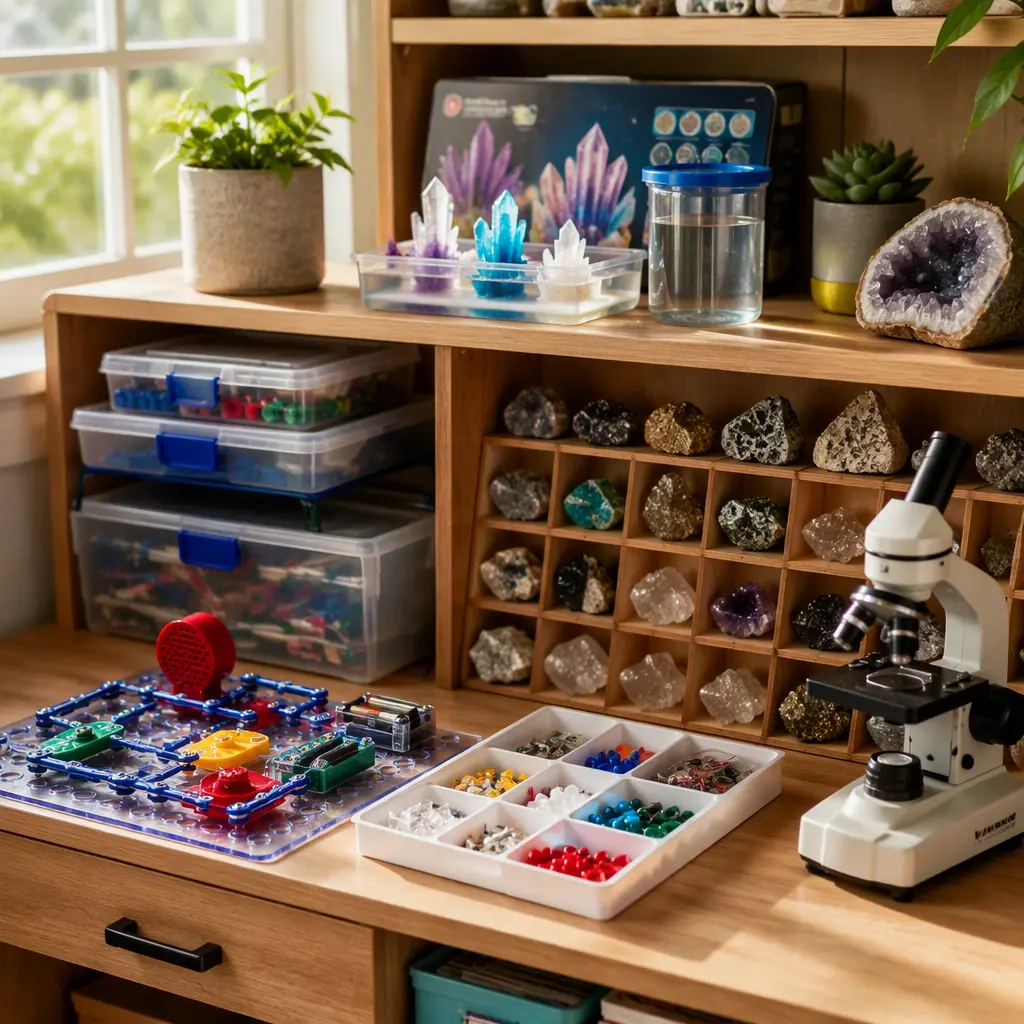
Crystal-growing kits are often among the easiest truly independent science activities for this age group. Most include pre-measured compounds and straightforward instructions, and the experiments create visible results over several days. They suit patient children who enjoy observation and collecting. The trade-off is that many crystal kits are largely single-use, so replay value may be limited once the main experiments are complete.
Simple circuit and electronics kits tend to offer stronger long-term use because children can build multiple combinations repeatedly. Snap-together systems are especially practical for independent play because they avoid soldering and usually include durable components. These kits suit problem-solvers and children who enjoy trial and error. They are less ideal for families sensitive to repetitive electronic sounds or blinking lights, although many beginner sets keep noise fairly minimal.
- Chemistry starter kits: Good for children who enjoy mixing reactions and following procedures. Look for contained experiments with small quantities and washable materials. Avoid large sets requiring extensive kitchen supplies or heat sources.
- Engineering and mechanics kits: Often the best replay value. Suitable for children who enjoy building and modifying designs. Storage can become difficult if many small connectors are included.
- Microscope and nature kits: Strong option for quiet, screen-free exploration. Best for curious children who enjoy collecting leaves, rocks, or insects. Less structured children may lose interest if experiments feel too open-ended.
- Chain-reaction and physics kits: Encourage creativity and problem-solving with minimal mess. Some larger builds need more floor space and patience than compact tabletop kits.
- Excavation and geology kits: Usually low setup and satisfying for independent play. Cleanup can be dusty, so they work better outdoors or on protected surfaces.
- Coding-free robotics kits: Good for children interested in engineering without requiring apps or computers. Battery needs and moving parts can increase maintenance compared with passive kits.
Frequently asked questions
Are chemistry kits safe for independent use?
Many beginner chemistry kits designed for ages 9 to 12 use diluted or low-risk materials and include protective equipment such as goggles. However, independent does not mean unsupervised indefinitely. Parents should still review instructions first and make sure children understand safe handling and cleanup rules.
Which science kits create the least mess?
Snap-together electronics kits, magnet experiments, and compact engineering builds are usually the cleanest options. Crystal-growing and excavation kits can involve powders or dust, although many newer versions include trays or containers to reduce spread.
Do science kits still work well without screens?
Yes. Many of the strongest beginner science kits remain fully offline and focus on physical experimentation rather than apps. Screen-free kits can be especially useful for children who already spend significant time on school devices or gaming systems.
What if a child loses interest after one experiment?
Replay value varies widely between categories. Engineering, physics, and electronics kits generally support repeated building and experimentation, while some chemistry or crystal kits are designed around a fixed number of activities. For hesitant learners, smaller focused kits may work better than large all-in-one sets.
How important is storage?
Storage matters more than many parents expect. Kits with divided compartments, resealable bags, or stackable trays are easier for children to manage independently. Poorly organized kits often lead to missing pieces and reduced long-term use.
The best starter science kits for ages 9 to 12 are usually the ones that make experimentation feel accessible rather than overwhelming. Low-mess materials, clear instructions, manageable storage, and repeatable activities often matter more than the total number of experiments listed on the box. Families looking for independent play should focus on kits that support curiosity without turning every activity into a major setup or cleanup project.